mrkeyoor.com_
Thu 10 Sept 16:50 UTC
Dataevaluationupdated 10 Sept 2026

Ontology-Playground review

Microsoft Ontology Playground is a preview web application for learning ontology concepts, drawing entity-and-relationship models, and exporting RDF/XML for Microsoft Fabric IQ. The default site is fully static, so a class, teacher, or analyst can explore examples and edit diagrams without operating a database or application server.

trackingstars / 7d
Verdict

Our Ontology Playground run installed 314 packages in 19 seconds and passed all 397 tests, but npm audit found 11 known vulnerabilities, including 6 high-severity findings. It is a good teaching and early-design tool for small Fabric IQ models because the static app combines examples, a visual editor, RDF import and export, and lessons. Do not use it as the authority for general OWL interoperability or large taxonomies until the open parser and standards issues are resolved.

We ran it

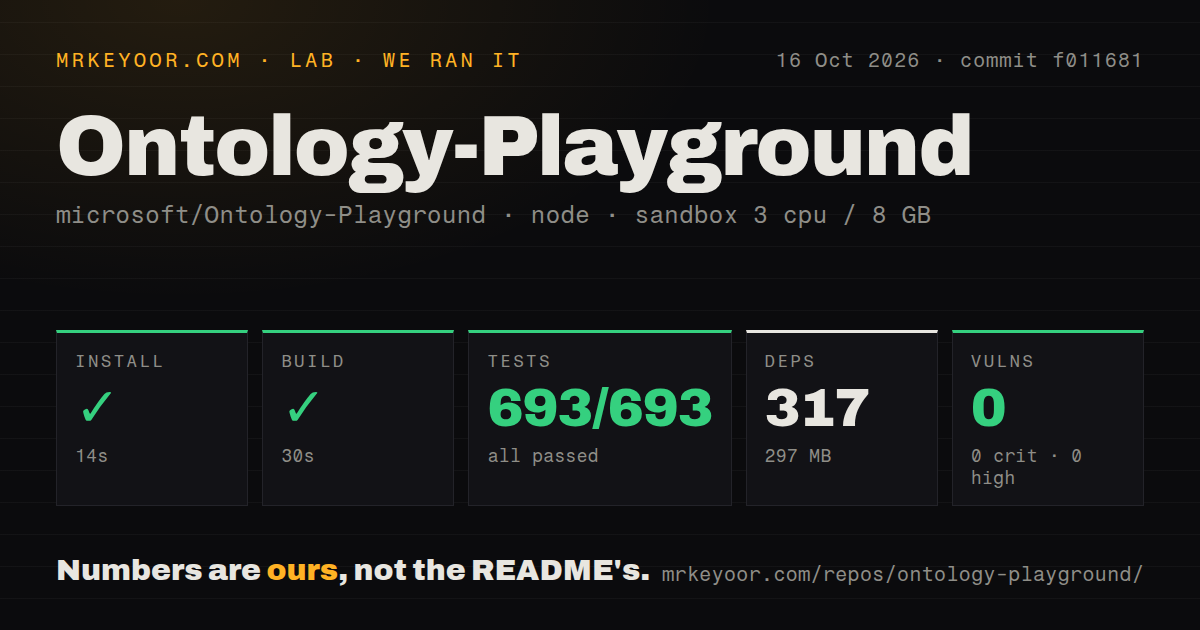
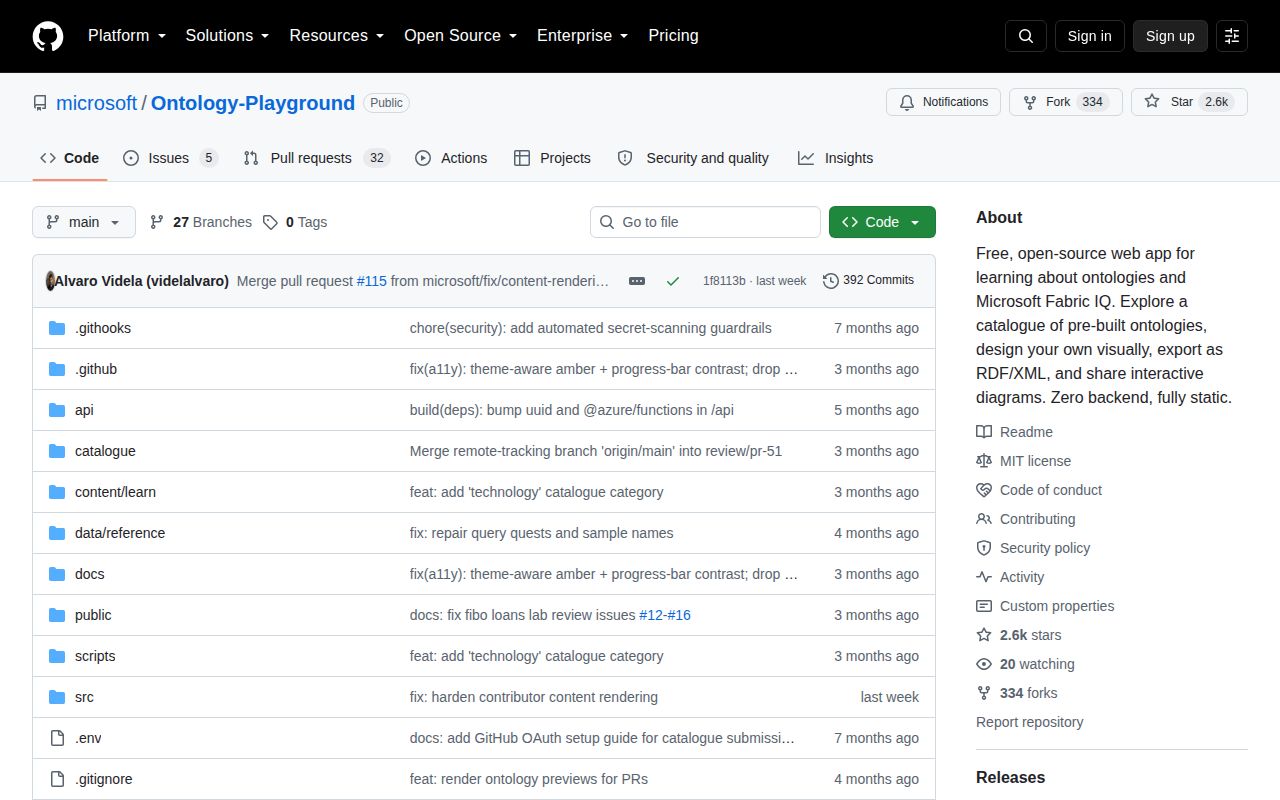
Lab card: what happened when we ran Ontology-PlaygroundScreenshot of Ontology-Playground (github.com/microsoft/Ontology-Playground)
Install✓ · 19s314 packages · 294 MB
Build✓ · 21s
Tests✓ · 20s397 passed · 0 failed of 397 (vitest)
Known vulns110 critical · 6 high · 5 moderate · 0 low (npm audit)
Repo387 files~20,183 lines of source · 3.5 MB · 8 CI workflows

Answers from our run

Does Ontology-Playground build from source?

Dependencies installed in 19 seconds (314 packages), and the build succeeded in 21 seconds. We cloned commit 1f8113b into a clean Debian container with 3 CPUs and no project-specific setup.

Do Ontology-Playground's tests pass?

Yes: 397 of 397 passed when we ran the project's own test command (vitest). Some failures need services or credentials a bare container does not have.

Does Ontology-Playground have known vulnerabilities in its dependencies?

npm audit flagged 11 known advisories in the dependency tree at the time of our run.

Who should not use Ontology-Playground?

Ontologists who require standard OWL or SHACL semantics across other tools: issue 79 documents custom annotations, serialization-dependent ordering, and nonstandard relationship attributes.

What are the alternatives to Ontology-Playground?

Protégé Desktop, WebVOWL. Our Ontology Playground run installed 314 packages in 19 seconds and passed all 397 tests, but npm audit found 11 known vulnerabilities, including 6 high-severity findings.

Setup4/5Install, build, and 397 tests passed; optional services add setup
Docs5/5Authoring, embeds, OAuth, learning content, and deploys are covered
Community3/52,634 stars with current pushes and 37 issues and pull requests
Maturity3/5Passing tests, but preview status, no releases, and audit findings

Who it’s for

Analysts and architects learning how entities, properties, relationships, and cardinality fit together.
Microsoft Fabric IQ teams sketching a small ontology before moving it into their data platform.
Teachers who want guided courses, quizzes, presentation mode, and live graph examples.
Web developers who need a static, embeddable ontology viewer or a catalogue contribution workflow.

Who it’s NOT for

Ontologists who require standard OWL or SHACL semantics across other tools: issue 79 documents custom annotations, serialization-dependent ordering, and nonstandard relationship attributes.
Anyone exploring large class hierarchies: issue 101 reports a Brick import with 1,530 entities and 0 relationships because rdfs:subClassOf links were ignored.
Teams expecting a collaborative ontology repository with server-side storage, permissions, or data binding: the default app is static and edits live in the browser.
Users relying on the optional AI builder to enforce designer rules: issue 84 says its output bypasses validateOntology.
Security-sensitive deployments that cannot accept the measured dependency state: npm audit found 11 known vulnerabilities, including 6 high-severity findings.
Organizations that require tagged releases for pinning: GitHub's latest-release endpoint returned no release for this repository.

Setup reality

Our Node 22 sandbox installed 314 packages in 19 seconds and used 294 MB. The build succeeded in 21 seconds. Vitest then passed all 397 tests in 20 seconds. Npm audit found 11 known vulnerabilities: 6 high and 5 moderate, with none critical or low.

Local development needs Node.js 18 or newer and npm 9 or newer. The normal build needs no database or secret. Azure Static Web Apps deployment needs a deployment token; one-click catalogue submissions need a GitHub OAuth client ID; the optional AI builder needs separate Azure OpenAI configuration and a function backend.

The 3.5 MB checkout contained 387 files and about 20,183 source lines, with 8 CI workflows, no Dockerfile, and no top-level tests directory. It is a browser application, so large graph layout, import fidelity, OAuth storage, and embed behavior still need hands-on checks beyond the passing unit suite.

The browser turns small ontologies into teachable diagrams

Ontology Playground renders entities and relationships as a Cytoscape graph, with pan, zoom, search, and an inspector for properties and cardinality. The designer adds typed properties, colors, icons, relationships, and a live preview. Undo and redo retain 50 levels. A beginner can start from one of five templates instead of an empty canvas, then export RDF/XML or JSON. That is a useful bridge between a whiteboard sketch and Fabric IQ's ontology format.

The catalogue covers six named domains in the README, and the learning area contains 9 courses. Seven are domain paths, one teaches fundamentals, and one is a retail supply-chain lab that grows from 3 to 15 entities. Articles can become slides and include quizzes. These details make the project more useful for a workshop than a bare graph editor. The natural-language query box maps questions to the ontology structure; it does not query a connected business dataset.

RDF round trips work best inside the Playground's model

The editor imports RDF/XML and OWL classes, datatype properties, object properties, and cardinalities, then serializes the result again. Its own authoring guide recommends 3 to 8 entities and warns that graphs above 10 become crowded. The model favors one identifier per entity, short verb-based relationships, and a small set of property types. Those rules produce readable demos, though they describe this application's expected shape rather than the full expressive range of OWL.

Open issue 79 gives the clearest interoperability warning. It says property order depends on serialization order, relationship attributes use custom annotations, cardinality is stored as descriptive text, and enum values become comma-separated strings. Issue 101 shows another boundary: a 5.2 MB Brick file produced 1,530 entities and 0 relationships because the parser ignored 2,016 rdfs:subClassOf statements. Use a representative ontology for import testing, especially when class hierarchies carry the model.

The embed widget escapes catalogue content

The standalone widget can load an ontology by catalogue ID, URL, or inline base64 and render it inside another page. Microsoft's security note says entity text goes through React escaping, graph labels are drawn on a canvas, and RDF output goes through XML escaping before JSX renders it. The catalogue compiler validates safe directory slugs and rejects symlinks. Community entries also pass validation and human pull-request review before appearing in the catalogue.

One-click contribution needs more trust than viewing. GitHub device flow requests the public_repo scope, stores the access token in localStorage, forks the repository, commits RDF and metadata, and opens a pull request. With no client ID, the app falls back to an RDF download and manual contribution. A self-hosted deployment should decide whether that browser-stored token and broad public-repository scope are acceptable before enabling the button.

What happened when we ran it

Our Node 22 sandbox installed commit 1f8113b in 19 seconds. Npm added 314 packages and used 294 MB. The production build completed in 21 seconds, including catalogue compilation, learning-content compilation, TypeScript checking, the Vite application, and the embed bundle. Vitest finished in 20 seconds with 397 passed and 0 failed. The clean result gives contributors a useful baseline for changes to parsing, validation, lessons, or UI behavior.

The dependency audit is the counterweight. Npm reported 11 known vulnerabilities: 6 high and 5 moderate, with 0 critical and 0 low. Our run did not establish exploitability in the deployed static bundle, so the correct next step is to inspect the affected packages and paths rather than dismissing or exaggerating the totals. The 3.5 MB repository had 387 files, about 20,183 source lines, 8 CI workflow files, no Dockerfile, and no top-level tests directory.

Static hosting is simple until optional services are enabled

The default application has no backend dependency. A fork can deploy to GitHub Pages, while the included Azure Static Web Apps workflow supports preview environments for pull requests. Local work asks for Node.js 18 or newer and npm 9 or newer. The Azure route needs its deployment token. Hash-based routes make catalogue pages, designer states, and lessons shareable without server-side routing rules.

Optional features change that profile. GitHub submissions need an OAuth application and device flow. The AI builder is disabled by default and requires Azure OpenAI plus an API function. Issue 84 reports that generated ontologies go straight into application state after only basic shape checks, bypassing the designer's identifier and type-consistency validation. Until that path is fixed, validate generated work manually before RDF export or Fabric IQ use.

Preview status matches the unresolved large-graph issues

GitHub recorded a push on September 10, 2026. The repository had 2,634 stars and 37 open issues and pull requests when fetched, but no tagged GitHub release. Current activity matters more than the missing release alone, and the same-day dependency pull request shows automation is still working. The absence of releases still leaves deployers choosing a commit instead of a maintainer-defined stable version.

Issue 87 reports an overlay obscuring graph nodes, difficult navigation on a large ontology, and an empty PNG export. Combined with the authoring guide's preferred 5 to 8 entities, that makes the intended scale clear. Ontology Playground earns a place in training and early Fabric IQ design. A standards-heavy ontology program should keep Protégé or another OWL-focused editor as the source of truth and use this Playground only after representative round-trip checks.

Alternatives

ProjectWhat it isPick it when
Protégé DesktopA desktop ontology editor with mature OWL modeling and plugin support.pick this instead when standards-based authoring, reasoning, and large ontology work matter more than a simple teaching site.
WebVOWLA browser visualization focused on OWL ontologies and their relationships.pick this instead when inspecting an existing OWL graph is the main job and Fabric IQ guidance is irrelevant.

What people are saying

  1. [github-trending] microsoft/Ontology-Playground

Sources

  1. Ontology Playground README
  2. Ontology authoring guide
  3. Embed widget security analysis
  4. GitHub OAuth setup guide
  5. RDF and OWL interoperability issue 79
  6. AI builder validation issue 84
  7. Large ontology usability issue 87
  8. Subclass relationship import issue 101

More data reviews

awesome-osint · data-engineering-zoomcamp · zju-icicles · matplotlib · awesome-datascience · quickwit · the whole board →