ONNX is a portability contract, not an AI platform
ONNX makes a trained model less dependent on the framework that created it. Started in 2017, the project defines an extensible computation graph, built-in operators, and standard data types, with its current emphasis on inference. That matters when a research team trains in one environment but a platform team needs to validate, transform, or run the result elsewhere. ONNX is the shared artifact between those stages, not the trainer, server, or hardware driver.
That distinction is the key to judging v1.22.0. A format can be valuable even when it never becomes the visible center of a stack. The README says ONNX is supported across frameworks, tools, and hardware, and backs the format with an intermediate-representation specification, versioning principles, and an operator catalog. This reduces translation work where multiple exporters and runtimes must agree on graph meaning.
What happened when we ran it
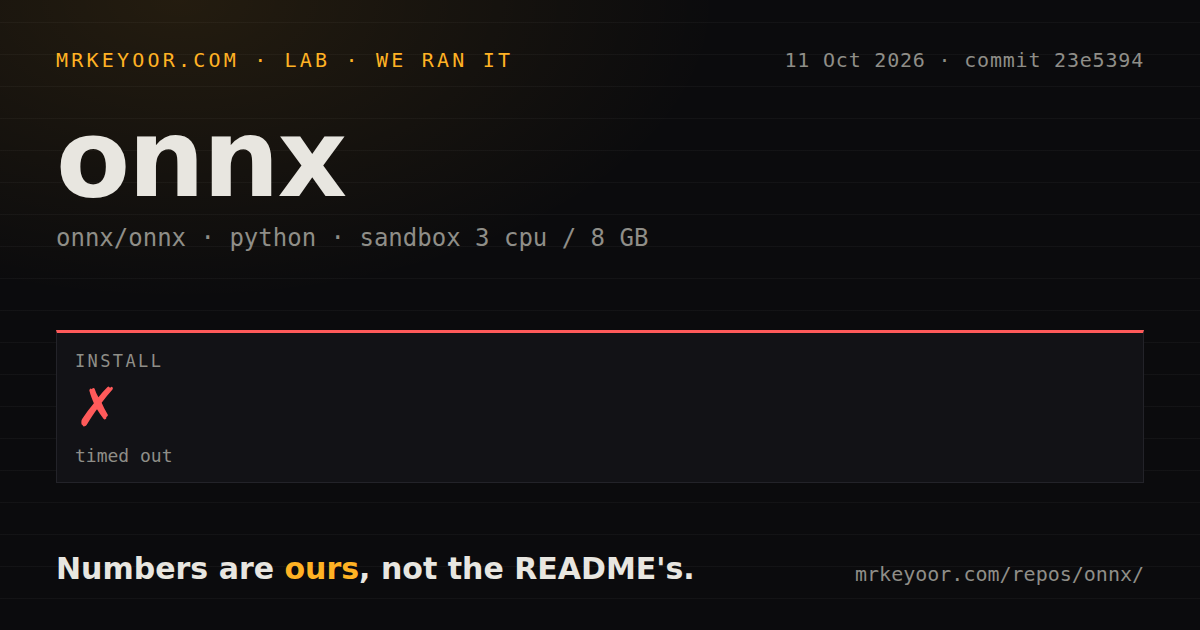
Our installation did not complete before the 900-second limit. We cloned commit 6e96797 into a fresh Debian sandbox using Python 3.12, 3 CPUs, and 8 GB of RAM. The checkout contained 1,469 files, about 188,376 lines of source, and occupied 24.2 MB. Because installation timed out, the measurement record contains no completed build or test outcome. That central finding makes the README's pip install onnx instruction look much easier than our run was.
We also measured 24 CI workflow files, a tests directory, and no Dockerfile. Those are useful signals, but they do not turn the failed install into a pass. The result identifies a timeout only; it does not show which dependency or build step caused it. A fresh-container failure can expose undocumented prerequisites, but assigning that cause here would be guesswork. Reproduce installation in your own base image before committing operationally.
The specification and utilities are the strongest reasons to adopt it
The v1.22.0 project's best feature is scope discipline. ONNX defines model graphs and operator behavior, then provides utilities for shape and type inference plus opset version conversion. The README separates graph optimization into another project, clarifying the core repository's responsibility. For importer or exporter teams, the linked IR, operator, Python API, and versioning documents provide a better contract than reverse-engineering serialized models from one framework.
Packaging work also looks serious. The README describes abi3-compatible wheels for Python 3.12 onward and an optional onnx[reference] install for reference-implementation dependencies. It documents reproducible-build support through SOURCE_DATE_EPOCH, while correctly warning that a fixed timestamp alone does not guarantee byte-for-byte identical artifacts. That language distinguishes a useful reproducibility input from a complete supply-chain guarantee.
Setup remains the biggest practical warning
The main rough edge is the gap between the one-line install pitch and our 900-second timeout. Detailed installation guidance exists in INSTALL.md, including common build options and errors, but README users may not expect meaningful environment work. With no Dockerfile in the measured checkout, the repository supplies no canonical container path alongside that quick command. This lowers confidence in a minutes-only evaluation.
Its size signals standards infrastructure, not a tiny serialization library. Roughly 188,376 source lines and 1,469 files mean contributors face a broad code and specification surface. Users must understand opsets, operator support, and both exporter and consumer capabilities. A valid ONNX file does not prove that every downstream runtime will execute every graph as intended, so compatibility testing belongs in release gates.
The project looks active, although the issue queue is substantial
Health is strong on the provided evidence. The repository had 21,416 stars, and its last push was September 5, 2026, one day before this review. The latest release, v1.22.0, arrived June 15, 2026. A tag from roughly 3 months earlier is not concerning when code is moving, and the README describes an annual roadmap plus open steering, working groups, and special-interest groups.
The 228 open issues are a meaningful burden, but volume alone cannot show whether reports are answered promptly. One latest-release date is also insufficient to calculate cadence. The safer conclusion combines both signals: current repository activity is clear, while adopters should inspect the operators and integrations they depend on rather than treating popularity as support assurance. The 24 workflow files at least show substantial automation.
It belongs between model creation and serving
In a real stack, ONNX fits between 2 stages: training or conversion, then an inference runtime, accelerator toolchain, or deployment service. Keep the original framework artifact, export an ONNX model, validate it, and test it against the exact runtime and hardware combination you ship. Shape and type inference can catch graph problems, while opset conversion addresses version boundaries. Production acceptance should still compare model outputs using representative cases.
These 3 alternatives serve different priorities. Choose StableHLO for an OpenXLA-style compiler pipeline. Choose Apache TVM when cross-target compilation and optimization are the main need, or OpenVINO when an inference toolkit and its deployment path matter more than a neutral format. ONNX fits best when interoperability is the contract and multiple tools need to exchange models without sharing a complete framework stack.
Adopt it for interoperability, with a tested compatibility matrix
ONNX earns its maturity reputation through a defined IR, documented operators, v1.22.0 packaging, open governance, and active development. Our failed 900-second installation prevents an easy setup recommendation, but does not erase its architectural value. Adopt it when crossing framework or hardware boundaries is a real requirement, then pin versions, record opsets, and test every exporter-runtime pair you support. If no such boundary exists, your framework's native format will usually be simpler.