Anchor generates account checks and client interfaces
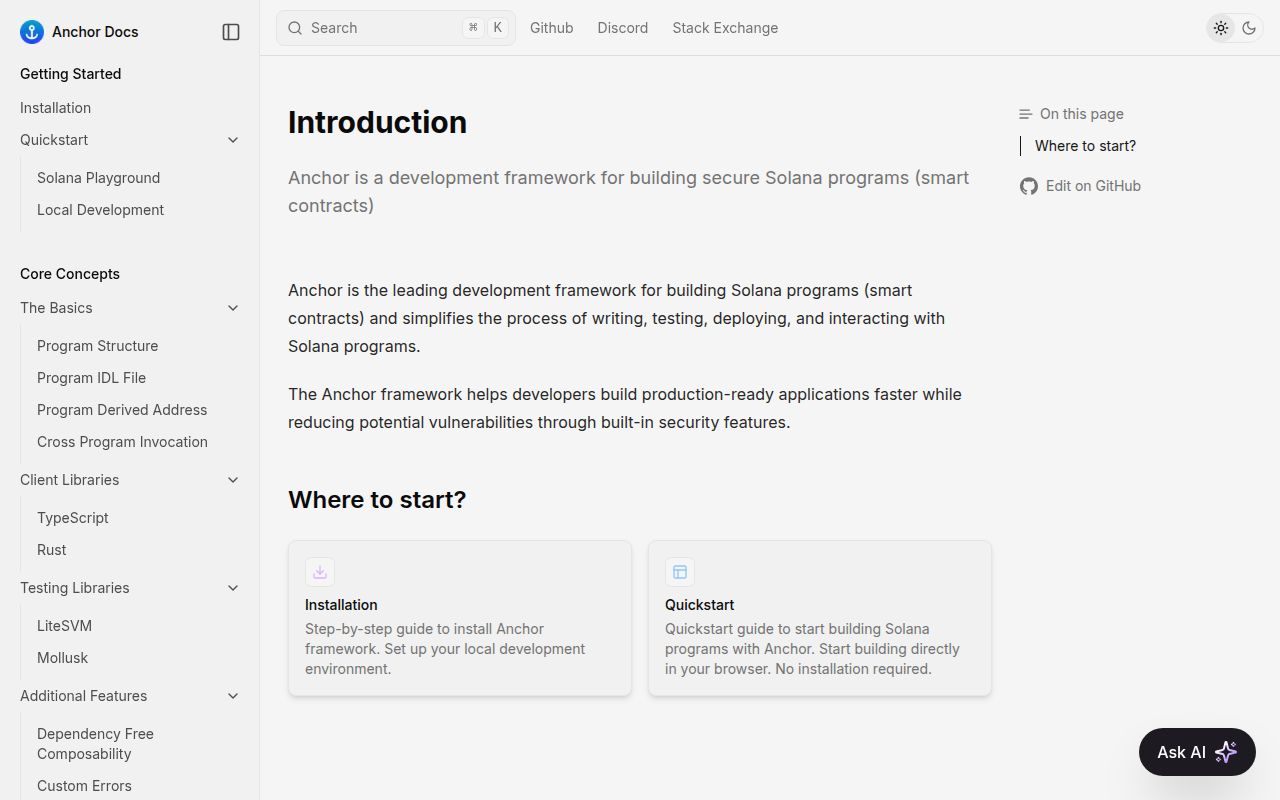
Anchor wraps common Solana program work in Rust macros and a workspace CLI. Developers describe instructions and account requirements in Rust, then Anchor generates dispatch, serialization, validation, and an interface description. Rust and TypeScript clients can use that IDL to call the program. The project also manages builds, local validator tests, deployments, and multi-program workspaces. This is a coherent default for teams that want application structure on top of Solana's lower-level SDK.
The counter example shows the appeal. An Accounts struct declares which signer pays, which account is initialized, how much space it needs, and which system program participates. Another constraint ties later writes to the saved authority. Those checks sit next to the handler rather than being repeated by hand. The benefit is fewer places to forget a routine check. Developers still need to understand what every attribute verifies and what it leaves unchecked.
Five toolchains sit behind the one-line installer
The documentation names Rust, Solana CLI, Anchor CLI, Node.js, and Yarn in a complete local environment. Linux also needs compiler and system packages including LLVM, Clang headers, Protobuf, OpenSSL development files, and udev headers. Windows users must install WSL and run the Linux steps inside Ubuntu. The quick installer can assemble this stack, while manual sections exist for diagnosing individual pieces.
Anchor Version Manager is the recommended CLI route in the repository README. Its installer downloads current nightly AVM and Anchor binaries, enables nightly mode, and links commands under Cargo's binary directory when possible. avm nightly --disable returns to ordinary version selection. A production team should make that pinning decision explicitly, because periodic nightly updates are a poor surprise during a release or audit.
What happened when we ran it
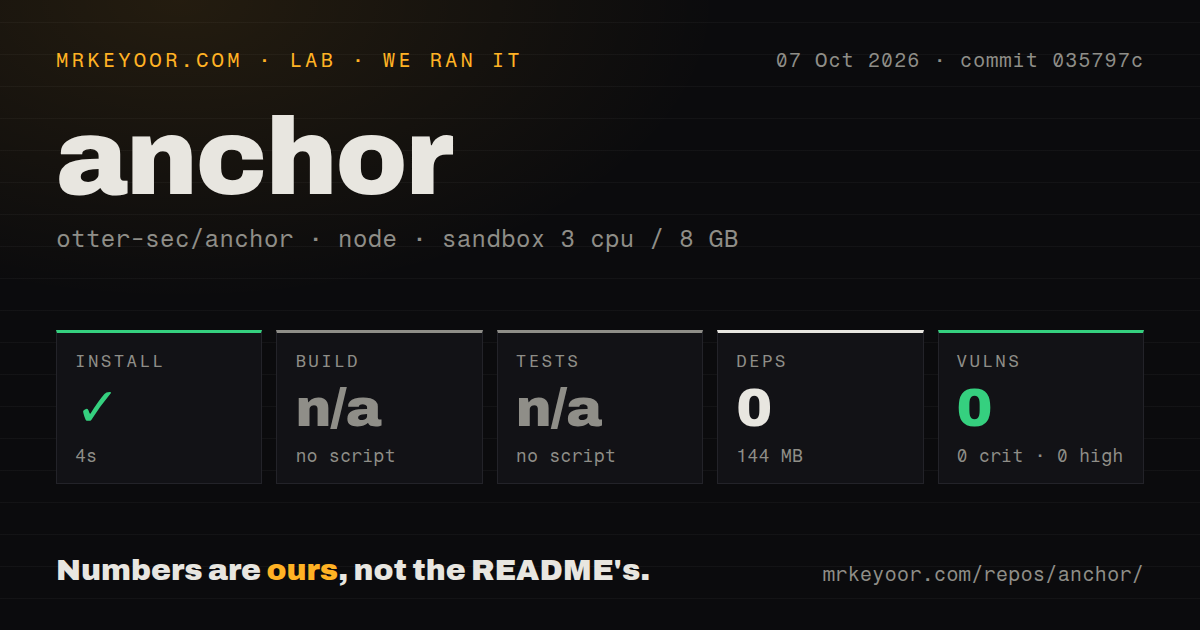
Our sandbox checked out commit db4c9d6 and completed the npm-oriented install step in 9 seconds. It added 0 packages and left 148 MB on disk. Npm audit found 0 critical, high, moderate, or low known vulnerabilities. The repository itself contained 1,999 files, about 192,956 source lines, and occupied 90.6 MB before the harness result.
The harness found no build script or target, so it skipped the build. It also found no test script or target and skipped tests. Those findings do not mean Anchor lacks build or test systems. The repository has a tests directory and 15 CI workflow files, while the contribution guide documents cargo build, cargo test, package-specific Yarn commands, and anchor test for integration cases. Our run simply did not expose those through the detected Node entry points.
No Dockerfile was present in the checkout. The clean npm audit describes only the dependencies represented in that install path; it says nothing about Cargo crates, Solana tooling, AVM downloads, or a program produced by Anchor. A useful follow-up evaluation needs the documented system packages, a pinned Anchor and Solana combination, a Cargo workspace build, and a local-validator integration suite.
Local tests build and deploy to a validator
anchor init creates a program, configuration, deployment keypair, and a default test. anchor build produces the program's shared object under target/deploy. On localnet, anchor test starts a Solana validator, builds and deploys the program, runs the selected tests, and stops the validator. Developers can keep the validator running and pass --skip-local-validator for quicker iteration and account inspection.
Tests can use TypeScript, the Rust client, or Mollusk. The contributor guide adds Rust unit tests and package-specific TypeScript unit tests, and recommends adversarial cases that prove account checks reject bad inputs. Integration tests depend on local package links, with setup-tests.sh as the recommended preparation. This is more setup than an ordinary Cargo crate, but it exercises the deployment boundary where many program errors appear.
Mainnet safety requires reading beyond the macros
Anchor's security reference tells mainnet developers to understand the behavior generated by the framework. Its attack examples distinguish insecure, fixed, and idiomatic Anchor forms while warning that an isolated example is not a security guarantee. The project also has coverage-guided fuzzing through anchor fuzz, backed by Crucible. These tools help when the test author models the dangerous states and account relationships.
Open issue 4941 reports a dispatcher stack overflow in a program with several large nested Accounts structures. The reporter says every instruction failed before its handler when the generated frame exceeded Solana's stated stack offset. The issue proposes configurable inlining. We did not reproduce it. Teams with large CPI-heavy account sets should build size limits into their tests and examine generated code when the compiler reports a stack problem.
Security reports belong in a private advisory, with the policy asking for a proof of concept and promising an initial response typically within 72 hours. Public GitHub issues are explicitly discouraged for vulnerabilities. That process is appropriate for a framework whose generated checks may protect many deployed programs at once.
Current source activity supports v1.1.2
GitHub recorded 5,122 stars, 160 combined issues and pull requests, and a last push on August 21, 2026. Release v1.1.2 arrived on June 26, 2026. Current issue discussion and source pushes continued after that tag, so the release date does not suggest abandonment. The combined open count includes pull requests and should not be read as 160 defects.
Anchor earns its default status by joining Rust program structure, IDL generation, clients, local testing, and deployment in one system. Our 9-second Node path did not test the parts that decide whether a contract is safe. Before choosing it for funds-bearing code, pin the full toolchain, run local-validator and adversarial tests, fuzz important instructions, and commission a security review that treats generated constraints as code rather than proof.