Source plugins decide what Nuclear can play
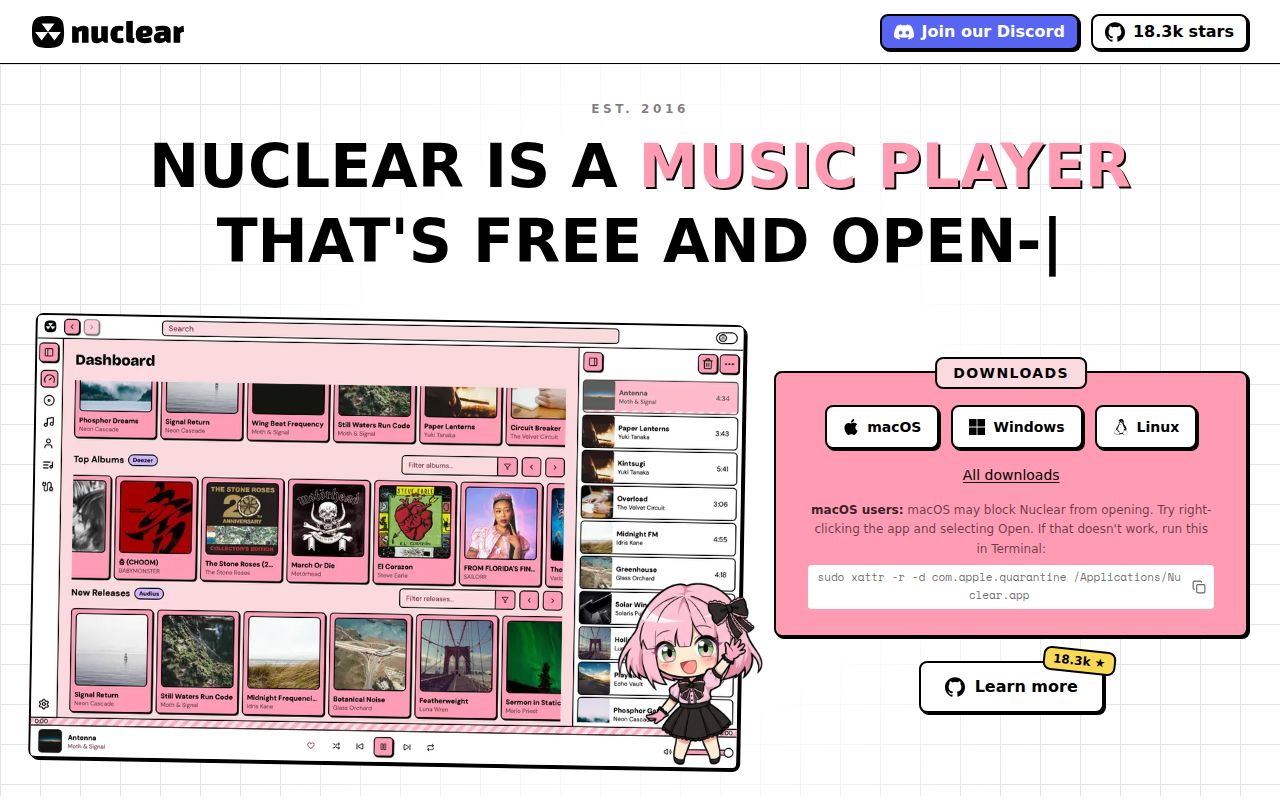
Nuclear is a desktop player for people who dislike tying their listening software to one paid catalog. Search, artist and album pages, queues, favorites, playlists, themes, and keyboard shortcuts live in one Tauri application. Music and metadata arrive through plugins, so the player is best understood as a shell around selectable sources. That separation is useful when one provider disappears or a different metadata service has better results. It also means the experience depends on the plugins you install rather than one catalog controlled by Nuclear.
The README promises streaming from any source in the sense that plugins can implement sources. It does not promise every recording, licensed access, or offline downloads. That distinction matters for someone replacing Spotify or Apple Music. Nuclear removes ads and tracking from the player, but it cannot make an upstream source permanent. A cautious trial starts with the artists you actually play, then checks track matching, availability, playlist import, and source reliability before moving a library.
The plugin store makes the player flexible and more variable
Streaming sources, metadata, playlists, and dashboard content can all come from plugins. A built-in store handles discovery and installation, while @nuclearplayer/plugin-sdk is available for authors. Themes include bundled choices and custom CSS. This is more adaptable than a fixed desktop client, especially for a developer who wants to add an internal service or repair one part without maintaining the entire player.
That flexibility moves some judgment to the user. A source plugin can affect what is found and played, and the README does not provide a compatibility table for every plugin. Teams deploying Nuclear to managed desktops should decide which plugins are acceptable and test upgrades before rollout. The 1,354-file monorepo contains roughly 74,421 lines of source, so maintaining a private fork is possible but not a casual patch set. AGPL-3.0 also deserves review before code is folded into a closed product.
MCP control is local and optional
Nuclear can expose an MCP server after the user enables it in Settings. Claude Code connects with a single claude mcp add command, while Codex CLI, OpenCode, Claude Desktop, Cursor, and Windsurf use the documented HTTP endpoint at 127.0.0.1:8800/mcp. The repository also supplies a Nuclear MCP skill intended to teach an agent the available controls. For someone using an agent at a desk, requests such as managing playback can sit beside other local tools.
An MCP connection gives software control over a running player, so enabling it should be a deliberate choice. The default loopback address keeps the documented connection on the same machine. The README separately documents dev:remote, which binds Vite to 0.0.0.0 for a remote control interface on a local network. Those are different paths. Do not expose either beyond the intended host or LAN merely because the setup command is short.
What happened when we ran it
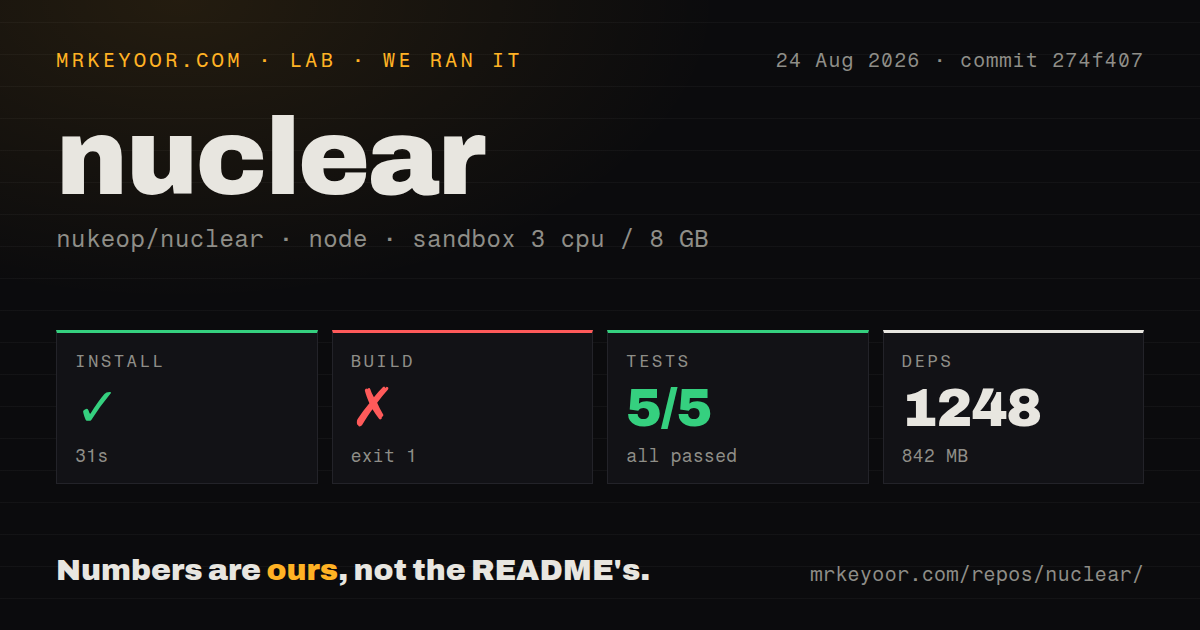
Our sandbox installed 1,248 pnpm packages in 31 seconds, occupying 842 MB on disk. Vitest then reported 5 passed and 0 failed after 139 seconds. Those are the only tests the measured command found, despite the checkout containing about 74,421 source lines and no top-level tests directory. Five passing tests are better than a broken suite, but they provide limited evidence for a desktop app with plugins, playback, packaging, updates, and three operating-system families.
The build ran for 67 seconds and failed with exit code 1. Turborepo finished 8 of 9 tasks, and the player frontend reported that it had built in 10.06 seconds. The remaining player task tried to run cargo metadata --no-deps --format-version 1 and received a missing-command error. The log establishes that Cargo was unavailable in our Node sandbox. It does not establish whether any later Rust compilation or platform packaging step would have passed.
The README lists stable Rust and platform-specific Tauri dependencies as prerequisites, along with Node.js 22 or newer and pnpm 9 or newer. Our result is a useful boundary: pnpm install alone does not prepare a fresh Debian container to build the desktop application. Contributors need the Rust toolchain and the correct native packages for their target system before the documented monorepo build can finish.
Desktop packages cover three systems, not phones
Nuclear publishes Windows installers, macOS disk images for Apple Silicon and Intel, plus AppImage, Debian, RPM, and Flatpak choices for Linux. That breadth lowers the effort for listeners who use packaged releases. It does not extend to Android or iOS in the README. Anyone whose listening moves between a phone, car, and desktop will get more continuity from Spotube or from a server such as Navidrome with multiple clients.
Packaging still has platform edges. Release player@1.47.1, published August 16, 2026, fixes several AppImage issues caused by Wayland. Its notes also tell macOS users what command to run if quarantine prevents the app from opening. Neither warning makes the release unusable, but both show why the packaged route should be tested on the exact desktop environment rather than treated as one uniform target.
August activity supports a serious trial
GitHub recorded the last push on August 16, 2026, followed minutes later by release 1.47.1. The repository had 18,344 stars and 5 open issues and pull requests when fetched. All 5 open entries returned by the API were pull requests, including dependency and translation updates, so the combined count should not be read as five player defects. The same-day push and release are stronger health evidence than the star total alone.
Nuclear is most convincing as a packaged desktop player for a technical listener who accepts plugin-dependent sources. Its ad-free interface, desktop packaging, and local MCP control make it unusual. The source checkout asks more of contributors: 1,248 packages, 842 MB, Rust, Tauri libraries, and a test sample of only 5 cases in our run. Try the release first, verify the sources you depend on, and reach for Navidrome when ownership of the music library matters more than open-ended search.