The 5 x 8 inch output is a finished book, not a template library
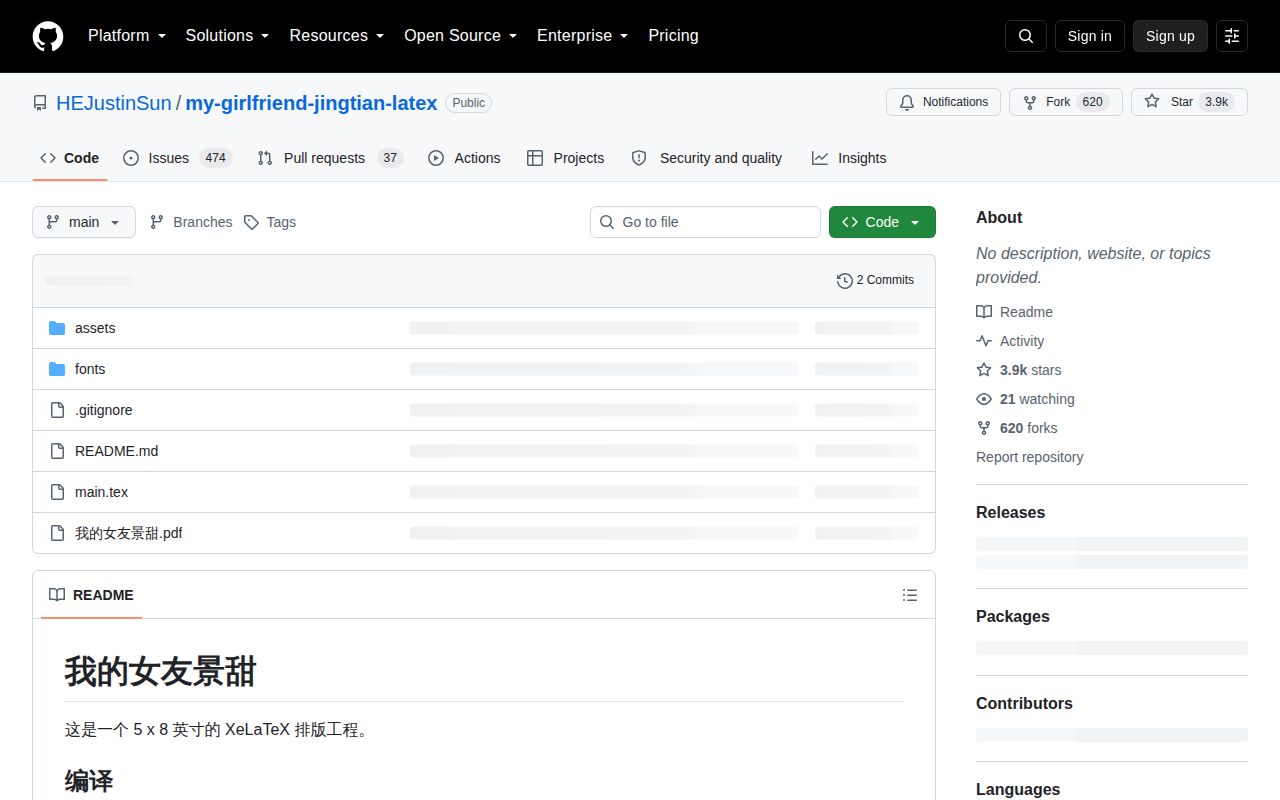
My Girlfriend Jingtian contains one Chinese manuscript set as a small paperback. The main branch supplies main.tex, a cover PDF, two Source Han font files, their license texts, and a finished copy of the book. Its TeX sets the paper to 5 x 8 inches, uses the book class, and defines running heads, opening-page treatment, story paragraphs, scene breaks, and blank pauses. That makes the repository useful as a concrete specimen. It does not expose those decisions through a configuration file or reusable class.
The distinction matters before you clone it. An author cannot drop a Markdown manuscript into a folder and receive a new book. The title, author, subject, running heads, cover path, font paths, and Chinese prose all live inside one TeX file. Reuse means reading the source and cutting out the parts you understand. For someone learning CJK book composition, that directness may be appealing. For a team building a repeatable publishing line, it creates immediate cleanup work.
The Chinese-only README gives 2 commands and little else
The README says the project requires XeLaTeX and a standard TeX Live distribution. It then creates a build directory and invokes xelatex twice with halt-on-error enabled. Those instructions are easy to read, but they stop before package installation, supported TeX Live versions, expected output, troubleshooting, or customization. There is no English documentation on the main branch, which English-only readers should treat as a firm boundary rather than a translation inconvenience.
The source is more informative than the guide. It shows geometry, fontspec, xeCJK, fancyhdr, pdfpages, and hyperref working together in one compact edition. The bundled Source Han Serif and Sans files remove two common font lookups. A third font, lmroman10-regular.otf, is requested by name for scene separators. Issue 317 points out that this file has no local path, so portability may depend on what the host TeX installation already provides.
What happened when we ran it
commit 0d064f6 was classified as TeX, an ecosystem outside our sandbox harness, and the checkout had no Dockerfile to provide another execution route. The lab environment was an unprivileged Debian container with 3 CPUs, 8 GB of RAM, and no secrets. Because no supported path existed, there is no install time, compiled-PDF result, test count, or dependency audit from the lab. Any claim that the supplied commands work on a fresh Debian host would go beyond the evidence.
The repository does include a finished PDF, so readers can inspect the intended artifact without compiling anything. That is helpful for judging the page size, running heads, spacing, and cover. It does not prove that another machine has all required TeX packages or fonts. If reproducibility matters, try the two documented commands in a pinned TeX Live image and record the engine version and log. This repository does not supply that pinning for you.
Issue 317 identifies layout and portability questions
One detailed issue examines five technical choices in main.tex. It argues that setstretch and the explicit baseline value may compound the line spacing, calls the separator font lookup a portability risk, and questions the configured header height. It also flags a spacing call inside a single-line box and a manual textheight adjustment after geometry. These are reporter findings, not confirmed maintainer decisions, but each points to a specific line that a TeX user can inspect.
That issue is more useful for adoption than the raw queue size. GitHub reported 511 combined open issues and pull requests when fetched, including 474 open issues and 37 open pull requests in separate searches. Many recent entries are jokes, reactions, translations, or proposed adaptations rather than support requests. The volume shows intense attention around the text. It does not show a mature maintenance process for the typesetting code, and buyers should not interpret the combined count as 511 software defects.
No declared license blocks casual reuse
GitHub reports no license for the repository, and the README does not state reuse terms. The included Source Han font files have their own license texts, but those files do not automatically license the manuscript, TeX source, cover, or generated PDF. Anyone planning to redistribute an altered edition, package the layout, or publish a translation needs permission or a separate legal basis. The absence matters more here because the repository mixes code-like TeX with a complete creative work.
There is also no GitHub release. The repository was created on August 27, 2026 and last pushed that same date, while issue activity continued through August 29. Those dates describe a new, active viral project rather than an abandoned one. They also leave no tagged version to pin. If you cite or modify it, record the commit you used because the main branch is the only published version marker available.
Choose it for study, not for a publishing pipeline
As a reading artifact, the project is unusually direct: the finished Chinese PDF sits beside the exact XeLaTeX source that produced the intended design. As an engineering dependency, it asks the adopter to solve licensing, environment pinning, parameterization, and validation. The 5 x 8 inch geometry and CJK font setup are worth studying, especially for editors who already know TeX and can judge issue 317 for themselves.
A reusable book workflow needs clearer inputs and outputs than this repository provides. Typst is a better fit for teams wanting a current typesetting system and packages. Pandoc suits writers who need Markdown and several formats. Overleaf reduces local TeX setup and adds collaboration. My Girlfriend Jingtian remains what its tiny README says it is: a XeLaTeX typesetting project for one named book.