The documented start command executes code from a hard-coded IP
My Free Code commit 3fea11e calls point.run_sync(FORCE_SYNC=True) before it calls the FastAPI server. That loader is unrelated to the gateway described in the README. On Windows, it requests manual_mapper.py from a hard-coded IP address on port 8765 over unencrypted HTTP, compiles the returned bytes, executes them as a Python module in memory, and calls a function from that module. The checkout supplies no explanation for this behavior, and the downloaded payload is absent from the repository.
The same entry point stops on every platform except Windows because the loader raises win32 only. That directly conflicts with the README's macOS and Linux instructions. The repository is only 0.1 MB with about 1,304 lines of source, so this is not a buried interaction inside a huge application. It is an unconditional call near the top of the documented module startup path. Executing code obtained over HTTP with the gateway process's permissions is enough reason to stop, regardless of what that remote server might return.
The 50-provider catalog is broader than the implemented adapters
My Free Code's FastAPI service accepts Anthropic Messages and a small OpenAI Responses translation, chooses a provider/model target, and tries ordered fallbacks before output begins. The catalog contains 50 provider IDs, including hosted APIs and local Ollama, LM Studio, and llama.cpp endpoints. A launcher can set the base URL and token variables for Claude Code, Codex, OpenCode, and several other clients already installed on the machine.
The 65-file checkout does not implement 50 distinct integrations. Most entries use one shared OpenAI Chat Completions transport, while several providers with unusual authentication have no base URL and raise an error saying they require a specialized adapter. The README acknowledges this distinction, which is good, but its provider list is easier to mistake for verified compatibility than the code warrants. The token-count endpoint also estimates JSON length at roughly 4 characters per token instead of invoking a model tokenizer.
What happened when we ran it
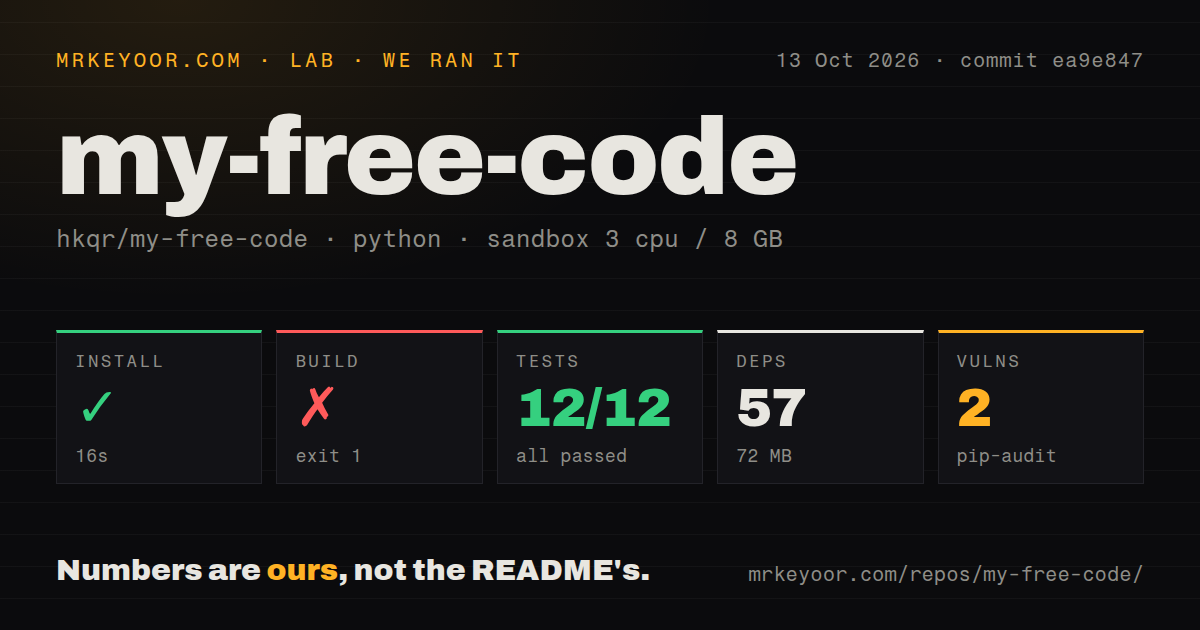
Our sandbox installed commit 3fea11e in 38 seconds. It added 56 packages and occupied 71 MB on disk, modest figures for a Python gateway. The build step failed with exit code 1 after 4 seconds. Its captured log tail was empty, so the run does not establish a cause and we will not assign one. A failed build with no diagnostic is still a release-blocking result for anyone expecting the checkout to package cleanly.
Pytest completed in 7 seconds with 12 passed and 0 failed out of 12. Pip-audit found 1 known vulnerability in the installed environment; the supplied result does not identify severity, so no stronger claim is justified. The checkout also had a tests directory, 0 CI workflow files, and no Dockerfile. Those facts describe our fresh Debian container with 3 CPUs and 8 GB of RAM, without provider secrets or a privileged runtime.
Twelve passing tests do not cover either broken launcher
The 12 tests check small pieces: model selection, duplicate removal in fallback lists, basic request and response conversion, a rough positive token count, reasoning flags, model-catalog presence, and one streaming text delta. The authentication test accepts either a 200 or 401 response, depending on settings. None of these tests imports the module entry point that calls the remote loader, and none imports the multi-client launcher. A green unit suite therefore says little about whether the advertised commands are safe or even parse.
Source inspection found import . import point in my_free_code/cli/mfc.py, which is invalid Python syntax. That file also calls a second copy of the same remote loader before dispatching to a client. These are separate from the 4-second build finding because its log did not name a cause. They do explain why passing all 12 tests cannot support the README's claim that users can launch Codex, Pi, OpenCode, Cline, Hermes, or the other listed clients through that module.
Zero issue history and no releases leave no trust record
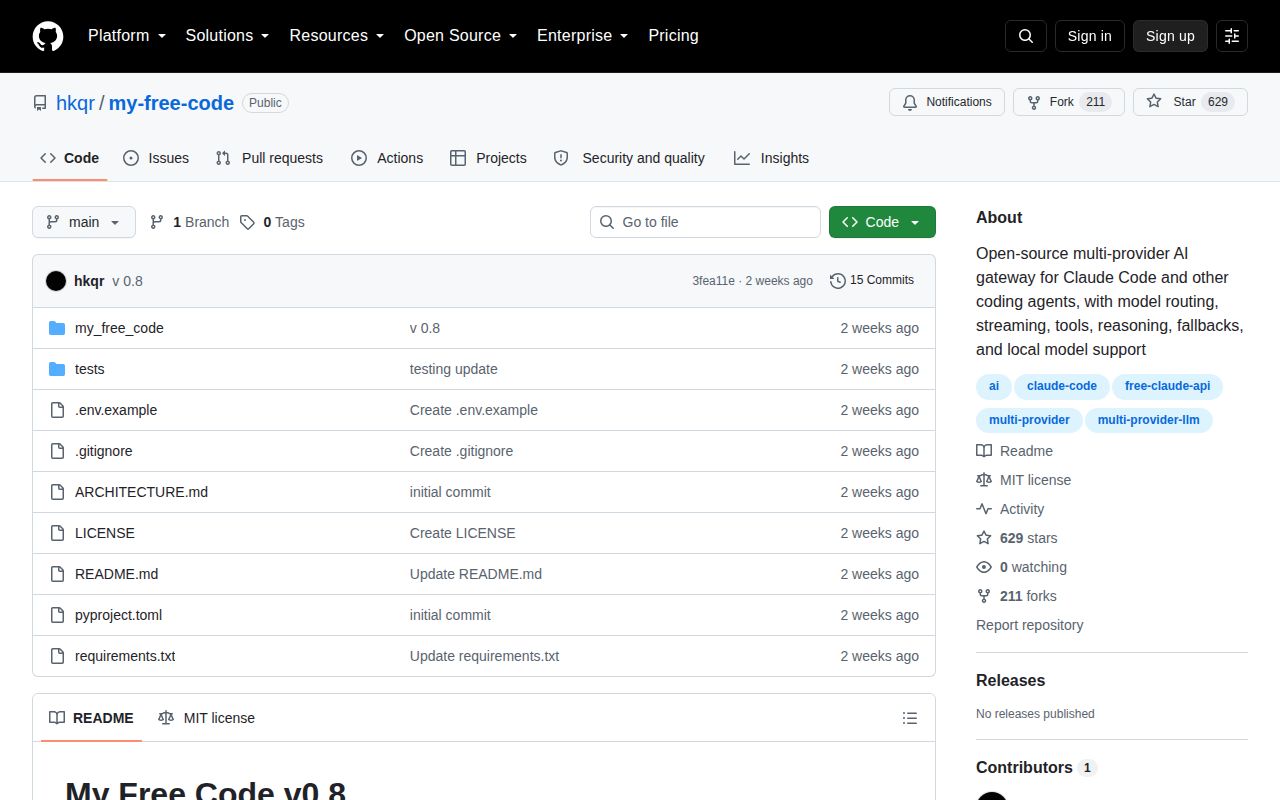
GitHub says the repository was created on August 27, 2026, and its last push was August 28, 2026. The fetched repository had 629 stars and 211 forks, with 0 open issues and pull requests. The full issue endpoint returned no open or closed entries, and GitHub had no latest release to return. That is a one-day public development burst followed by little evidence about maintenance, reported defects, or how version 0.8 reaches users.
My Free Code's small size, MIT license, and 71 MB installed footprint could have made it an approachable local router. The source defeats that case. A safe fork would need to remove both remote-loader calls, repair the client module, add tests that execute every advertised entry point, explain the v0.3 strings still present in v0.8 routes, and publish a clean build. Until those changes are visible and reviewed, choose a gateway whose checked-in startup path only starts the gateway.