MongoDB fits records you usually read together
MongoDB stores nested objects and arrays inside documents, so a product's attributes and available options can live in the same record. The embedding guide explains how keeping related data together can simplify reads and updates. I'd shortlist it for a catalog with varied attributes. I'd want a stronger reason for choosing it for accounting records whose relationships dominate every operation.
The source checkout contained 44,322 files and roughly 10,120,770 lines of source, occupying 518.1 MB. GitHub identifies C++ as the main language. The README names mongod as the database server and mongos as the sharding router, then directs you elsewhere for the shell and drivers. Application developers can use the published server distribution without taking ownership of this entire source tree.
What happened when we ran it
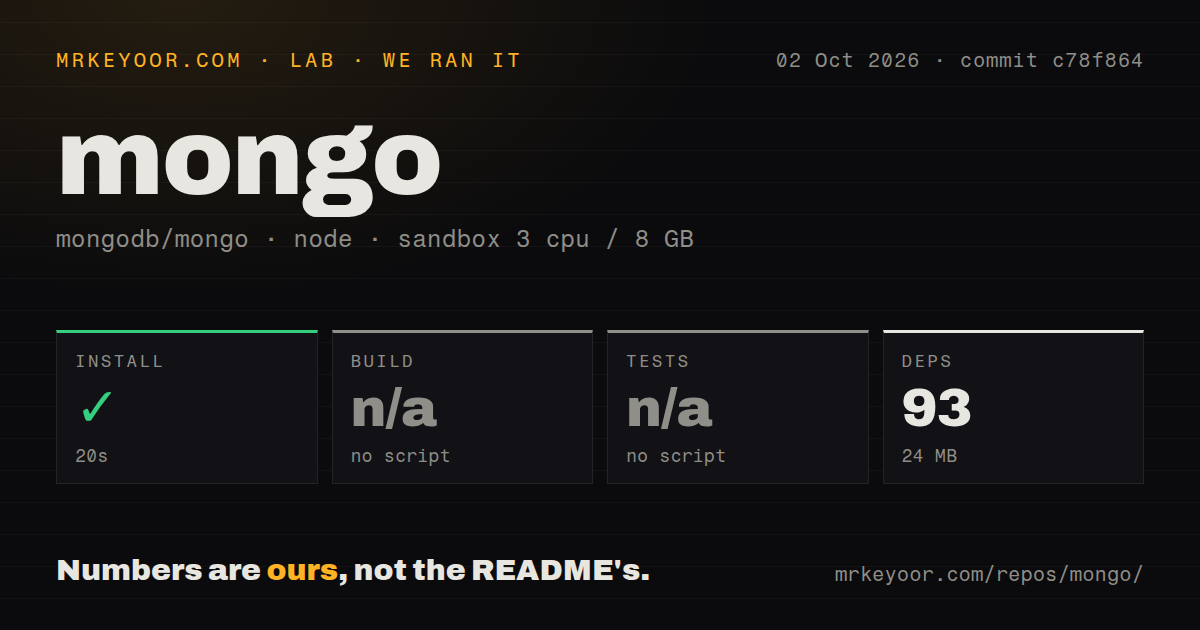
Our run installed 93 pnpm packages in 20 seconds, with 24 MB on disk after installation. We cloned commit c78f864 on October 2, 2026, into a fresh Debian sandbox with 3 CPUs and 8 GB of RAM. The image was lab-node:22, and the container had no secrets or elevated privileges. The harness classified the checkout as Node with pnpm, and its install step succeeded.
Build and tests were skipped because the harness found no build script or target and no test script or target. Its scan reported 0 CI workflow files, no Dockerfile, and no tests directory. Those are the supplied detection results, rather than evidence that MongoDB has no upstream checks. Our measurement establishes a successful package-manager step. It supplies no server compilation result, passing suite, or database workload result to base a performance recommendation on.
The README reaches a local server before it addresses operations
The README offers Community Server downloads, Homebrew, and a published container image. Its running example creates /data/db with sudo, starts mongod, and connects using a separately downloaded mongosh. A writable data location is part of the setup. If you're adding a database to an application, these distribution routes are the sensible starting point. Reading the source is useful when you need to understand or change the engine.
Our sandbox's 3 CPUs and 8 GB of RAM give context for the package step, without establishing production capacity. MongoDB's security checklist calls for access control, application users with limited permissions, encrypted connections, and restricted network exposure. No hosted API key is needed for a local Community server. You still need database credentials once access control is enabled, and somewhere durable to keep the data. The README's local example leaves those deployment decisions to you.
Standalone deployments cannot run multi-document transactions
MongoDB's transaction guidance says standalone deployments do not support transactions. Transactions across documents need a replica-set or sharded deployment. That matters if your first successful local connection becomes the template for production. An application that updates an order and its payment record together needs a deployment that supports the operation, plus error handling for aborted transactions. A connection string alone cannot settle those requirements.
The 24 MB recorded after our package installation tells you nothing about the storage or memory needed for that deployment. Choose the data model first: embedding related information can keep a change within a document, while references let separately managed records remain separate. Neither choice removes the need to decide what happens when related updates fail. I'd draw the important write operations before selecting a topology, especially if the application currently assumes SQL transactions everywhere.
SSPL excludes MongoDB from an OSI-only shortlist
The README places current server releases under SSPL v1. MongoDB's license FAQ explicitly says SSPL is not OSI approved. It also distinguishes offering MongoDB functionality as a service from using MongoDB behind another SaaS application: the service-source condition applies to the former. That distinction deserves attention before a hosting product adopts this server. A team restricted to OSI-approved software already has a concrete reason to choose something else.
The 20-second package step cannot decide between these databases. FerretDB is the relevant alternative when retaining MongoDB drivers matters. Its README describes a proxy translating MongoDB wire-protocol queries to PostgreSQL with the DocumentDB extension, and links a compatibility list. Check your actual commands against that list. PostgreSQL with indexed JSONB is my preference when SQL relationships and flexible records must coexist. CouchDB is worth considering when an HTTP document API and synchronization between disconnected copies define the product. These choices change the application or its compatibility obligations.
The October 9 push and September pull requests show maintenance
The repository was pushed on October 9, 2026. GitHub returned 28,629 stars and 36 open issues and PRs. September activity included documentation fixes and a closed pull request correcting spelling in server comments and messages. Those facts show ongoing work, though they say little about defect severity. The README directs bug reports to a separate reporting process, so the GitHub total cannot serve as MongoDB's complete defect backlog.
A 518.1 MB source checkout makes sense for engine work. For a supported server distribution, the README points to MongoDB's own downloads. The latest-release API returned 404. An empty GitHub release response alongside recent source activity is insufficient evidence of abandonment. For adoption, I'd follow the supported distribution and its lifecycle rather than infer a shipping schedule from that endpoint. The documentation separates server usage, source work, and community support clearly enough, even though you must leave the short README to answer deployment questions.
The 20-second result supports a narrower recommendation
MongoDB's package step succeeded in 20 seconds, and both server build and test execution remain unverified by this run. Use the database when records naturally belong together and your team accepts its license and deployment responsibilities. Choose the published distribution for application work. Before committing production data, require evidence from your own query patterns and recovery procedure. If those records mainly express relationships between independent entities, start the comparison with PostgreSQL.