Modly puts image-to-mesh work inside one desktop app
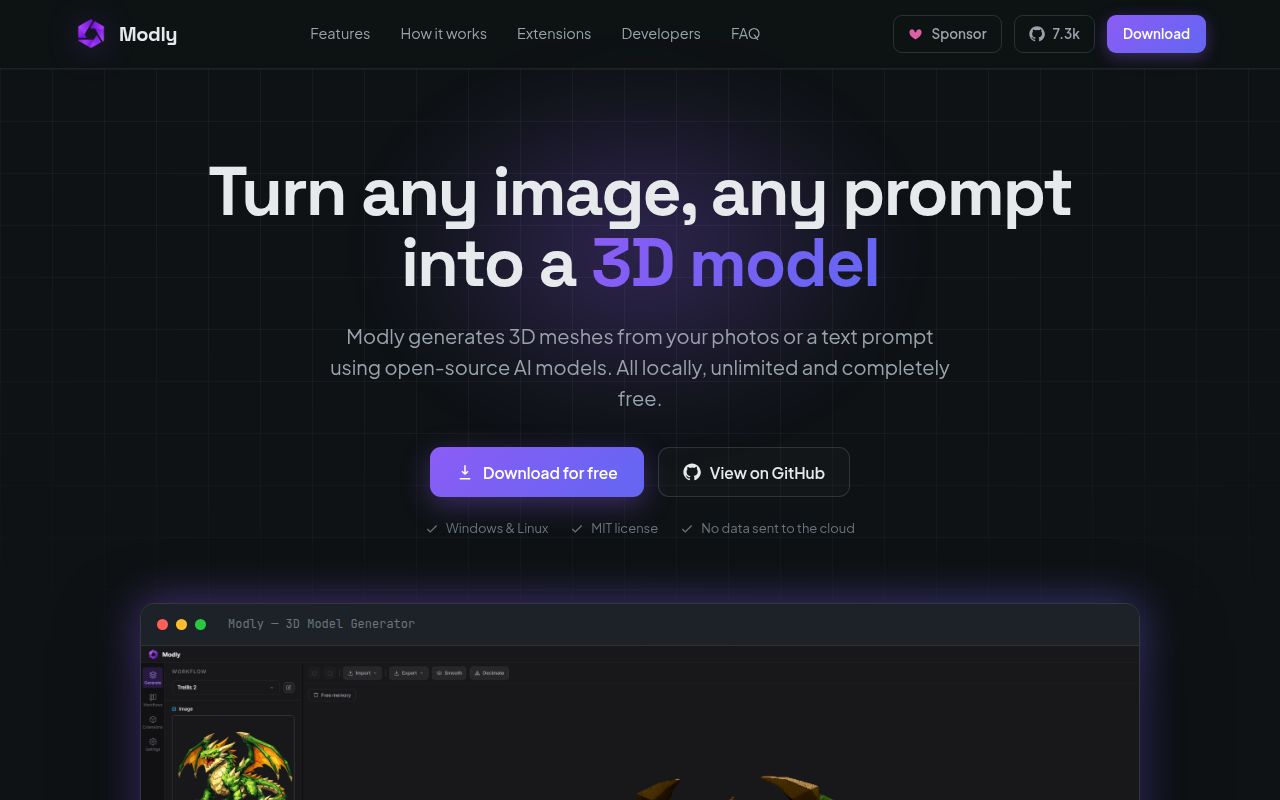
Modly takes a source image, runs a local AI model, displays the resulting mesh, and lets the user smooth, decimate, organize, and export it. The interface is built around an Electron desktop app rather than a notebook or hosted account. A node editor handles repeatable workflows such as Image to Generate Mesh to Add to Scene. That makes it easier to inspect intermediate work than a single command that drops a GLB file into a directory.
The model layer is separate from the application. Five official extension repositories are listed in the README, covering Hunyuan3D 2 Mini variants, TripoSG, and Trellis2 GGUF. Each extension supplies a manifest and runtime entry files, then downloads its own model or variant. This keeps the 102.3 MB checkout from bundling weights, but it also means installing Modly is only the first part of setup.
Local generation still means trusting extension code
A local GPU keeps source images and generated assets off a vendor API. That is useful for private concepts or high-volume iteration, and the core app does not ask for a cloud token. The trust boundary shifts to the machine, however. Installing an extension from a GitHub URL brings in executable model code plus its dependencies. A team should pin the repositories it accepts and review changes before installing an update.
The README gives the user a visual installer rather than asking them to copy files by hand. Open issue 280 shows a practical limit: the installer assumes a repository has a main branch, so an otherwise valid extension on master fails with a missing-manifest message. That defect is narrow, but it matters because third-party extensions are the way Modly grows beyond its five listed choices.
What happened when we ran it
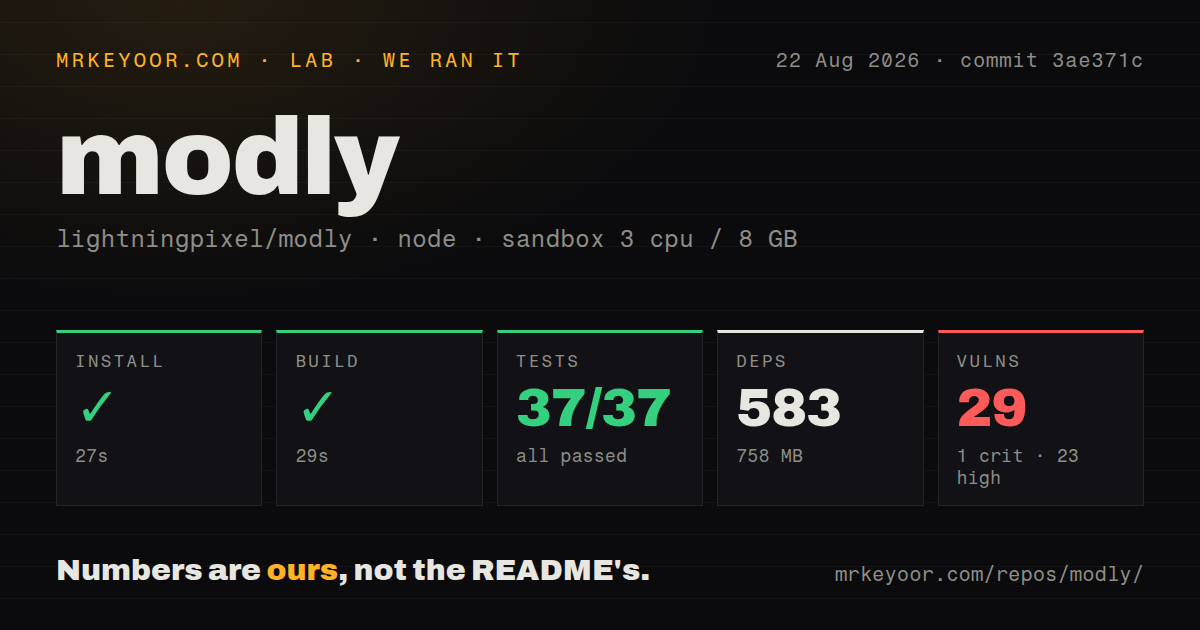
Our sandbox installed 583 npm packages in 27 seconds, leaving 758 MB on disk. The application build completed in 29 seconds. All 37 node tests passed in 9 seconds with no failed case. Those results cover commit 3ae371c in an unprivileged Debian container with 3 CPUs, 8 GB of RAM, no secrets, and Node 22.
The security audit was the poor result. Npm reported 29 known vulnerabilities: 1 critical, 23 high, 3 moderate, and 2 low. We did not infer which application paths were exploitable from those counts. They are still too numerous to wave away in a desktop app that downloads extensions and launches local processes. The checkout had 2 CI workflow files, no Dockerfile, and no top-level tests directory.
Our run measured repository install, build, tests, and dependency advisories. It did not download a 3D model, time generation, compare mesh quality, or measure GPU memory. Claims about seconds per mesh or output accuracy would require a named extension, fixed input set, and specific GPU. Modly's result in our box says the app code built cleanly, not that every extension will run on every supported machine.
The CLI automates a running app rather than replacing it
The stdlib-only Python CLI exposes health, model, workflow-run, capability, and process-run commands. Its friendly generate path can submit an image, poll the run, export the final mesh, and return recovery commands as JSON. That is a useful contract for agents and scripts because they do not need to click through Electron for every asset. Compatibility commands are kept separate from the canonical workflow API.
There is an important boundary in the documentation: dev serve-api and dev ensure-server start the FastAPI backend but do not prove the desktop bridge is available. Headless jobs need health checks that match the capability they will use. On Windows, open pull request 282 describes a UTF-8 decoding defect in extension subprocess pipes that can leave generation stuck near completion with idle CPU and GPU. Its proposed fix was still open when researched.
Platform support has one firm Mac boundary
Modly documents Windows, Linux, and Apple Silicon macOS. Intel Macs are outside that list. Source setup requires npm packages, a Python virtual environment, the backend requirements, and then npm run dev. Packaging macOS has its own Arm64 command. There was no Dockerfile in our 238-file checkout, which fits a desktop product but gives server operators no maintained container route to borrow.
The app includes a live RAM indicator and validates workflow wiring before a run. Imported meshes can be smoothed and decimated, with optimized assets written into the workspace. These are practical desktop details, yet they do not answer GPU compatibility for a chosen model. Before adopting it, test the exact extension on the exact driver and hardware combination that artists will use.
Active development is moving faster than the beta release
GitHub showed 7,274 stars, 63 combined issues and pull requests, and a last push on August 26, 2026. The latest release was Modly Beta v0.4.1, published July 16. Its notes cover macOS packaging, workflow iterators, extension recovery, a workflow browser, and several input fixes. New work continued after that tag, so judging health from the release date alone would miss current maintenance.
The license file starts with the MIT text and adds a request that forks keep visible credit in their UI or documentation. GitHub's repository metadata returned NOASSERTION, while the README calls it MIT. Organizations that redistribute a fork should read the actual file rather than rely on the badge-level label. For a personal workstation, Modly is worth a controlled trial. For a studio rollout, the 29 audit findings and open Windows hang deserve resolution first.