MuJoCo Warp 3.11 supplies the simulator
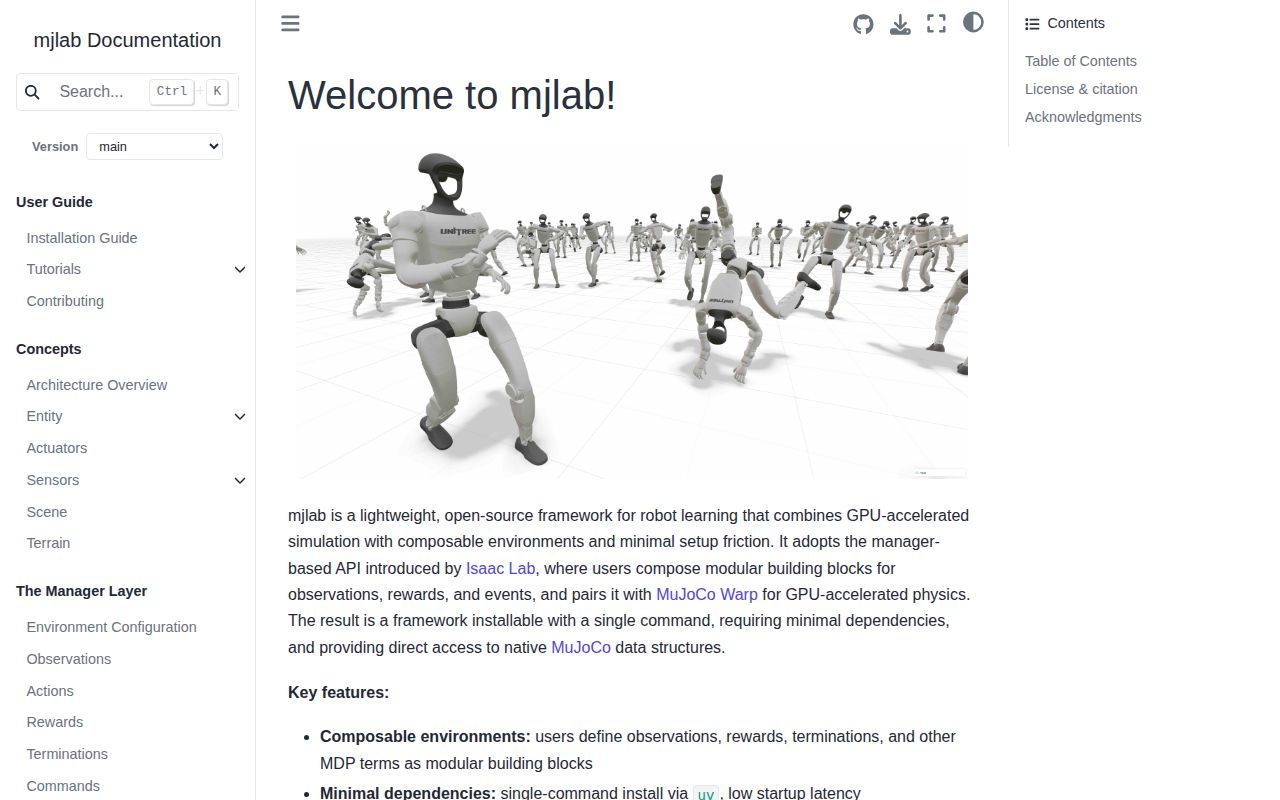
Version 1.6.0 combines MuJoCo Warp 3.11 with an environment API modeled after Isaac Lab. Researchers define a scene and plug in managers for observations, actions, commands, rewards, termination, curriculum, and events. The result is a familiar migration path for an Isaac Lab user who wants MuJoCo's native model and data structures. Included examples cover Unitree G1 velocity tracking and reference-motion imitation, while zero and random agents provide basic task checks before a training run.
This is a sizeable research framework rather than a thin simulator wrapper. The measured commit had 512 files, roughly 74,455 source lines, and a 62.2 MB checkout. Its package pulls in PyTorch, Warp, MuJoCo Warp, MuJoCo, RSL-RL, Weights & Biases, rendering tools, and geometry libraries. Seven CI workflow files, a Dockerfile, and a tests directory are present. Apache-2.0 covers mjlab, with a disclosed BSD-3-Clause-derived utility area from Isaac Lab.
What happened when we ran it
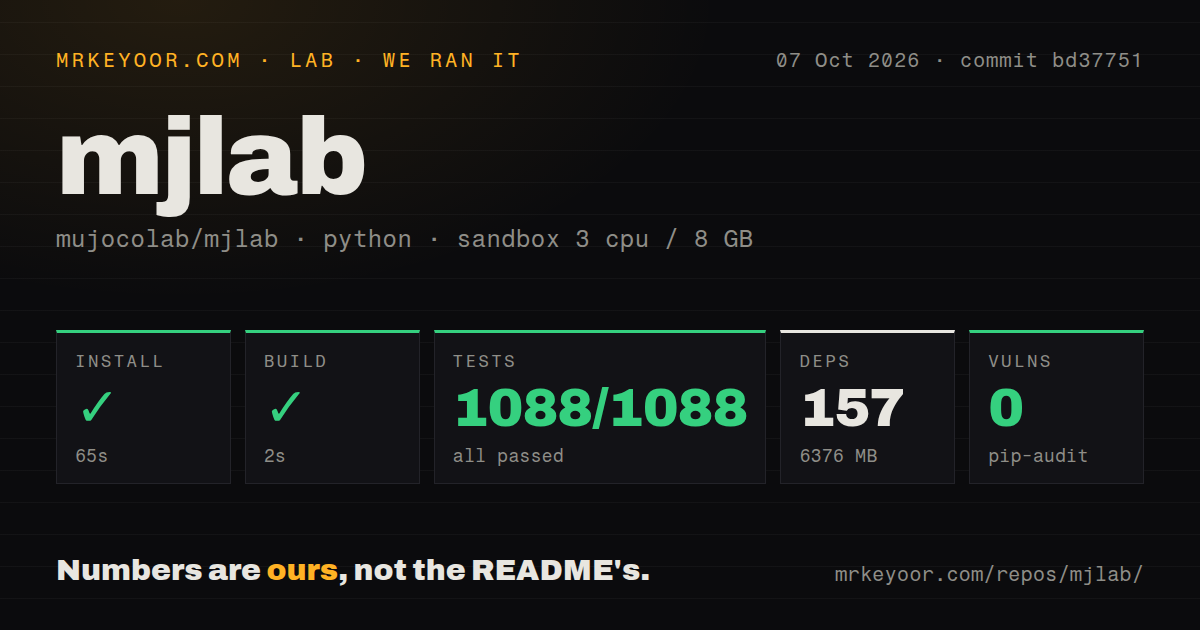
Our sandbox installed 149 packages in 113 seconds and used 5,765 MB on disk. The build completed successfully in 31 seconds. This was commit 8ee51fb in a fresh unprivileged Debian container with 3 CPUs and 8 GB of RAM. The commit fixes zero-radius flat-patch sampling, where a negative-zero slice had cleared the valid mask and forced all samples to a terrain center.
The test step succeeded in 135 seconds. Pytest reported 1,067 passed, 0 failed, and 15 skipped of 1,067 in the supplied lab summary. Pip-audit found 0 known vulnerabilities in the installed Python environment. Those results make the checkout credible to develop against, though they do not measure simulation throughput, policy quality, GPU memory use, or sim-to-real transfer. We did not turn a passing test command into a claim about robot performance.
Training requires an NVIDIA GPU after a 5,765 MB install
The README states that training needs an NVIDIA GPU and limits macOS to evaluation. Python 3.10 through 3.13 is supported. A reader can launch the demo with uvx, use a Colab notebook, install from source with uv, or follow the Docker path. CUDA 12.8 and CPU extras are separated in the package configuration, but the CPU option does not change the README's training requirement. Hardware planning begins after the already large local environment is installed.
The 5,765 MB footprint matters on shared runners and disposable research machines, even before checkpoints or motion assets arrive. Velocity training examples use 4,096 simulated environments, while the multi-GPU command accepts a list of device IDs. Playback can retrieve the latest checkpoint from Weights & Biases, and motion imitation expects a registry entry for its reference data. A quick demo is low ceremony; reproducing another lab's training run still requires matching assets, configuration, drivers, GPU allocation, and tracking credentials.
RSL-RL 5.5.0 is the bundled training library
The package pins rsl-rl-lib 5.5.0, and the documented training commands follow that route. This is a sensible choice for legged-robot work and keeps the provided examples coherent. It narrows the ready-made integration story, however. Issue 695 asks about other RL libraries, issue 759 requests SB3 and SBX support, and issue 1156 asks about official AMP support. All three remained open.
An experienced team can write its own adapter because mjlab exposes environment state and direct MuJoCo structures. That work belongs in the adoption estimate. If Stable-Baselines3, SBX, or a custom offline trainer is fixed by organizational policy, prove reset semantics, terminal observations, batching, and logging before porting a large task. MuJoCo Playground may fit better when its tasks and training approach already match the study. Isaac Lab remains the closer option when the wider Isaac Sim sensor and asset ecosystem is required.
One actuator combination escaped 1,067 passing tests
Open issue 1170 documents swapped PD targets when sort_actuators=True is combined with the built-in position and velocity actuator. The reporter showed position commands reaching velocity controls and vice versa. Pull request 1172 proposes a fix, but it was still open on September 1, 2026. The report is specific, reproducible, and outside the covered actuator combination despite the 1,067 passing tests.
Rendering has a narrower hardware warning. Issue 1160 reports a Colab G4 headless EGL failure when a full mjlab environment and Warp share one process: initialization either segfaulted or hung in the reporter's matrix. Local RTX 4090 runs did not reproduce it, and the reporter uses a two-process record-and-replay workaround. Do not generalize that issue to every GPU. Do include an RGB rendering check on the exact driver, GPU, and headless setup intended for training.
September activity supports a careful trial
GitHub recorded a September 1, 2026 push, 2,935 stars, and 32 combined issues and pull requests. The latest release, v1.6.0, arrived on August 9 with MuJoCo 3.11 updates, new visual randomization controls, and fixes for partial-reset state leakage. The September actuator-fix activity shows that maintainers and users are still examining simulation correctness after release, which is healthier than a quiet queue and also a reminder that this code changes quickly.
mjlab earns a trial for an NVIDIA-equipped robotics group that likes Isaac Lab's structure but wants MuJoCo Warp underneath. Our 113-second install, 31-second build, and 135-second successful test run reduce uncertainty around the repository itself. The remaining decision is task-specific: validate the actuators, resets, sensors, renderer, and trainer path your policy uses, then pin the 149-package environment. A five-gigabyte install is acceptable research infrastructure only when it replaces a heavier platform or makes the team's experiments easier to reason about.