One local cluster can expose most everyday Kubernetes features
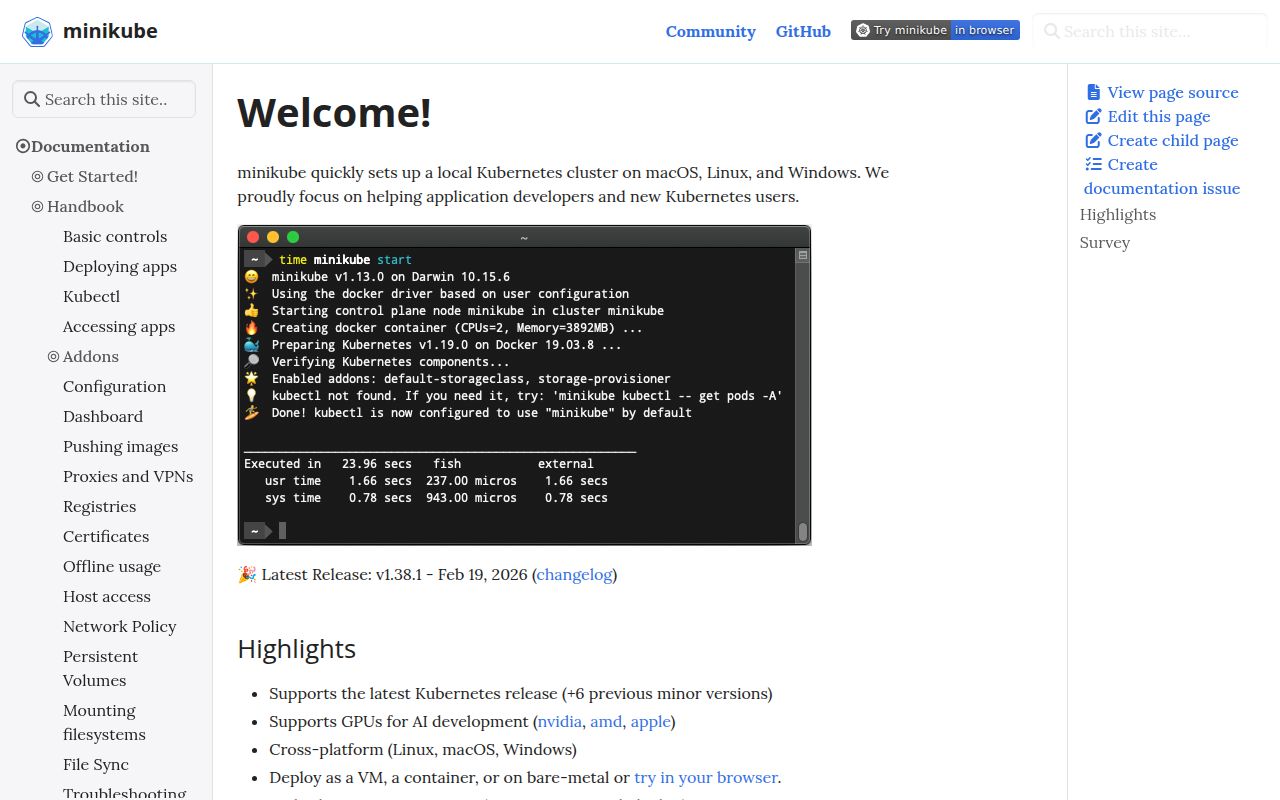
Minikube turns one workstation into a Kubernetes learning and development environment. It supports NodePorts, LoadBalancer access through minikube tunnel, persistent volumes, a dashboard, filesystem mounts, configurable container runtimes, and API server or kubelet flags. Named profiles let a developer keep more than one cluster. GPU tutorials cover NVIDIA and AMD hardware. That range makes Minikube useful when the local environment must resemble more than a basic container scheduler.
It also hides many choices behind minikube start. The selected driver may be Docker, a virtual machine, or another host-specific option. Kubernetes images and supporting components still need to download, networking must reach the cluster, and local services need an exposure method. The result is convenient after the driver works. Driver failures, VPN rules, nested virtualization, or corporate proxies can make the first cluster far less simple than installing one binary.
Local development is the goal, not a small production cluster
The README defines local Kubernetes application development as the primary purpose. Minikube can run several nodes and many standard features, but it remains tied to one host and a developer-oriented lifecycle. It is excellent for checking manifests, trying an addon, learning kubectl, or reproducing a Kubernetes-version problem. It does not supply the failure domains, managed upgrades, backup plan, or operator accountability expected from production infrastructure.
Version 1.38.1, released February 19, 2026, added Kubernetes 1.35.1 support and fixed lock-file, cross-architecture, and Windows connectivity regressions. It also updated many addons and networking components. That six-month-old release tag is not evidence of inactivity: GitHub recorded a last push on August 26, 2026, with current issue discussions about the next container-runtime default, cgroup v2, CI, images, and drivers.
What happened when we ran it
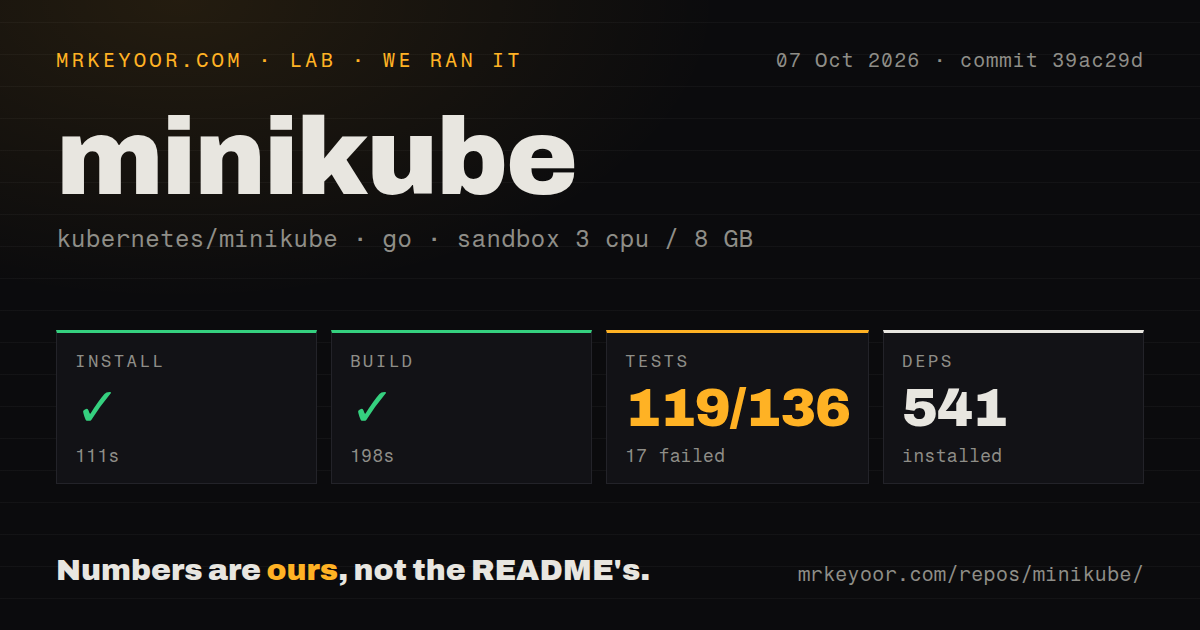
Our Go sandbox installed 529 packages in 61 seconds from a 176.9 MB checkout. commit 89bcdfa contained 2,618 files and around 160,870 source lines. The build succeeded in 160 seconds. The repository has a tests directory and 70 CI workflow files, reflecting the number of operating systems, drivers, Kubernetes versions, architectures, addons, and network paths the project has to cover.
The test command exited 1 after 137 seconds, with 72 passed and 10 failed out of 82. The tail shows the integration package failing and TestStress failing because latest minikube binary is missing, run make. We had already recorded a successful build step, but the log does not say why the expected artifact was absent or which build target would place it correctly. The honest result is that our general build passed while the configured test run did not.
Driver choice determines speed, permissions, and failure modes
A container driver is usually convenient when Docker or Podman is already working. VM drivers add their own hypervisor, kernel, and networking requirements. Issue 19639 reports a current VirtualBox start failure on Ubuntu where a graphics feature is rejected. Issue 19577 says a Docker Desktop command can hang without Minikube's slow-Docker warning appearing. Neither report condemns every installation, but both show that host integration matters as much as the Go binary.
Resource expectations also vary. Issue 22169 reports an Apple Silicon vfkit experiment where --no-kubernetes required 2,400 MB to start, while lower values stalled or panicked. That is one reported configuration rather than a universal minimum. It is still a useful warning for small CI runners and older laptops. Budget memory for the driver, cluster services, application pods, image cache, and local development tools together.
Cached images can penalize non-Docker drivers
Minikube's cache helps avoid repeated image pulls and supports disconnected work. Issue 23349 identifies a poor interaction on vfkit, hyperkit, QEMU, and KVM: each configured image causes checks against a host Docker daemon that may not exist. The report measures 10 to 30 seconds of extra startup time per cached image before fallback. A profile with many images can therefore feel inexplicably slow even when files already exist locally.
The workaround decision depends on the environment. CI may prefer kind, where nodes already run as containers and image loading is part of that model. A developer needing Minikube-specific addons or VM isolation may keep the driver and reduce cached entries. Capture minikube start logs and compare a clean profile before blaming Kubernetes itself. The 160-second source build from our lab says nothing about cluster startup time.
Addons are convenient, with mixed ownership
The addon catalog can enable ingress controllers, dashboards, metrics, registries, storage components, and other common services without copying manifests. Some addons are maintained outside the Minikube team. Issue 23442 shows a third-party Traefik addon failing after 6 minutes while callback processing continued. The command itself warned that Minikube maintainers do not verify that addon. Treat addon enablement as installing another project, with its own version, support channel, and security review.
GitHub showed 32,070 stars and 541 combined open issues and pull requests on August 27, 2026. The number is plausible for a mature tool spanning 3 desktop operating systems and many drivers, and it is not a confirmed-bug count. Minikube remains the sensible default when developers need local Kubernetes breadth. For repeatable container-only CI, kind or k3d often has fewer host variables. Whichever tool wins, pin versions and test the same manifests against a real staging cluster.