6,399 files separate Milvus from an embedded index
Milvus stores vectors beside strings, numbers, and JSON fields, then searches them with metadata filters or hybrid dense and sparse retrieval. The project README names HNSW, IVF, FLAT, SCANN, and DiskANN among its index choices. It also supports BM25 full-text search and learned sparse embeddings. That range is useful when one retrieval system must serve search, recommendations, and retrieval-augmented generation without moving every workload into a different engine.
The same README offers three very different starting points. Milvus Lite persists to a local file through the Python client. Standalone mode puts the server on one machine. The distributed design separates compute and storage and scales query nodes independently from data nodes on Kubernetes. Our checkout contained 6,399 files and about 2,566,348 source lines, so the full repository belongs in the database-infrastructure category even if the first Python example fits on one screen.
What happened when we ran it
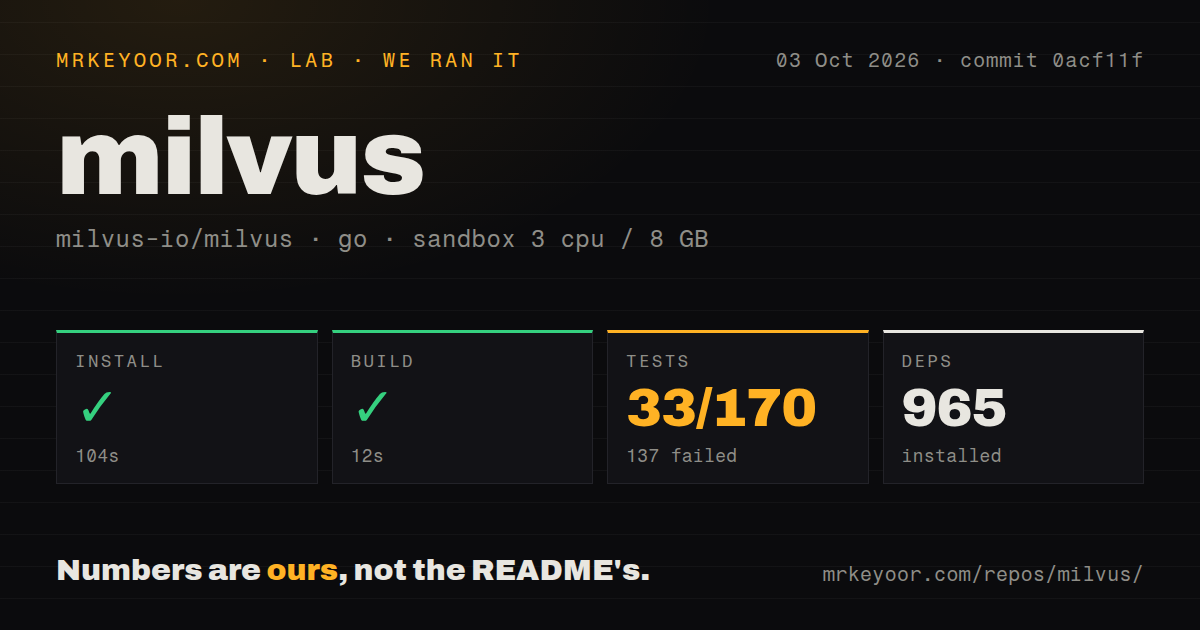
Our sandbox installed commit 0acf11f in 104 seconds and added 965 packages. The checkout occupied 131.2 MB before installation. We used a fresh Debian container with 3 CPUs, 8 GB of RAM, Go 1.24, no secrets, and no elevated privileges. The build completed successfully in 12 seconds. Those results show that the basic dependency and compile path worked on our box. They do not measure query speed, indexing throughput, recall, or cluster behavior.
The complete Go test command failed after 437 seconds. The harness counted 33 passing packages and 137 failed packages out of 170. The end of the log listed integration packages for replica loading, replication, resource groups, roaring matching, rolling upgrades, seal policies, search, snapshots, statistics, targets, and telemetry as build failures. The tail did not include the underlying compiler messages, so we cannot say whether a missing system package, generated artifact, or source defect caused them.
A 12-second build does not make source ownership simple
Milvus documents more than a Go toolchain for source development. Linux builds call for CMake, GCC, and Python alongside Go, with version ranges listed in the README, followed by ./scripts/install_deps.sh and make. Our build passed in 12 seconds, but the repository has no Dockerfile to define one canonical development image. It does contain a compose file and 21 CI workflow files, which is evidence of automation, not proof that a plain container matches the maintainers' build estate.
That distinction matters if your team plans to patch Milvus rather than consume a published image. A 131.2 MB checkout with native components, multiple language tools, and 170 discovered Go test packages needs its own reproducible builder. The failed integration packages cover coordination and lifecycle behavior that a vector search demo never reaches. Before carrying a fork, reproduce the exact CI prerequisites and get the subset you depend on green in your environment. Our log tail alone cannot supply those missing prerequisites.
v3.0.2 shows the cost of distributed storage
The v3.0.2 release, published September 20, 2026, improved filtered search, index building, external collections, and Storage V2. Its fix list is more revealing for buyers: it covers compaction, WAL recovery, query-node assignment, incomplete binlog reads, memory leaks, snapshot restores, and a case where compaction logs printed encryption keys and object-storage credentials. Mature distributed software has long fix lists because many components can fail at their boundaries.
One current report deserves an operator's attention. Issue 51659 describes 55 process panics across 22 Milvus instances during a 48-hour chaos-testing window. The reported triggers include transient S3 errors, a refused coordinator connection, and etcd leader changes. That is an issue report rather than a result from our sandbox, and it covers several 2.6 and master builds. Teams evaluating v3.0.2 should reproduce those failure paths under their own storage and coordination setup.
46,317 stars come with a 1,387-item issue and PR queue
GitHub reported 46,317 stars, 1,387 open issues and pull requests combined, and a last push on October 3, 2026. The repository was active the day before this review, while v3.0.2 had shipped less than three weeks earlier. Those dates support a healthy-maintenance judgment. The large combined queue still means you should search for your storage backend, index type, and upgrade path before choosing a version. Popularity does not make every configuration equally exercised.
The project also documents authentication, TLS, and role-based access control, plus monitoring through Prometheus and Grafana. Its ecosystem includes administration, debugging, migration, and connector tools. With 21 CI workflows in our checkout, this is plainly a maintained platform rather than a thin vector library. That breadth is the reason to choose Milvus, and it is also the reason a trial should include backup, restore, rolling upgrade, object-storage interruption, and overloaded-query behavior.
Milvus fits teams already treating retrieval as infrastructure
Our 104-second install and 12-second build make the source approachable enough to inspect, but the 437-second failed test run blocks an easy recommendation for casual source ownership. Milvus earns a serious evaluation when you need several index families, hybrid retrieval, access controls, and independent scaling of read and write services. If you need a local embedding store for one application, Milvus Lite keeps the API nearby without asking you to adopt the 2,566,348-line server tree.