MicroPython puts Python close to the hardware
MicroPython is an implementation of Python 3.x for constrained hardware, not a package that adds embedded helpers to desktop Python. Its repository contains a compiler, runtime, core library, cross-compiler, ports, tests, documentation, and native extensions. Choosing it means adopting a device runtime and hardware ecosystem, not merely picking friendly syntax for existing firmware.
Compatibility is practical rather than complete. The README says MicroPython implements all Python 3.4 syntax, adds async and await from Python 3.5, and selects later features. Familiar types are present, but modules and datatype behavior are CPython subsets. Programs can run as .py source or .mpy bytecode, stored on-device or frozen into firmware.
Hardware access is the main reason to choose it
MicroPython provides direct interfaces for GPIO, timers, ADC, DAC, PWM, SPI, I2C, CAN, Bluetooth, and USB. Some ports also offer threads, sockets, SSL, and asyncio, but capability depends on the target. The intended experience combines Python as the control surface with close access to the physical system.
The repository includes more than 20 ports across microcontrollers, Unix-like systems, and Windows. Targets can be as small as 256 KiB of flash and 16 KiB of RAM, although 512 KiB of flash and 128 KiB of RAM enable a fuller experience. Unix and Windows ports also support development and testing away from a board.
What happened when we ran it
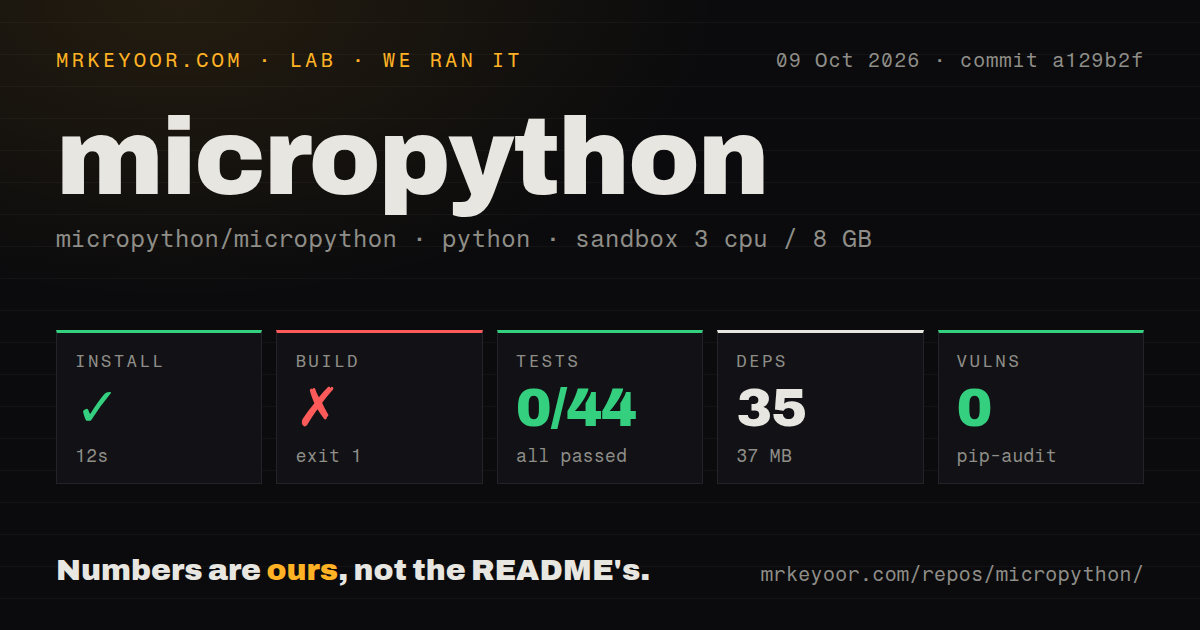
In our fresh Debian container with 3 CPUs and 8 GB of RAM, installation succeeded in 27 seconds: 35 packages consumed 37 MB. The build then exited 1 after 9 seconds. Its captured tail contains SyntaxWarning messages in RISC-V inline-assembly tests, including expressions such as lw(a3, 4(sp)), but no line that conclusively explains the nonzero exit.
The test command exited 3 after 19 seconds, with 0 passed, 0 failed, and 44 collection or setup errors out of 44. The final traceback shows pytest importing tests/multi_espnow/40_recv_test.py, which raised SystemExit. Repeated summaries contain 18 or 14 warnings and 44 errors. This shows generic pytest collection did not work; it does not establish why the build failed.
pip-audit found 0 known vulnerabilities among the installed Python packages. That is useful but narrow evidence, not an audit of the C runtime, firmware, submodules, or board SDKs. The checkout has 28 CI workflow files and a tests directory, but no Dockerfile, so it offers substantial automation without a container recipe that reproduced a build on our box.
The layout supports serious port work
The repository has clear engineering boundaries: py/ contains the compiler and runtime, mpy-cross/ produces bytecode, ports/ separates platforms, and extmod/ contains additional C modules. lib/, tests/, docs/, tools/, and examples/ cover dependencies, validation, guidance, utilities, and starting points. Experienced contributors can work at the correct layer instead of hiding every board difference in applications.
The README defines 3 support tiers, reserving Tier 1 for ports with the strongest development, support, and testing. That is more honest than treating every target equally. It also signals fragmentation: toolchains, commands, modules, memory limits, and peripherals vary. A Unix build cannot prove readiness for ESP32, RP2, STM32, or another board, so evaluation must start with the exact port.
Setup is port-specific, not one-command Python
Repository-level prerequisites are make, bash, gcc, and Python 3.3 or newer, with CMake additionally needed for ESP32 and RP2. Our failed generic run shows why linked documentation and port directories are part of setup. Select hardware first, follow its toolchain, build that port, and use the intended test harness rather than assuming ordinary pytest discovery measures project health.
GitHub reports 1,532 open issues, a large triage surface even with 22,040 stars. The supplied metadata lists the license as NOASSERTION, while the README identifies MIT; compliance-sensitive teams should inspect license files and bundled dependencies. Compatibility also remains intentionally partial, so validate every imported dependency rather than relying on the broad expectation that many Python scripts run unchanged.
Maintenance is current, while cadence remains unknown
Release v1.29.0 arrived on August 24, 2026, and the last push was September 3, 2026, one day before this review. Together with 28 CI workflows, those dates show current development. One supplied release date cannot prove a long-term cadence, and the open-issue total cannot reveal response time, closure rate, or maintainer capacity.
The project routes discussion to GitHub Discussions and Discord, and sends bugs through issue templates. It publishes API and implementation documentation plus contributor conventions. That separation gives users sensible support channels without automatically adding every question to the 1,532 open issues, though teams should still inspect discussions around their chosen port.
It belongs at the firmware layer
MicroPython sits on the device, below application logic and above board hardware or an operating-system port. Teams can freeze stable modules into firmware, deploy .mpy files, and leave selected .py code editable. Fleet provisioning, secure keys, telemetry, host services, and update policy remain separate decisions; this repository does not claim to be a complete device-management platform.
Choose MicroPython when Python productivity, interactive iteration, and supported peripheral APIs matter more than full CPython parity. Favor the 512 KiB flash and 128 KiB RAM guidance where practical, confirm the target's support tier, and prove its firmware build in CI. If deterministic RTOS behavior or a Go or JavaScript codebase dominates, compare Zephyr, TinyGo, Espruino, or CircuitPython first.