The repository and the product have split
LocalStack's job is easy to value. It gives AWS applications local endpoints for services such as S3, Lambda, DynamoDB, SQS, SNS, Kinesis, and CloudFormation. A developer can run infrastructure code or integration tests against a container instead of creating remote resources for every edit. CI jobs gain faster setup and can avoid many cloud credentials and usage charges during ordinary test runs.
The repository now carries a prominent warning: it is archived and read-only. LocalStack says development has been consolidated into a single unified image. The README directs users to LocalStack for AWS, including a free Hobby plan for non-commercial use, and moves bug reports and feature requests to organization discussions. That makes this codebase historical source, not the upstream a new adopter will follow.
This distinction should drive the decision. The LocalStack product can still be an effective development dependency. Forking this repository means owning an AWS emulator frozen after its March 23, 2026 push, with no open issue queue because GitHub archival closed that workflow. Most teams should evaluate the current image and commercial terms instead of treating this repository's Apache license as the whole ongoing offer.
What happened when we ran it
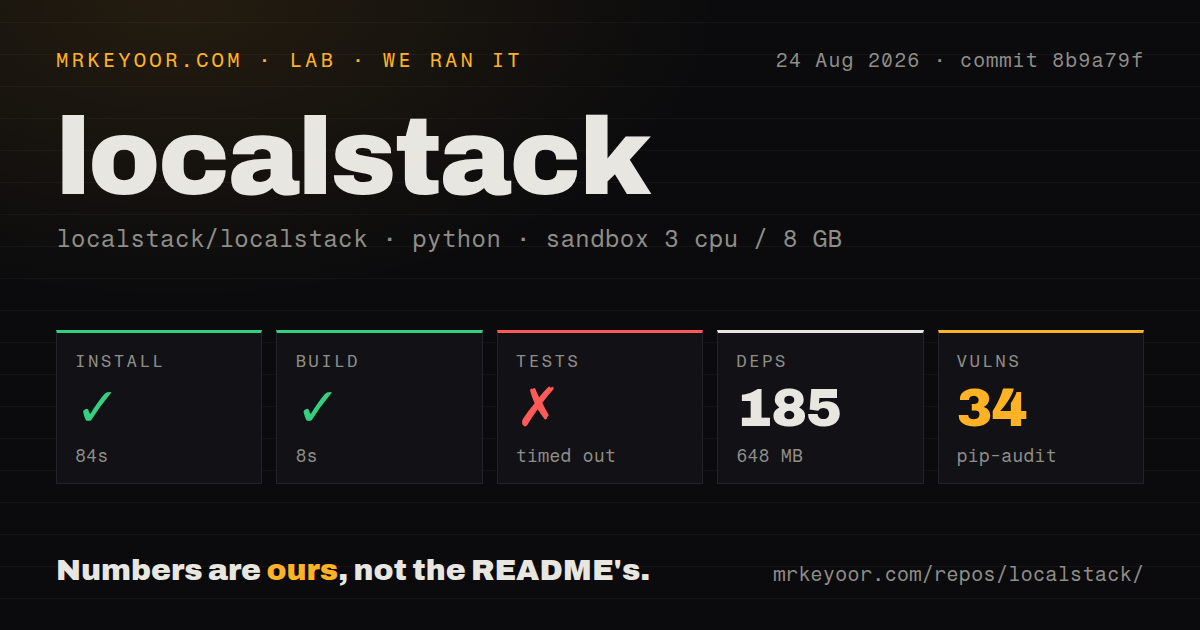
We cloned commit 8b9a79f into a fresh unprivileged Debian container with three CPUs and 8 GB of RAM, using the stated Python 3.12 Bookworm lab image. The checkout held 3,730 files, about 542,339 lines of source, occupied 42.7 MB, and included 27 CI workflow files, a Dockerfile, a Compose file, and a tests directory.
Installation succeeded in 84 seconds. It installed 185 packages and used 648 MB. The build then succeeded in 8 seconds. pip-audit reported 34 known vulnerabilities in the installed environment. That number is a dependency audit result from this exact snapshot, not a count of exploitable LocalStack flaws. It is still a reason to inspect package names, affected versions, and runtime reachability before using the archived source.
The tests did not complete within the 900-second limit. The final log shows a Twisted runtime inside its main loop and epoll polling, then the timeout marker followed by F..................FFFFFF. The excerpt does not identify the individual tests or explain whether they were already failing when time expired. We can say the suite timed out and displayed failures; we cannot responsibly name a root cause from that tail.
Container setup is short; faithful tests take work
The recommended start uses the LocalStack CLI to launch a Docker container. Homebrew, a standalone CLI binary, and pip are offered as ways to install that controller. awslocal is separate and provides an AWS CLI configured for the local endpoints. Docker access is mandatory in the current model: release 4.14 removed the host option and says the CLI runs LocalStack only inside a container.
Getting a green health check is only the beginning. Applications must point SDKs and infrastructure tools to LocalStack's endpoints, use a consistent region and test credentials, expose Docker to CI, and configure any Lambda execution or nested containers. Tests that preserve data need volumes and lifecycle rules so one job does not contaminate another. Teams should decide whether each suite starts clean or intentionally restores a known state.
Version 4.14 makes that last choice urgent. Its release notes say Cloud Pods, snapshots, and PERSISTENCE=1 state created before 4.14 are incompatible and must be recreated. Pinning an image protects a CI run from surprise changes, while an explicit upgrade job can rebuild fixtures and run representative infrastructure plans before the new tag becomes standard.
Emulation is a test layer, not proof of AWS parity
LocalStack publishes service and API coverage because implementations differ by feature and plan. Release 4.14 added or improved details across tagging, S3 conditional copy, CloudFormation policies, Step Functions, Route 53, ECS, ElastiCache, RDS, EKS, and MSK. Several additions are marked Base or Ultimate. Those labels matter when a test depends on one specific API rather than the broad service name.
A good test strategy uses LocalStack for fast feedback and retains a smaller set of checks against AWS. Authentication edges, IAM evaluation, networking, managed-service limits, eventual behavior, and newly released APIs can diverge. The local emulator is most valuable when it catches application wiring and infrastructure mistakes early, while cloud tests confirm the behavior that only AWS can own.
The licensing story also needs two readings. The archived code says Apache 2.0, while its EULA says use is conditioned on accepting additional terms and describes automatic communications for updates, error reports, and anonymized usage data. The new unified offering has its own plan boundaries. Legal and security reviewers should inspect the artifact actually being deployed rather than relying on the repository badge.
What to use instead, and when
Release 4.14 shipped on February 26, 2026, shortly before the final repository push. Its detailed changes show active engineering before consolidation, but the archived status means push date and zero open issues cannot be used as ordinary community-health signals. Current product support now lives outside this issue tracker.
Moto is a better fit when a Python suite wants mocked AWS calls without operating a large local cloud container. AWS SAM CLI is narrower and useful for teams centered on Lambda, API Gateway, and SAM templates. LocalStack's unified image remains the broader option when several AWS services must interact in one local environment. Choose it only after mapping required APIs to the current coverage and plan, and keep AWS contract tests for the behavior that matters most.