LobeHub is an agent workspace, not another chat skin
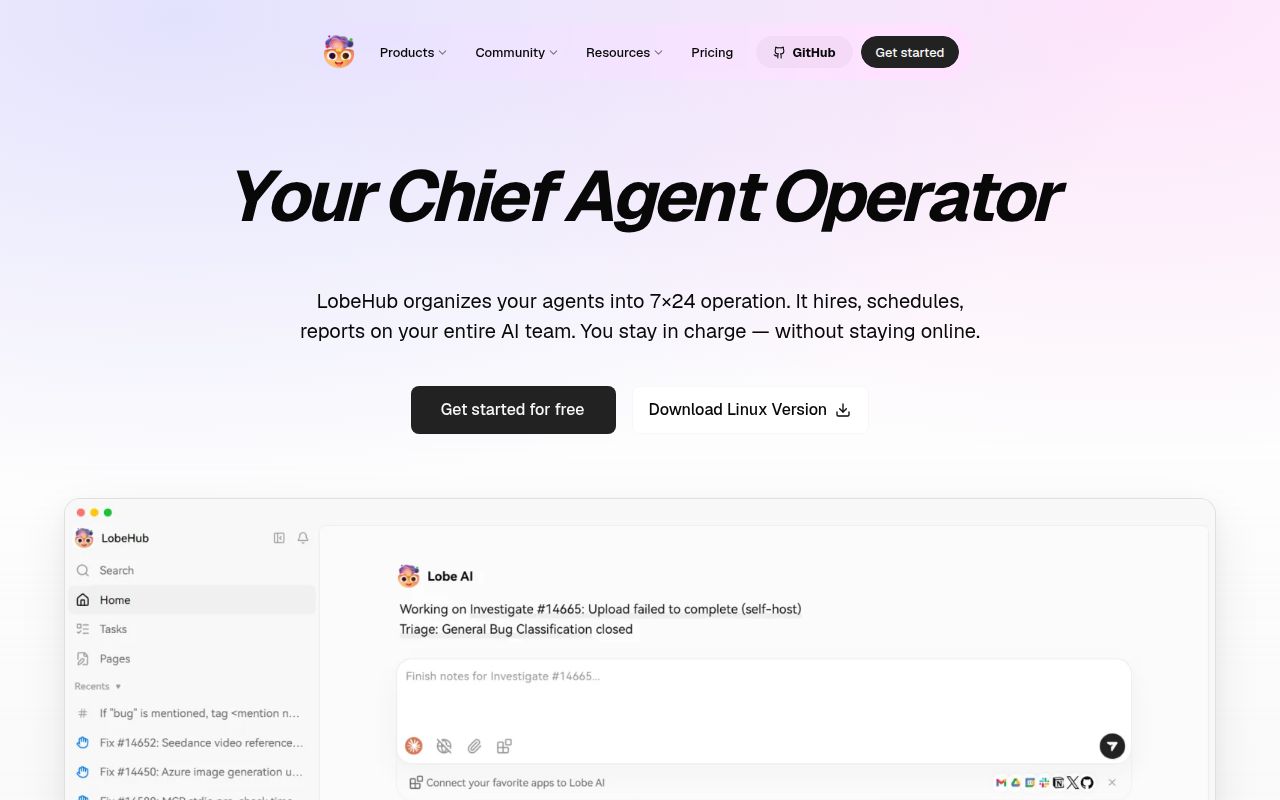
LobeHub treats an agent as a unit of work. You can create agents, organize them into groups, give them projects and goals, schedule tasks, and let them use shared pages or resources. The product also connects to model providers, tools, MCP-compatible plugins, messaging gateways, and local coding agents. That scope puts it closer to an operating console for an AI team than a prettier prompt box.
The current repository is also much broader than the old lobe-chat name suggests. Release v2.2.14 added seven CLI coding-agent runtimes, a local sandbox, scoped API keys, and a generated SDK. Projects and Goals arrived as alpha features in the same release. Anyone evaluating an older tutorial should check the current LobeHub documentation, because both the name and the product boundary have moved.
Projects and schedules justify the extra machinery
The strongest reason to choose LobeHub is persistent work. A normal chat client stores conversations; LobeHub adds projects, team workspaces, scheduled runs, group agents, and structured memory that users can inspect and edit. Messaging gateways let an agent meet users where they already communicate. Those parts can reduce the handoffs between a browser chat, a task scheduler, a coding terminal, and a separate knowledge tool.
That convenience comes with a large application surface. Our commit contained about 2,097,297 lines across 15,260 files, and the checkout occupied 198.4 MB. LobeHub is not a thin wrapper that one developer will fully understand in an afternoon. The repository has server code, web and desktop clients, databases, provider adapters, agent runtimes, public APIs, plugins, and deployment machinery. Custom work needs ownership boundaries and careful upgrades.
Model choice is broad, but somebody still owns every credential
The README starts with an OpenAI API key because agents need a model behind them. LobeHub can present several providers and model types through one interface, yet self-hosting the interface does not self-host those models. Operators must decide where requests go, who pays, how keys are stored, and which providers are allowed for each workspace. Local runtimes and the Local Sandbox add another trust boundary because agent work can touch a real working directory.
Release v2.2.14 added scoped API keys and expanded API endpoints for evaluations, MCP servers, usage, and other platform functions. That is useful for integration, but it means a serious deployment needs an access policy, not a shared administrator token. The release also says restricted knowledge bases are hidden from members and provider base URLs are validated. Those controls are encouraging signs, while the 805 open issues and pull requests show how much behavior is still being discussed or changed.
What happened when we ran it
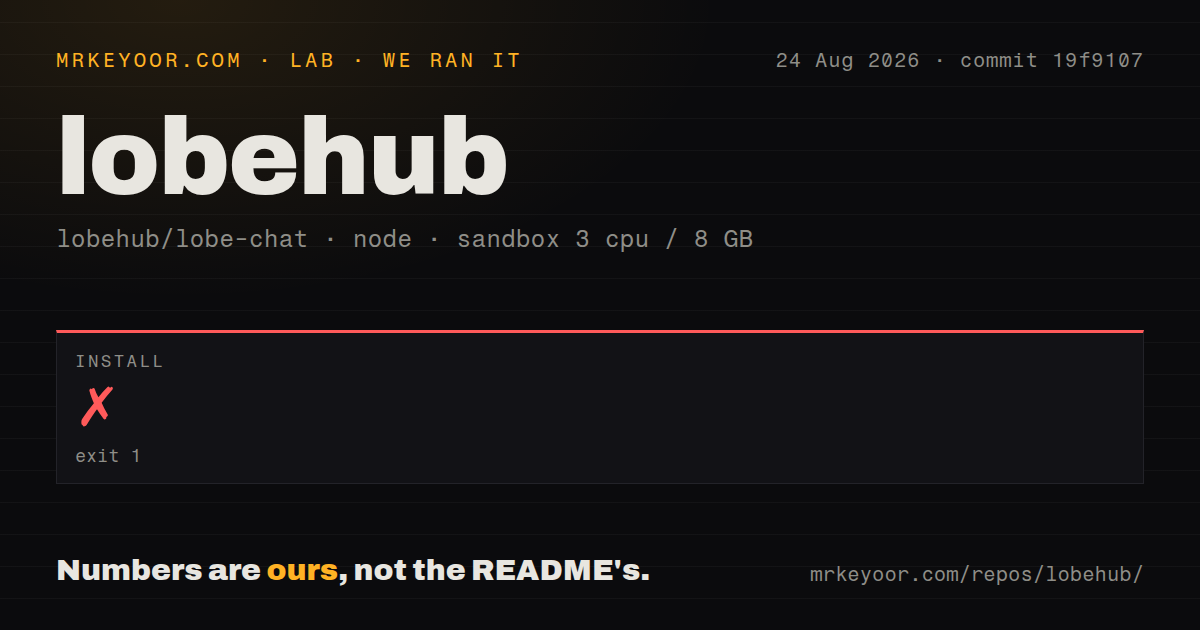
Our sandbox cloned commit 19f9107 into an unprivileged Node environment with 3 CPUs, 8 GB of RAM, and no secrets. The repository had 36 CI workflow files, a Dockerfile, a tests directory, and monorepo workspaces. npm spent 303 seconds on installation before exiting with code 1. Its final useful message was Unsupported URL Type "workspace:", pointing at workspace:* dependencies.
The log does not prove that LobeHub itself is broken. It proves that the npm route used by our harness did not match what this monorepo expects. The README tells contributors to run pnpm install and pnpm dev. Because installation failed, our run never reached a build or test command, and we have no measured build result or test count for this commit. Switching package managers may address the logged protocol error, but we did not rerun the job outside the supplied measurement.
The failure is still useful purchasing information. A project that depends on workspace-aware monorepo tooling needs its documented toolchain followed exactly. It also means a source install is the wrong first trial for many evaluators. The Docker Compose flow or a hosted deployment can answer the product question sooner, while a pnpm checkout is appropriate when a team has decided it needs to modify the code.
Release activity is high, and stability is a moving target
GitHub recorded a push on August 25, 2026, one day after our measured checkout, and the latest tagged release was v2.2.14 from August 16. Its notes credit 21 contributors and 363 merged pull requests since v2.2.13. Current pull requests address stuck topic operations, cache behavior, gateway connections, and desktop updates. This is plainly maintained software, but its pace raises the cost of carrying patches or skipping upgrades.
The release notes are unusually useful for a project moving this quickly. They name alpha features, security work, architectural changes, and runtime additions rather than hiding everything behind a short changelog. The main README is weaker as an operator's manual: its promise of self-hosting in a few minutes sits far above the database, identity, storage, provider, and security decisions documented elsewhere. Follow the linked deployment guide, not the landing-page summary.
Choose the packaged product before choosing the codebase
LobeHub makes sense for a team that already feels the cost of scattered agents. Group work, schedules, editable memory, messaging, and several coding runtimes give it a reason to exist beyond model switching. The UI and deployment options also make it more approachable than assembling those parts from separate frameworks.
Source-level adoption is a heavier call. Our 303-second install failure stopped before build and tests, and the 2-million-line checkout makes local forks expensive to maintain. Run the packaged edition against one real workflow, confirm how credentials and local execution are isolated, then decide whether extension points cover the job. Teams that mainly need shared chat should choose a narrower alternative and keep the operational surface smaller.