
The output is a folder of Markdown, not a hidden index
LLM Wiki turns source material into a persistent set of Markdown pages with YAML metadata, [[wikilinks]], summaries, and references back to the imported files. The app keeps raw sources separate from generated pages and maintains an index.md, log.md, and overview.md. That structure matters: the result can open as an Obsidian vault, and you can inspect what the model wrote without depending on the desktop interface.
Ingest uses 2 model calls, first for analysis and then for page generation. It accepts PDFs, office documents, EPUB and MOBI books, Markdown, media, images, and web clips. A SHA256 cache skips unchanged sources, while a persistent queue retries failed jobs and survives restarts. The attractive part is the source trail on generated pages. The uncomfortable part is that a model is still deciding how to split, name, and connect your knowledge, so review is part of the job.
Search combines text, vectors, and a 4-signal graph
The default retrieval path searches words and expands through a graph built from direct links, shared sources, common neighbors, and matching page types. Optional LanceDB embeddings add semantic matches through an OpenAI-compatible endpoint. LLM Wiki then fits selected pages, chat history, and system material into a configurable context budget from 4K to 1M tokens. Read Sources Only mode is available when answers must stay with imported evidence.
The graph is useful for browsing a modest collection, but issue 714 gives a hard reason to test your own scale. On a project with 4,359 Markdown files, the reporter found the API stopped at 1,000 nodes, ignored the offset, missed links written with paths, and took about 24 seconds per request before later calls stalled. That report concerns v0.6.11 and the graph API, not every ingest operation, but it rules out assuming that a large vault will behave like the screenshots.
What happened when we ran it
Our sandbox installed 862 npm packages in 21 seconds and used 621 MB on disk. The build completed successfully in 14 seconds. The checkout itself contained 465 files, about 129,347 lines of source, and occupied 48.9 MB before dependencies. We found 2 CI workflow files, no Dockerfile, and no top-level tests directory. Those inventory signals describe commit e808211, not the latest binary release.
The test command exited 1 after 36 seconds. Its output is internally split: one Vitest summary says 132 files passed and 1,876 tests passed, with 0 failures in that group. The tail then prints Failed Tests 6 and a separate summary of 2 failed files, 6 failed tests, 3 passes, and 71 skips across 10 files. The tail names queue restoration messages but does not show enough error detail to assign a cause. Npm audit reported 16 known vulnerabilities: 9 high, 5 moderate, and 2 low.
A working desktop build needs more than npm
Prebuilt packages are the sensible first trial. Release v0.6.11 includes Windows installers and portable files, Linux packages for x86_64 and ARM, and an Apple Silicon DMG. The README says macOS binaries cover Apple Silicon and Intel, yet the v0.6.11 asset list has no Intel DMG. Issue 713 asks about the same gap. Intel Mac owners should verify a compatible artifact before investing time in a project.
A source build needs Node.js 20 or newer, Rust 1.88 or newer, and protoc. The documented sequence also installs and builds the MCP server because Tauri bundles its output as a resource. Once the app starts, you still need an LLM provider, API key, and model. Semantic search adds an embedding endpoint. Deep Research adds Tavily, SerpApi, or a SearXNG instance, and MinerU is optional for complex PDF layouts. Local models can reduce external data exposure, but they shift model setup and hardware costs to you.
Agent access is useful, with one current Codex fault
The app exposes a token-capable API on 127.0.0.1:19828 for project listing, file reads, review items, search, chat, graphs, rescans, and embeddings. Its bundled MCP server calls that API, and a separate skill connects Claude Code or Codex to the running desktop app. This is a practical route for asking an agent about your wiki while preserving page-path citations. The loopback bind also makes the default integration local to the machine.
Issue 703 documents a v0.6.11 Codex CLI regression on Windows. Connection and function tests passed in the report, yet a normal chat with no retrieved wiki references returned a backend-model configuration error before Codex CLI generated anything. The issue is open and was updated on August 30, 2026. If CLI-based chat is central to your setup, reproduce that exact no-reference case before importing a large collection.
Active maintenance does not settle the product fit
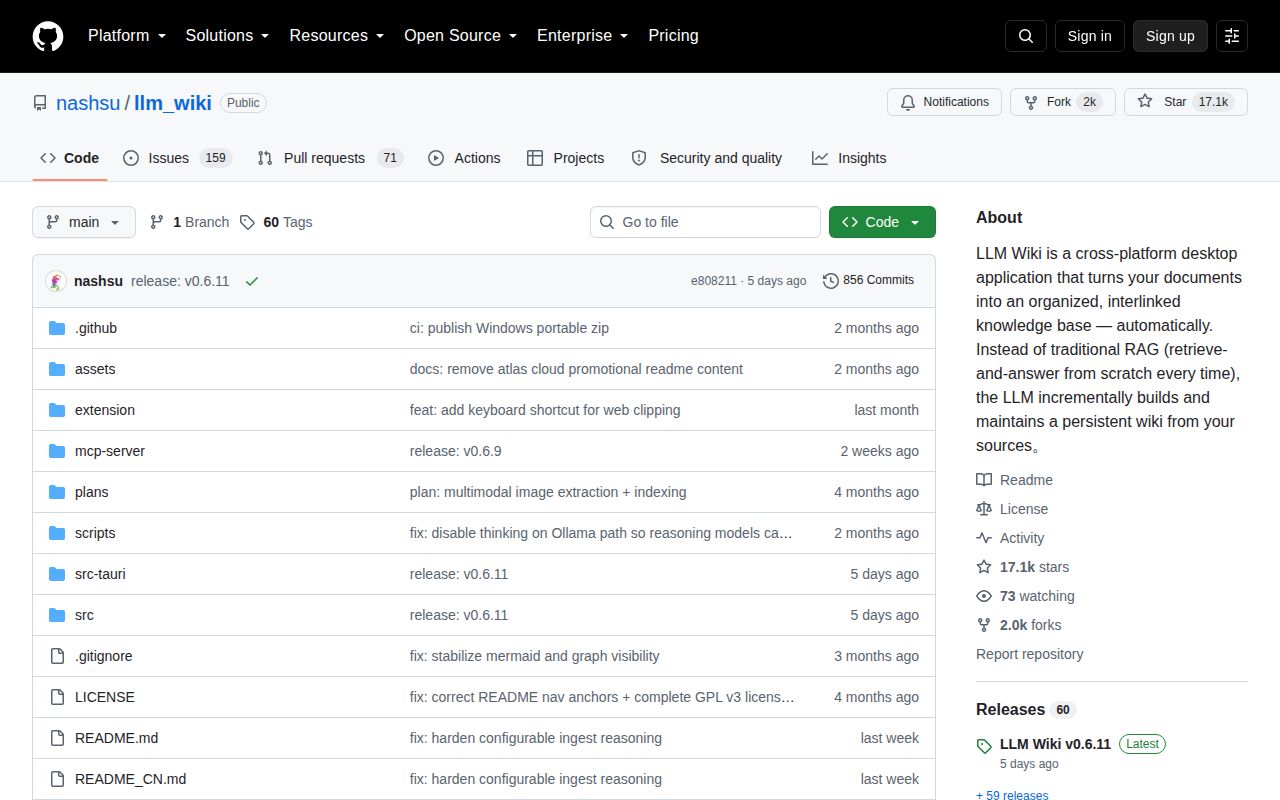
GitHub recorded 17,110 stars, 230 combined issues and pull requests, and a last push on August 25, 2026. Release v0.6.11 followed the same day, while issue discussion continued through August 30. This is active work with a large user queue. The GPL-3.0 license stated in the README also matters to organizations distributing modified builds.
LLM Wiki earns a trial when the desired artifact is a readable, linked knowledge folder and the source trail matters more than one-shot document chat. The 14-second successful build lowers the cost of checking the code, while the failed test command, 16 audit findings, large-graph report, and current CLI bug argue for a small pilot. Import a representative folder, inspect the generated pages, test retrieval misses, and measure graph behavior before making it your only copy of research work.