The Linux runner exposes an unfinished file-loading option
Pass files through the Linux runner's --insert-file option and, at commit 97001fd, the code reaches an unimplemented! branch. The option requires an unstable flag. Read the runner source before relying on this execution path. I'd approach LiteBox as systems code to investigate before depending on it.
Our checkout had 346 files and roughly 110,826 source lines in 15.8 MB. LiteBox divides work between application-facing shims and host-facing platform implementations. Its Rust API requires a platform provider before exposing operating-system operations. Adoption starts with choosing the shim and platform your application needs.
What happened when we ran it
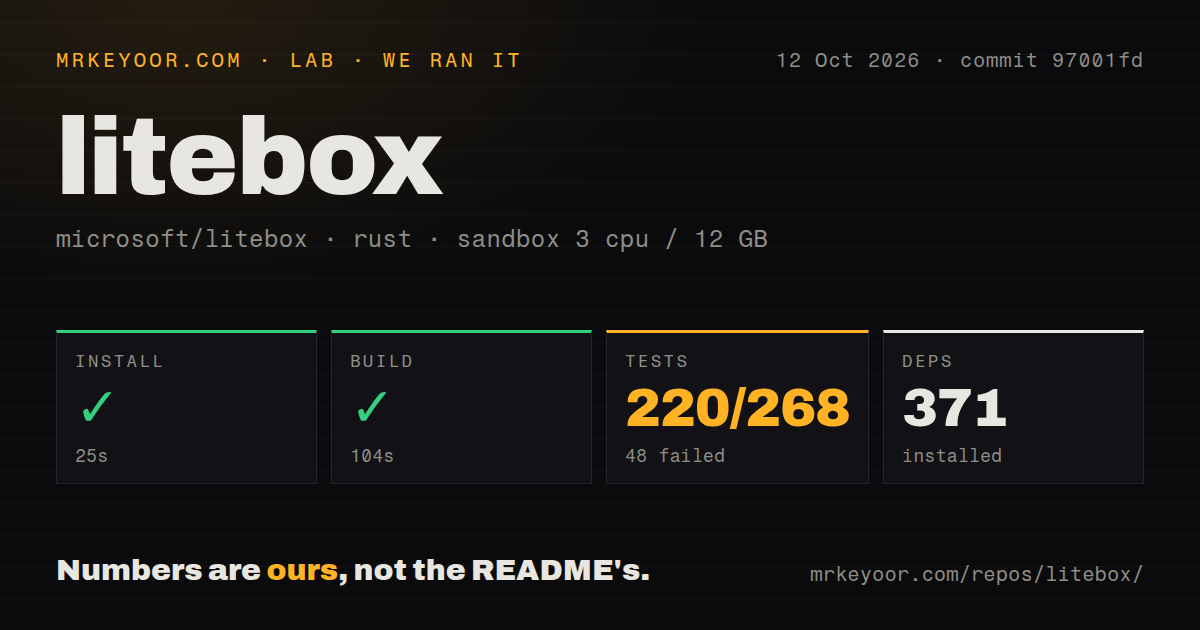
Our LiteBox run installed 371 packages in 25 seconds and built successfully in 104 seconds. We cloned commit 97001fd on October 12, 2026, into a fresh Debian container with 3 CPUs and 12 GB of RAM, using image lab-rust:1. The sandbox was unprivileged and held no secrets. Dependency setup and compilation succeeded under those conditions.
Cargo test failed with exit 101 after 42 seconds. The supplied overall tally was 220 passed and 48 failed out of 268 tests. A successful build therefore did not give us a passing suite. That distinction matters for a project meant to sit between an application and its host: I'd investigate which failures affect the intended execution path.
The log tail names filesystem cases under fs::nine_p::tests, including large reads and writes, directory creation, seeking, truncation, and removal. It also prints a package-level result of 106 passed and 24 failed, followed by a rerun instruction for -p litebox --lib. That package result is distinct from the supplied overall tally. The visible names locate some failing cases without establishing the cause of each failure.
The 42-second failure log excerpt contains no underlying assertion or exception explaining those cases. It doesn't establish a missing system package, permission problem, or filesystem defect. We can report that the suite failed in our sandbox and that filesystem cases appear in the tail. Diagnosing why requires fuller logs. The cause remains unresolved.
Linux networking can require privileged host preparation
The Linux userland platform README requires access to an initialized TUN device, a virtual network interface. Its setup helper exits unless run as root. That's a practical constraint for developers limited to ordinary containers or locked-down workstations. Arrange device access before expecting guest networking.
Our 3-CPU, 12 GB container result covers compilation and the reported suite. It doesn't establish usable guest networking. The runner also exposes environment forwarding and an initial filesystem tar archive, with several options marked unstable. Those are choices about what the guest receives. The repository doesn't require a hosted inference service or API credential for this local path, but you still need to supply the program and its intended environment.
Changing APIs and limited support weaken the production case
The main README explicitly warns that APIs and interfaces may change, advising users who need long-term stability to wait or adapt. The v0.1.0 release, published October 7, 2026, is described as the initial release. Its short notes provide little migration guidance. The support policy limits assistance to the listed GitHub resources, so Microsoft's ownership doesn't supply a separate operational support commitment.
Our scan found 4 CI workflow files, no Dockerfile, and no dedicated tests directory. Cargo still exercised tests, so that directory signal doesn't mean the project lacks coverage. More consequentially, our complete run returned failures. For a team adopting LiteBox internally, I'd budget for reading crate-level instructions and runner code, pinning a commit, and investigating updates before rolling them into an isolation boundary.
An open epoll report deserves attention from server developers
Issue 1443 concerns the Linux shim's epoll implementation, which lets programs wait for file or socket activity. The report says closing a target leaves its interest entry in memory until explicitly removed or the epoll instance closes. For servers that rely on Linux automatically clearing those entries, the author describes an interest map that can keep growing. The issue remained open when checked.
Our 48 failed tests don't prove that epoll report, and the supplied tail doesn't connect the failures to it. It's separate compatibility evidence worth checking against your workload. A short command finishing successfully wouldn't answer the long-running server concern. If your application repeatedly opens and closes sockets, include that lifecycle in evaluation before treating Linux compatibility as sufficient for unattended operation.
gVisor and Gramine offer more specific adoption paths
gVisor supplies the OCI runtime runsc and integrates with Docker and Kubernetes. I'd compare it first for existing container workloads. Gramine targets unmodified Linux applications and Intel SGX on Linux. It's the closer comparison when an application library OS or SGX environment is the actual requirement. Neither alternative's README establishes how your application will behave, but both give the choice a clearer workload focus.
Bubblewrap constructs Linux sandboxes using namespaces and caller-selected filesystem access. Choose it for that narrower job if you can define the policy yourself. LiteBox's 371-package install is manageable evidence for a contributor trial, but package count doesn't compare isolation strength. Pick the mechanism around the host access you need to restrict, then verify the particular application path.
October development is active, while adoption still needs investigation
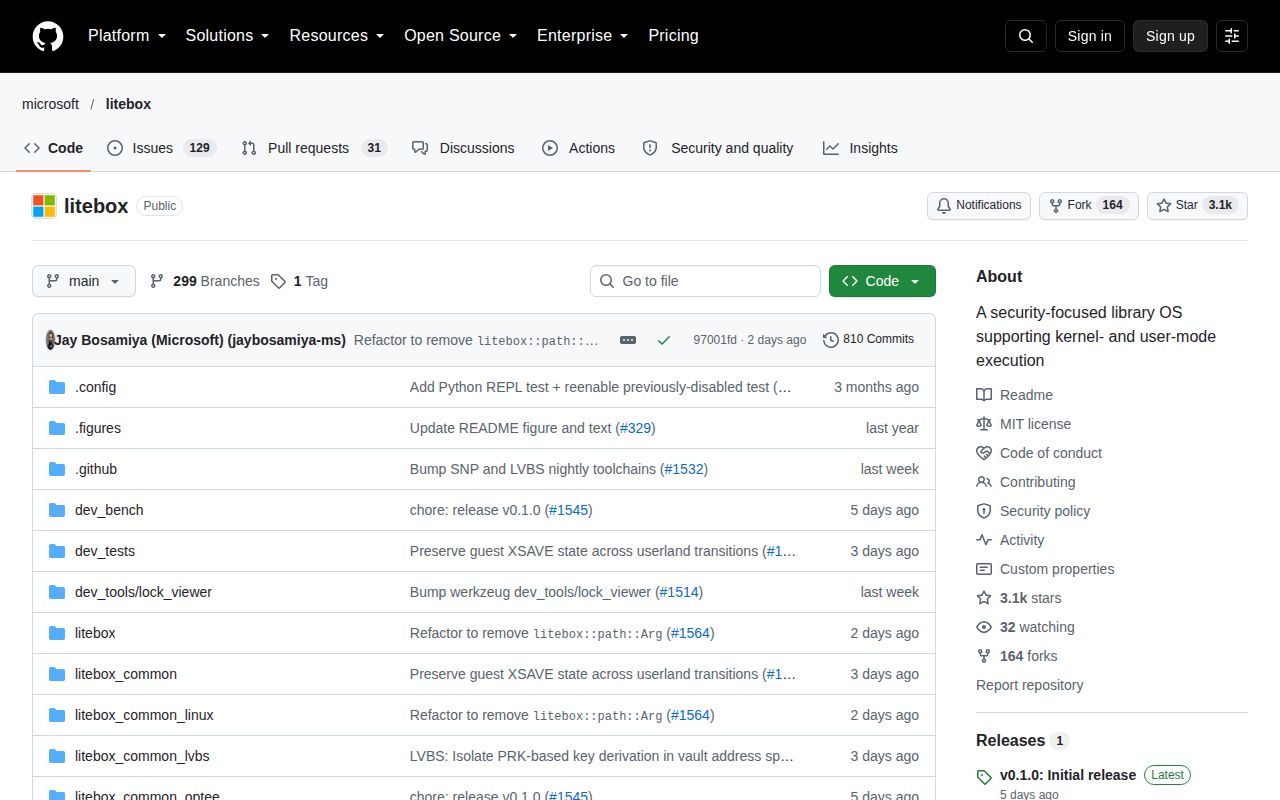
GitHub recorded a push on October 12, 2026, with 3,116 stars and 160 open issues and PRs. Recent pull requests addressed guest-thread initialization and symlink handling, while issue activity included the epoll report. The dates show ongoing work. Open proposals don't establish shipped fixes or equivalent behavior across platforms.
I'd keep LiteBox in a systems engineer's evaluation workspace today. Our 220 passing tests justify further investigation, while 48 failures and an unfinished file-loading path leave work before production adoption. Choose one runner, pin the commit, and reproduce the failures with full logs before adding your workload. If you can't explain the failures that touch that path, you don't yet have enough evidence to rely on it.