Streaming context makes long camera sequences the reason to try it
A camera that keeps moving needs its reconstructed scene to stay coherent as new images arrive. LingBot-Map addresses that problem with a model that carries geometric context through a sequence. Its anchor context establishes coordinates, a pose-reference window supports local camera estimates, and trajectory memory helps correct drift over longer stretches. For a robotics engineer, the attraction is a reconstruction method built around incoming frames.
Our checkout contained 1,028 files and about 37,316 source lines, occupying 234.3 MB before installation. That is substantial enough to deserve a scoped evaluation. Start with a recorded route where you know what the camera did, rather than putting the model immediately into a control loop. A convincing point cloud still needs a comparison against the geometry and movement your application depends on.
What happened when we ran it
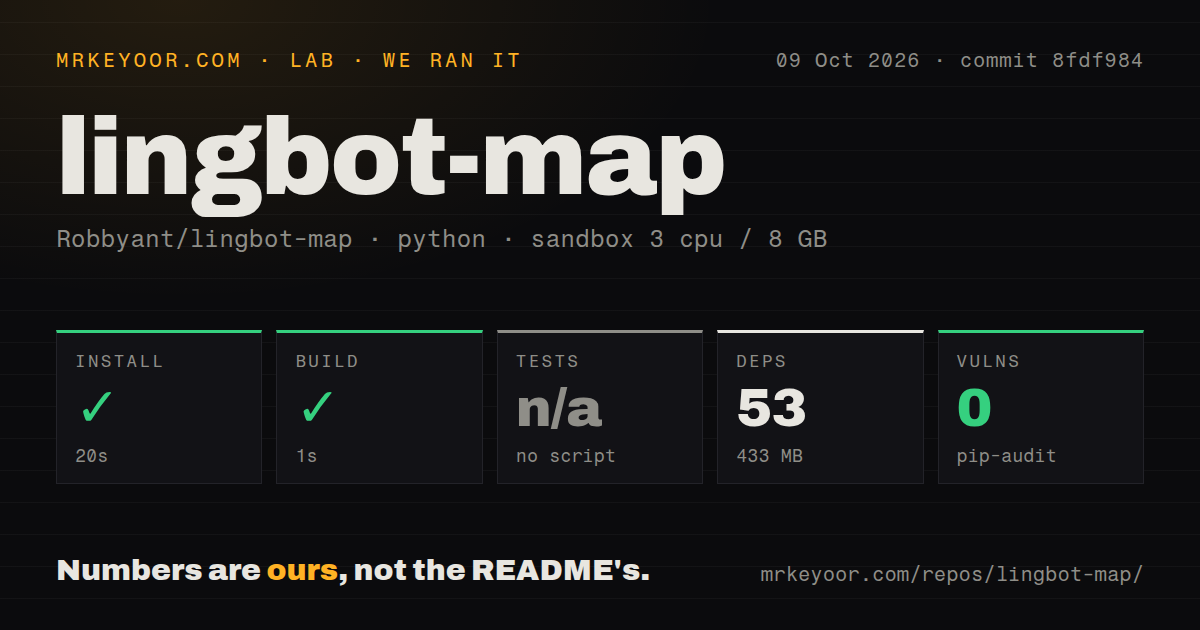
Our sandbox installed LingBot-Map commit 8fdf984 in 20 seconds and built it in 1 second on October 9, 2026. Installation added 53 packages and occupied 433 MB on disk. The unprivileged Debian container used the uv Python 3.12 image, had 3 CPUs and 8 GB of RAM, and held no secrets. Those package and build steps succeeded.
Tests were skipped because our run found no test script or target. The checkout also had no tests directory, no Dockerfile, and 0 CI workflow files. Pip-audit reported 0 known vulnerabilities. A clean dependency audit cannot establish that camera estimates are accurate, and the missing test target leaves no suite result to support that claim. The lab summary contains no reconstruction-quality or inference-speed measurement.
The package result leaves CUDA inference unproven
The 433 MB installed environment is useful evidence about our package path, but the README describes a longer route to a working reconstruction. You need the model checkpoint, input images, and the GPU software stack. FlashInfer supplies attention kernels, while PyTorch's native attention is the documented fallback. FlashInfer can compile CUDA kernels on first use, so finishing the package step leaves runtime work ahead.
The GPU setup and demo instructions also separate the basic package from visualization extras. Download the checkpoint before relying on local operation and account for optional sky-segmentation assets. The viewer runs in a browser served by the local process. That is convenient for examining a capture, but it does not give you an application integration or prove that predictions suit your downstream coordinate system.
Windowed mode is the documented response to pose collapse
The README explicitly warns that inference distance is bounded by the training data's range. When a sequence travels beyond it, state resetting can become necessary. The suggested response to pose collapse is windowed inference. Keyframe selection reduces stored context while other frames still receive predictions, so cache policy is part of the reconstruction configuration you must choose.
Our 8 GB sandbox memory allocation tells you nothing about GPU memory requirements for that choice. Evaluate an actual long route, including revisited places and transitions between windows. Inspect camera motion as well as the final point cloud. If your application assumes one stable reference frame across an unrestricted journey, the documented range warning is a reason to pause adoption until that specific behavior has been checked.
Offline rendering adds another hardware-sensitive toolchain
The batch renderer needs Kaolin, ffmpeg, and locally compiled CUDA extensions in addition to the inference stack. Its output is a headless point-cloud flythrough video. This path is useful when an interactive viewer cannot comfortably handle a long sequence, but its dependencies deserve their own environment. The README explains that the recommended PyTorch build matches available Kaolin wheels.
Our 1-second build result does not establish that those optional CUDA extensions compile or that the renderer completes. Treat the interactive demo and batch output as separate acceptance checks. Sky masking also uses different model assets in the root demo and offline pipeline. Pin each downloaded asset and keep its path explicit, especially when running jobs from different working directories. That makes a failed download or wrong model file easier to identify.
October activity includes unresolved viewer and batch fixes
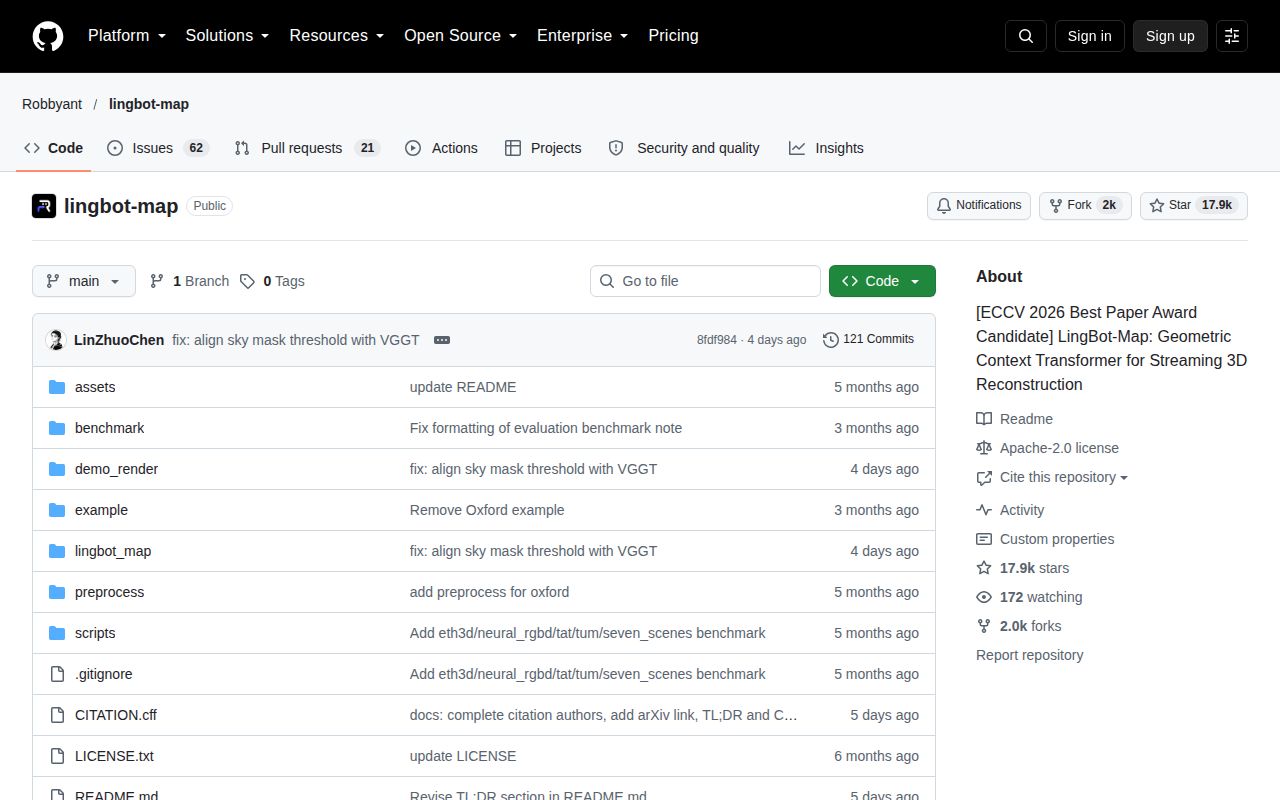
The repository's last push was October 6, 2026, and recent discussion remained active on October 10. GitHub listed 17,881 stars and 83 open issues and PRs combined. The latest-release endpoint returned no release. These facts support current development activity, while the missing release tag alone says little about readiness. Apache-2.0 licensing gives the code a clear reuse basis.
Pull request 104 reports unnecessary GPU storage of input frames and a viewer corruption problem after camera-handle regeneration. It remained open when checked. Pull request 116 addresses prediction-only batch jobs repeating inference despite the skip-existing option. These are contributor reports about the actual demo and batch paths, not failures from our sandbox. Check their disposition before depending on either workflow.
Choose the reconstruction workflow before choosing the model
VGGT is the closer comparison for learned camera and scene geometry from image sets. COLMAP suits conventional offline structure-from-motion and multi-view stereo. Choose between them by how your images arrive and what output your next stage requires. LingBot-Map earns attention when retaining context through a moving-camera sequence is central to the job.
The 20-second install removes one small obstacle to evaluating it. The deciding experiment is a known route on the hardware you intend to use, with camera estimates checked against a reference and saved output inspected across window boundaries. Keep that capture as an acceptance fixture. If a dependency or checkpoint change breaks its geometry, you need to discover that before the next live journey.