Lance keeps vectors and source data in one table
Lance is for datasets where an embedding is only one part of the record. A row can carry text, an image, audio, video, or features beside the vector used to retrieve it. The same table supports vector similarity, BM25 full-text search, SQL predicates, and secondary indexes. That removes the synchronization job created when a lakehouse stores the source while a separate vector database stores a partial copy.
The repository contains a file format, a table format, and a catalog specification. Its Rust core feeds Python and Java bindings, while the README lists integrations with Arrow, Pandas, Polars, DuckDB, Spark, Ray, Trino, and Flink. Our checkout at commit 29c4d59 contained 1,913 files and about 874,829 lines of source, so this is a storage system with several language surfaces, not a thin serializer.
Stable storage versions require deliberate writer settings
Every dataset records a data_storage_version. The project promises that future Lance releases will keep reading stable versions, which is the compatibility guarantee that matters for durable data. SDK and API compatibility is separate and follows semantic versioning. Older clients may fail to understand a version introduced by a newer writer, so mixed fleets should choose a stable version explicitly rather than accepting whatever the newest process writes.
The README reserves the next storage alias for experiments and says never to use it for production data. Preview packages are also published more frequently than full releases and remain available for at least 6 months, but that promise concerns package availability rather than a stable file layout. A staged rollout should pin both the package and the storage version, write sample datasets, then prove that every reader in the fleet can open them.
What happened when we ran it
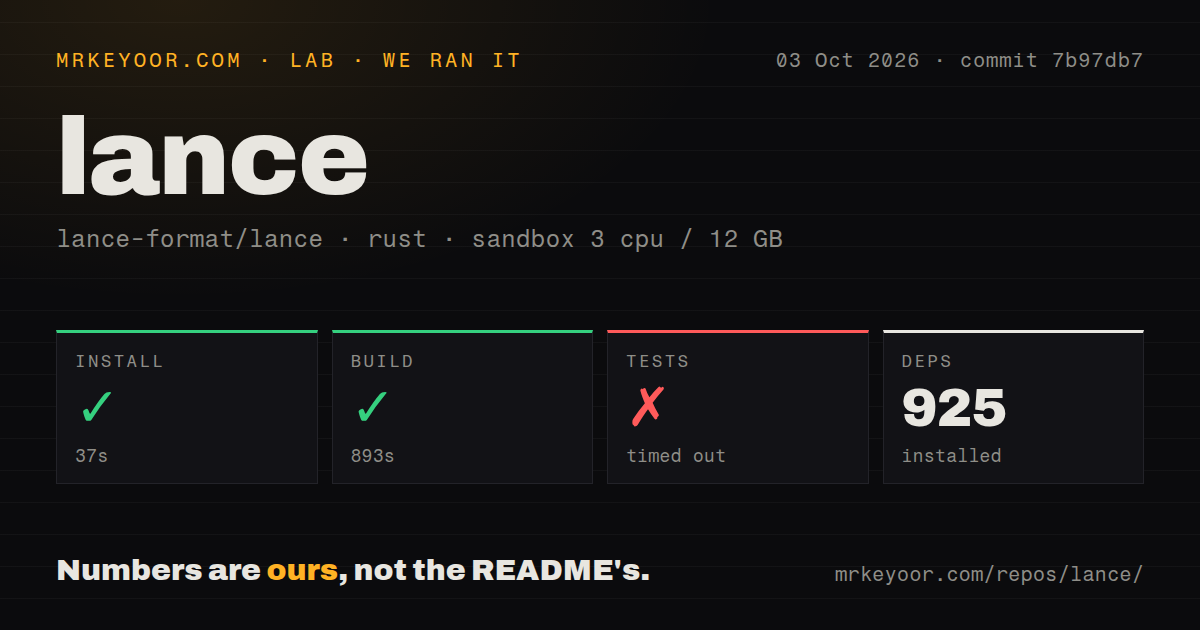
Our sandbox installed 917 packages in 48 seconds and completed the build in 715 seconds. The clean checkout occupied 54.1 MB before those dependencies. Installation and compilation both succeeded, which confirms that commit 29c4d59 can get through its build in an unprivileged Debian container with 3 CPUs and 12 GB of RAM. It also shows why editing the Rust core is a heavier job than the short pip install pylance quick start suggests.
Tests did not finish inside our 900-second limit. The final log lines show compilation still moving through aws-sdk-s3, datafusion-substrait, hf-hub, Lance namespace packages, lance-tools, lance-examples, and bit-packing crates. There is no assertion failure or error in that tail, and no test count was produced. The honest result is a timeout during compilation, not a failed behavior check and not a passing suite.
Local files are easy; shared object storage adds ownership
The README's smallest example converts a Parquet dataset in /tmp, reopens it through PyArrow, and reads it into Pandas. That path needs no hosted account. A production lakehouse changes the job: the team must supply object-storage credentials, settle URI and catalog configuration, choose who may write, and coordinate storage versions across services. Lance provides ACID transactions, version history, tags, and branches, but it does not operate your identity or storage controls.
The repository has 29 CI workflow files and a compose file, with no Dockerfile and no top-level tests directory in our scan. Those signals fit a multi-language library that is tested through several targeted workflows. They do not give a one-container production recipe. Teams building Rust, Python, and Java consumers should test the exact binding and object-store path they will deploy, particularly when separate services may upgrade on different schedules.
Compaction reports deserve a pre-production regression test
Open issue 8501 provides a public Rust reproducer for binary-copy compaction on files whose physical column order differs from the table schema. The report says v11.0.0-beta.4 can record the compacted mapping in schema order while copying pages in physical order. A debug build panics on the mismatched data type; a release build may return wrong values. That is a narrow set of conditions, but silent corruption is serious enough to test directly.
Another open report, issue 8281, describes a full scan failing after adding a column and compacting a dataset on storage version 2.3. Its author could not reduce the problem to the simpler combinations they tried, so it should not be generalized to every compaction. Together, the 2 reports point to a practical acceptance test: reproduce your schema evolution, merge-insert, and compaction sequence, then compare every value before and after optimization.
Same-day work and v10.0.0 show an active project
GitHub showed a push on August 28, 2026, 6,984 stars, and 1,062 combined open issues and pull requests. Recent activity included fixes and performance work across encoding, HNSW, namespaces, full-text search, and Java callbacks. The large combined queue is not a defect count. It matches a repository with many bindings and active development, and same-day updates show maintainers and contributors are still working through it.
The latest stable release fetched from GitHub was v10.0.0, published August 7, 2026. Its notes include breaking changes, format-decoder safety fixes, new indexes, and many storage fixes. That pace is useful if Lance solves your access pattern, but upgrades deserve migration review. The format is a strong fit for multimodal training or retrieval tables; an ordinary analytics lake with broad SQL-engine requirements may be better served by Iceberg, Delta Lake, or Hudi.