Five checkpoints produce native skeleton motion
Kimodo.cpp runs 5 released Kimodo motion checkpoints through C++ and GGML. A caller supplies either a UTF-8 prompt or a precomputed LLM2Vec embedding, then receives root translations and local XYZW rotations. The runtime works on CPU or Vulkan, which makes it relevant to native graphics tools and robotics software that cannot comfortably host NVIDIA's Python API.
Output shape depends on the checkpoint. SMPL-X RP v1 returns 22 joints, SOMA RP and SEED v1.1 return the compact 30-joint control skeleton, and the G1 models return 34 Unitree joints. The API exposes the selected result's joint count, so callers do not have to hard-code one skeleton.
The 36-second install is only the repository layer
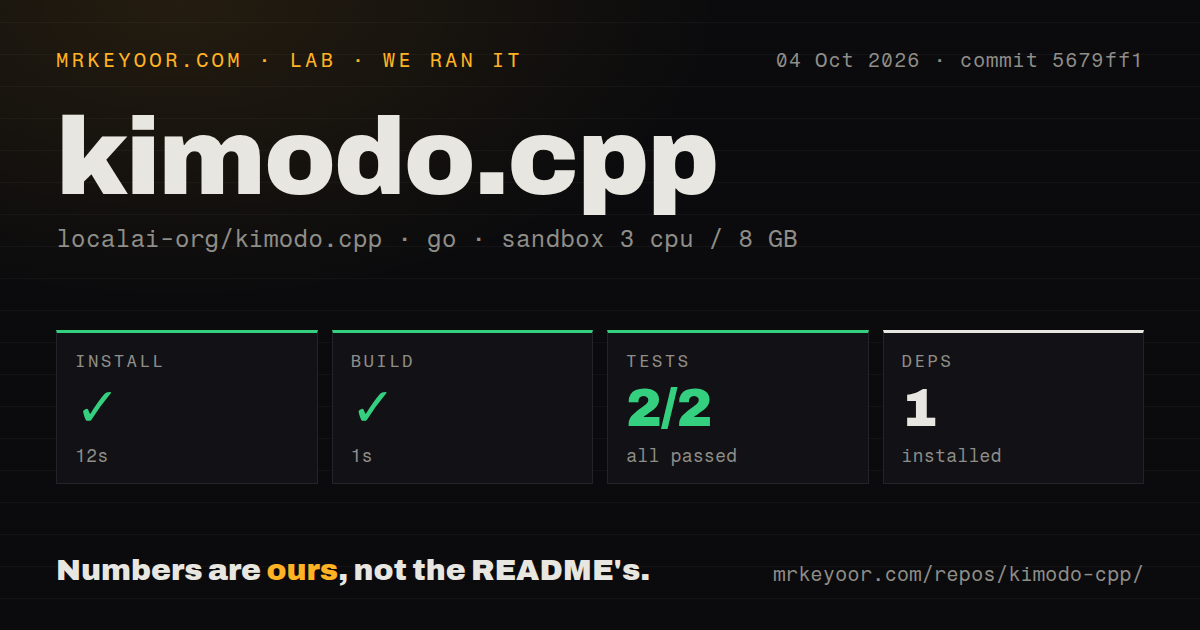
Our sandbox installed 1 package in 36 seconds, and the subsequent build passed in 4 seconds. Those are encouraging numbers for checking the code at commit f782a72. They do not include fetching the native model bundles or preparing a gated upstream checkpoint. Kimodo.cpp keeps those assets outside the GitHub repository and supplies a script that downloads selected GGUF bundles from the LocalAI-io organization on Hugging Face.
A native build needs a C++23 compiler, CMake 3.25 or newer, Ninja, Python 3, and an initialized GGML submodule. The Hugging Face CLI is required for the documented download route, while Vulkan users need its loader and headers. Nix can provide a repeatable shell, but it is optional. The standard test suite also expects motion weights, a text bundle, and fixtures already on disk; it never downloads them itself.
What happened when we ran it
Our run used a fresh unprivileged Debian container with 3 CPUs and 8 GB of RAM. Installation completed in 36 seconds with 1 package installed. The build then completed in 4 seconds, and go test finished in 24 seconds with 2 passed and 0 failed out of 2. No install, compiler, or Go test error appeared in the measured steps.
The checkout held 2,257 files, about 371,617 lines of source, and occupied 23.2 MB. Our harness found a tests directory, 0 CI workflow files, and no Dockerfile. The successful test result describes the 2 Go tests reported by the lab, not the README's separate CTest suite with its downloaded weights and fixtures. Buyers should run that native suite with the exact checkpoint and backend they intend to ship.
GLB export contains bones without a character mesh
Every successful demo animation writes a GLB file with the selected animated node hierarchy. The file can be copied into a Three.js project, and the running server exposes it through an animation-specific API route. It does not contain a skinned mesh. A team with an existing rigging pipeline may prefer that clean skeleton output, but an app team expecting a finished character will still need mapping, skinning, presentation, and export work.
Several limits are stated plainly. The native SOMA path returns the 30 joints the model predicts rather than NVIDIA's expanded 77-joint relaxed-hand skeleton. General constraint input, skinned-mesh GLB export, and quantized models are absent. Multi-prompt transitions are implemented, but they do not turn the runtime into a full animation editor. These omissions are good reasons to stop evaluating if they sit in the middle of the intended product.
Model choice changes what commercial use permits
The port and its original tooling use Apache-2.0, while each checkpoint keeps its own terms. SOMA RP and SEED v1.1 plus the G1 RP and SEED v1 models permit commercial use under NVIDIA's Open Model License. The SMPL-X RP v1 checkpoint is different: its license limits use to internal, non-production research and prohibits redistribution of derivative models. Converting that checkpoint to GGUF does not change those restrictions.
The text encoder carries separate terms because its bundle includes converted Meta Llama 3 material. Kimodo.cpp's installer verifies manifests and SHA-256 hashes, and its publishing script requires an explicit confirmation of upstream licenses before upload. That is useful friction, though it cannot choose a lawful model for your product. A commercial team should settle the motion and text licenses before building an asset pipeline around either bundle.
Vulkan memory use has one manual control
The text encoder processes 8-layer Vulkan chunks by default. KIMODO_TEXT_LAYER_CHUNK accepts values from 1 through 32, giving operators a direct way to trade chunk size against VRAM use. CPU inference is also documented, and the repository includes CPU and Vulkan parity tests. No performance benchmark was part of our 24-second Go test run, so the project does not yet tell us how long a motion takes on the hardware a reader owns.
The C API offers one path for text and another for an existing 4096-value F32 embedding. Loading checks the motion GGUF and text bundle before inference, which should fail earlier than a half-completed generation. The API then returns translations and rotations rather than making assumptions about a renderer. That boundary is sensible for engine integration, but it leaves retargeting and visible character quality outside the library.
Seven days of public history limit the health signal
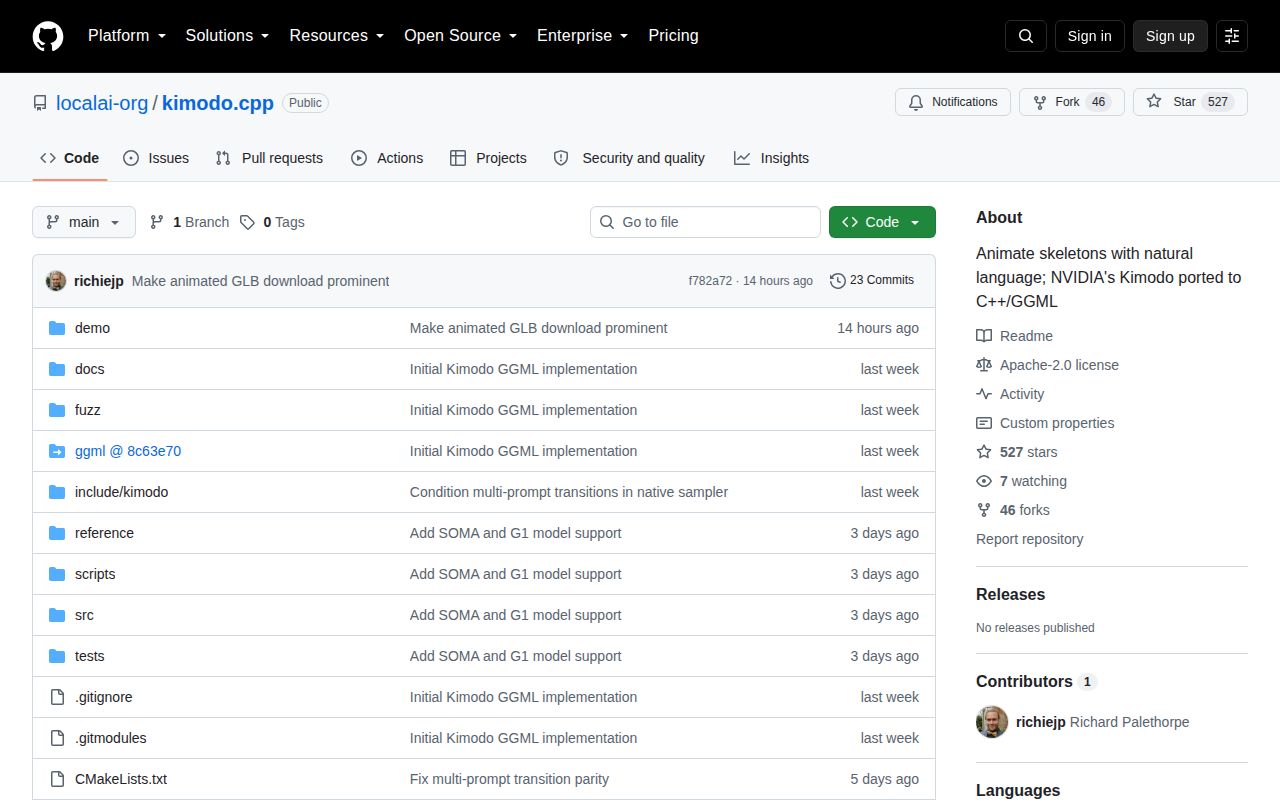
The repository was created on August 22, 2026, and the last push was August 29, 2026. GitHub showed 527 stars, 46 forks, and 0 combined open issues and pull requests when fetched. Both submitted issues had been closed by August 26. That is current activity, but 7 days is too little history to judge maintenance under real adoption pressure or compatibility across driver and model updates.
GitHub had no latest release for the source repository. Published weights live separately on Hugging Face, and our scan found 0 CI workflow files, so a tagged source-to-model release trail is not visible in the usual place. Kimodo.cpp is worth testing for a native text-to-skeleton component because the 4-second build and narrow API lower the trial cost. It is too early, and too deliberately low-level, to buy as a complete character-animation system.