A second Kubernetes control plane must solve a real second-cluster problem
Karmada v1.19 runs its own API server, controller manager, scheduler, and etcd, then connects them to 2 or more member clusters. A PropagationPolicy selects workloads and states where they should run. The scheduler creates a ResourceBinding, and controllers turn that decision into Work objects delivered to each chosen cluster. OverridePolicy handles differences such as storage classes or image registries without forcing separate application manifests for every location.
That machinery earns its place when one team must spread replicas by region, move workloads after a cluster failure, or apply the same placement rules across cloud and on-premises clusters. A single Kubernetes cluster gets none of that benefit. It only gains another API, credentials, certificates, controllers, and an upgrade path. If your need is simply deploying the same YAML to 3 clusters, Fleet or Argo CD may be the smaller answer.
What happened when we ran it
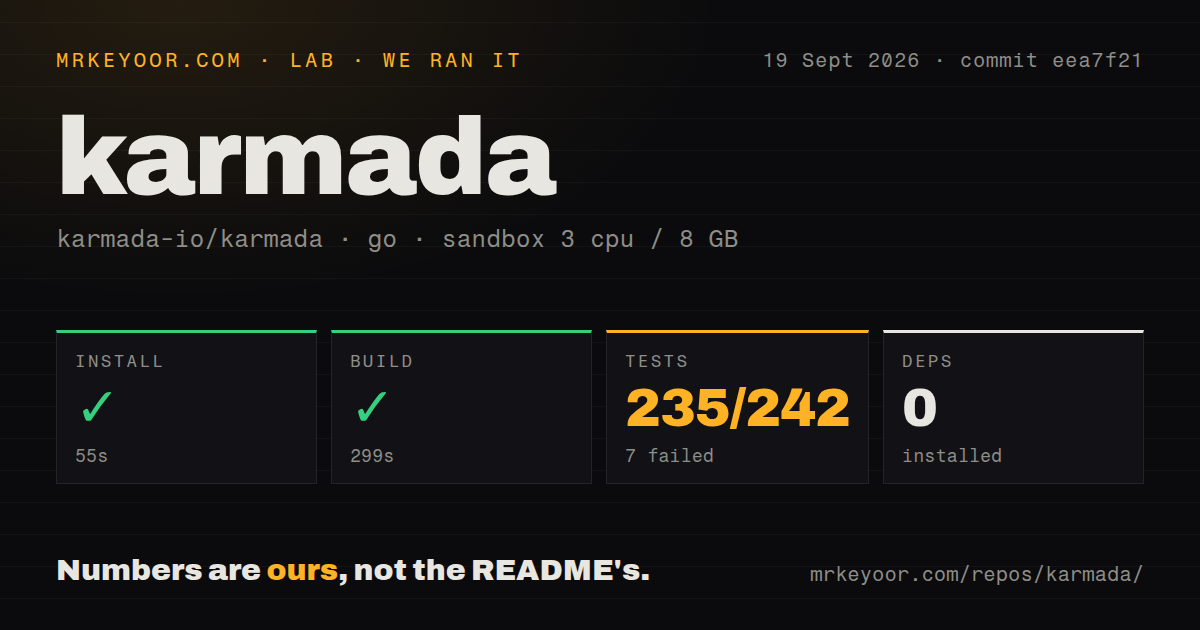
Our sandbox installed the repository in 55 seconds and installed 0 packages. The build completed in 299 seconds. Tests then ran for 256 seconds and exited with code 1: 235 passed and 7 failed out of 242. The last log lines show TestE2E panicking in the base, init, and operator suites. They do not show why those tests panicked, so we will not assign a cause.
Our test method used commit eea7f21 in an unprivileged Debian container with 3 CPUs and 8 GB of RAM. The checkout contained 2,260 files, roughly 401,067 lines of source, and occupied 36 MB. It had 18 CI workflow files and a tests directory, but no Dockerfile. An open tracker, issue 6841, collects intermittent E2E failures; it does not prove that our 7 failures were flakes or that a retry would pass.
v1.19 covers Kubernetes 1.27 through 1.36
The README marks Karmada v1.19 as exactly compatible with 10 Kubernetes releases, from 1.27 through 1.36. That is useful for fleets that cannot upgrade every member in one maintenance window. The chart itself lists Kubernetes 1.16 or newer as an installation prerequisite, but the current compatibility table does not grant the same v1.19 assurance below 1.27. Use the narrower claim when deciding what your oldest cluster may run.
Version 1.19 also promoted priority-based scheduling to Beta and enabled it by default. Push-mode informers can refresh rotated member-cluster credentials without restarting components. The release removed deprecated API values and updated Kubernetes dependencies, so an upgrade deserves API checks rather than a tag change followed by hope. A staging fleet should exercise policy order, credential rotation, failover, and rollback with the versions it actually operates.
The quick start creates clusters rather than proving production readiness
At commit eea7f21, go.mod requires Go 1.26.8. The README's local script starts 1 host cluster, builds the control-plane components, creates member clusters, and joins them. It also requires kubectl 1.19 or newer and kind 0.14 or newer. That is a useful tour because it leaves working kubeconfigs for the host, the Karmada API, and the members. It is still a development topology on one machine.
Production installation for v1.19 offers a Helm chart and an operator. The chart can run in host, agent, or component mode; the operator manages Karmada instances through a custom resource. Either path needs decisions about etcd durability, replica counts, API exposure, certificate names, image sources, observability, and member access. The chart documents encryption at rest for Secrets, but you must provide the encryption configuration and keep its key outside Git and Helm values.
Open CLI bugs make configuration checks part of the trial
Open issue 7883 reports that in v1.18.3 and master, karmadactl init --config accepts component resources, affinity, node selectors, and tolerations in YAML but ignores those settings during deployment. Open issue 7887 reports a panic when karmadactl get -w watches an empty resource collection. Both reports were open in September 2026. They concern ordinary operator actions, so a proof should inspect rendered workloads and test empty-state commands rather than stopping when pods become Ready.
The Helm documentation names 4 cleanup leftovers: the service account, ClusterRole, ClusterRoleBinding, and namespace used by hook jobs. That is manageable when it is in the runbook. It also shows the difference between deleting a chart release and fully removing a cluster control plane. Test installation and removal in a disposable host before granting Karmada access to production member clusters.
September activity is high, and so is the review surface
GitHub recorded 5,669 stars, 532 open issues, and 326 open pull requests on September 19, 2026. Code had been pushed on September 18, while v1.19.0 was released on August 31. The large queue includes bugs, feature requests, questions, and tracking work, so it is not a count of defects. Recent release work and daily repository activity point to active maintenance.
Karmada gives a platform team one place to express placement, overrides, priority, and failover across independent clusters. Our failed 242-test run prevents an unconditional recommendation, even though installation and compilation succeeded. The right proof is operational: build a small host, join 2 disposable members, rotate a credential, remove one member, upgrade the control plane, and confirm the workload state from both Karmada and the target clusters.