
The 118-skill catalogue is built around Korean daily life
k-skill packages agent instructions and helper programs for services that generic tool collections often miss. The README lists 118 entries covering train and bus schedules, Seoul transit, government records, business checks, property data, court information, Korean stocks, public statistics, shopping, delivery, health information, HWP files, sports, and Korean writing.
That focus creates a language boundary. The README and linked feature guides are primarily Korean, and the repository does not list an English README. Korean-speaking users get domain terms and service caveats in the language those sites use. Everyone else must translate operational instructions involving credentials, payment, law, or public records, which is a poor place to rely on partial understanding.
Skills range from simple lookups to guarded handoffs
Many entries are read-only wrappers over public data. KTX checks an official planned timetable, SRT checks live schedules and seat-class availability, and neither logs in, books, waits, pays, or cancels. Other skills query Seoul bike docks, holidays, weather, corporate status, National Assembly votes, library holdings, sports results, or public notices.
Some workflows go further. Express and intercity bus booking require user login. The property-registry helper can prepare a cart but leaves login and payment to the user. The court payment-order assistant organizes evidence and hands off after authentication rather than submitting by itself. The README's account column makes these distinctions visible, so users should read it before assuming a skill can finish the named task.
A few skills touch health, legal, financial, hiring, or account data. Their instructions can save research time, but the agent is not the decision maker. Keep human approval at login, paid disclosure, payment, filing, ordering, and submission steps. A skill name describes a workflow; it does not grant authority over the user's account.
What happened when we ran it
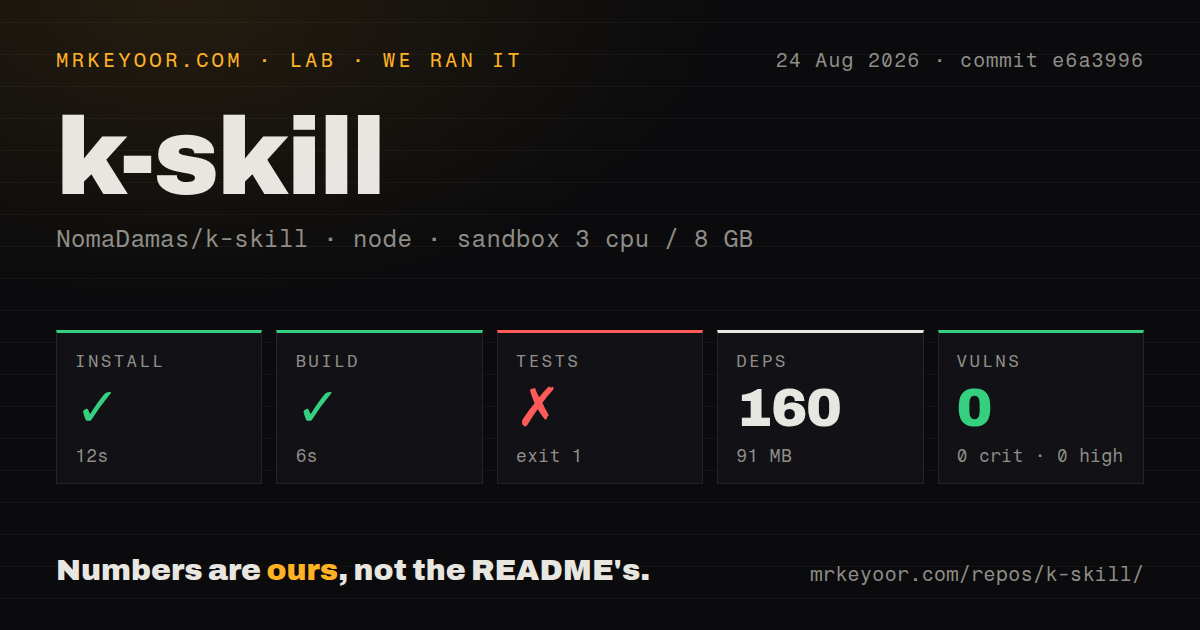
Our sandbox installed 160 npm packages in 12 seconds, consuming 91 MB. The monorepo build completed in 6 seconds. npm audit reported 0 known vulnerabilities, including 0 critical, high, moderate, or low findings in the installed Node dependency tree.
Tests stopped after 5 seconds with exit 1. The repository's test runner invoked a Python environment preparation script, which failed because ensurepip was unavailable. The log told Debian and Ubuntu users to install python3.11-venv, then recreate the environment. No test cases ran, so we cannot report a pass count or judge the suites behind that setup step.
We tested commit e6a3996 in a fresh Node 22 Debian container with 3 CPUs, 8 GB of RAM, no secrets, and no elevated privileges. The checkout contained 1,854 files, roughly 117,931 source lines, and 5 CI workflow files. It is a workspace monorepo with no Dockerfile and no tests directory detected by the harness.
Installation is global, while capability is per skill
The main command uses npx to add every skill globally, but the installer can select one named skill instead. Basic use needs Node.js 18 or newer. The KTX and SRT helpers add Python 3.11 and uv. Claude Code users may install the whole collection as a marketplace plugin and call entries through the /k-skill: namespace.
Installing all 118 skills is convenient for discovery and costly for agent context or permissions. The repository includes a cleaner that combines an interview with per-agent trigger counts to suggest unused skills for removal. Starting with one or two known jobs is still easier to audit. It limits helper dependencies, secret names, hosted routes, and ambiguous triggers before the collection grows.
Credentials follow several patterns. Some skills need a user's API key or authenticated browser session. Others call an operator-managed k-skill-proxy, so the user sees no key while the request still leaves the local machine. The README links a privacy policy and a security guide with credential resolution rules. Review both before sending business identifiers, locations, queries, or account-related input.
Public-data access has stated usage limits
The base repository uses the MIT license, while the proxy directories use AGPL-3.0-only. Service names and trademarks describe compatibility, not affiliation or approval. The README also limits public-information queries to personal, non-organized use and forbids bulk systematic crawling, access-control bypass, disruption, or interference with a service's business.
Those limits rule out casually turning a lookup skill into a company-wide scraper. They also matter when a helper uses browser fallback against a site with a WAF. A working endpoint does not establish permission for high-volume collection. Teams need the upstream service's terms, rate limits, data rights, and retention policy alongside the repository's code license.
Active development has not produced a tagged release
GitHub recorded a push on August 25, 2026, and 53 open issues and pull requests combined. Current proposals include court-auction documents, government services, commercial-area data, and clearer documentation for business-registration date limits. That activity shows the catalogue is being corrected and expanded, including cases where similar official dates must not be treated as equivalent.
GitHub returned no latest release for the repository. Users therefore need to pin a commit or understand how the installer resolves the source if repeatability matters. The 6-second build and clean npm audit are positive measured results, but the failed Python environment setup means contributors should add the documented venv package before relying on the full test path.
Pick narrowly and keep humans at action boundaries
For Korean users, k-skill covers many real local tasks in one install format. Its catalogue is most convincing where it names the data source, says whether login is required, and stops before payment or submission. Those boundaries separate a useful research helper from an agent with unclear authority.
Install individual skills first, confirm their source and credential route, and keep manual approval for consequential actions. English-only teams and bulk-data operators should look elsewhere. The collection's value comes from Korean specificity, which is also why its language, service, and policy constraints are mandatory.