Version 5.8 combines a downloader, collector, and local API
DouK-Downloader 5.8 handles more than pasting a single TikTok link. The documented modes cover Douyin and TikTok videos, image posts, account feeds, likes, favorites, collections, comments, search results, and live-stream addresses. It can save metadata as CSV, XLSX, or SQLite, while a local Web API exposes collection functions to other programs. That breadth is useful when the archive and its data belong together.
The default project language is Simplified Chinese. A complete English README and English terminal translations exist, so an English-speaking operator can get through setup and daily use. Some community issues and much of the deeper documentation remain Chinese-first. The 188-file checkout contains about 39,727 source lines in 6.1 MB, including Python application code and large JavaScript assets used around request parameters.
What happened when we ran it
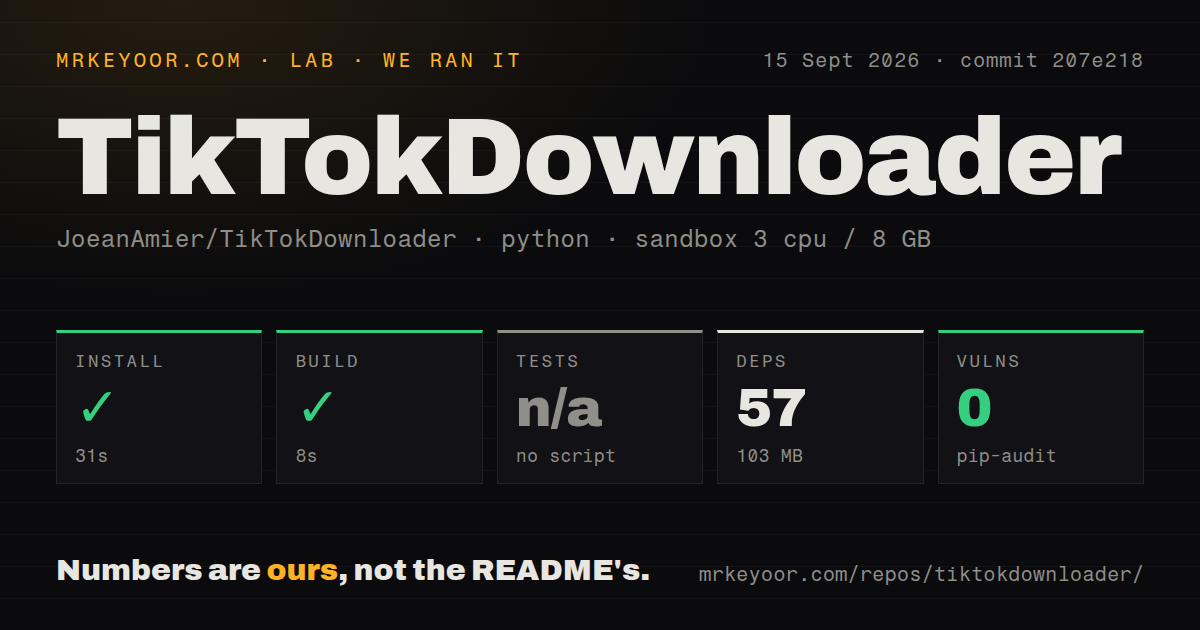
Our sandbox installed commit 207e218 in 31 seconds, pulling 57 packages and occupying 103 MB. The build completed in another 8 seconds. Pip-audit reported 0 known vulnerabilities in the installed Python dependency set. We ran those checks in an unprivileged Debian container with 3 CPUs, 8 GB of RAM, and no secrets. The repository also includes 6 CI workflow files and a Dockerfile.
The test stage had nothing to execute. Our harness found no test script or target, so it skipped testing rather than calling the repository green. The scan also found no conventional tests directory, although the source tree has a src/testers area. We did not log into Douyin or TikTok in this no-secret container, and these results say nothing about a live account download. They establish that installation and packaging worked at commit 207e218.
Version 5.8 needs a Cookie and may need your own signing code
Version 5.8 asks users to put Cookie data into the configuration, either manually or from the clipboard. Automatic browser Cookie reading was removed in the same release. Private-account collection has a stricter condition: the Cookie must represent a logged-in account that already follows the private account. That makes the credential part of the runtime. Store it like a session secret, keep it out of bug reports, and replace it when it expires.
Request signing is the larger maintenance boundary. The README says the project no longer maintains algorithms that generate encrypted parameters for legal and compliance reasons. If a platform update breaks an affected route, the user must provide generation code and connect it through the documented configuration. Release 5.8 added an X-Gnarly parameter and dynamic loading for external Python code, but that release does not reverse the policy. A working download today cannot prove the same endpoint will work after the next platform change.
Port 5555 provides an API, while the 6.0 Web UI is only expected
The current server mode exposes generated API documentation on port 5555 and enables LAN access by default in version 5.8. That also means you must decide who can reach the service and how its token is set. The README includes a request example, Docker port mapping, and volume instructions. It does not turn the server into a managed service with accounts or a hosted support promise.
The feature list still mentions a Web UI, then the UI section says its code has not been updated and is closed. The README says a full 6.0 refactor is planned and GUI or WebUI support is expected afterward. That wording offers no delivery date. Today, choose the terminal interface or API. If a visual queue, browser-based settings editor, or multi-user console is mandatory, DouK-Downloader does not currently supply it.
Version 5.8 live recording can lose its MP4 index after interruption
Live capture delegates to ffmpeg. Open issue 762 describes the current MP4 command and reports that pressing Ctrl+C, a process crash, or a power failure can leave the file without its moov atom. Such a recording may be unplayable until repaired, and the report also mentions possible audio-sync trouble. The issue requests TS or fragmented MP4 output, but it remains open. A recorder intended for long events needs an interruption test before the only copy matters.
Batch collection has its own warning. Issue 478 documents a 200-creator job that began reporting Cookie errors after creator 35 and could continue about an hour later. The thread discusses request delays, and the README says a delay mechanism is built in, but the report does not prove a single cause. It does show why unattended scale needs checkpoints, conservative request pacing, and logs that distinguish an expired Cookie from a temporary block or a parser failure.
15,960 stars and a September release show active maintenance
GitHub recorded the last push and release 5.8 on September 13, 2026. The repository had 15,960 stars and 34 combined issues and pull requests when fetched. The release fixed several API, TikTok account, XLSX, ID extraction, and request-parameter problems. Recent open reports cover repeated live-photo downloads and cover images that are downloaded again even when the video is skipped.
That maintenance record does not fill the missing automated test target. A downloader tied to private platform behavior needs regular live checks, while a data writer also needs regression coverage for filenames, deduplication, and CSV, XLSX, or SQLite output. Version 5.8 even carries a manual migration note for moving the old Volume data folder. Pin releases, back up that folder, and verify a small account before starting a large batch after each update.
The 103 MB environment suits supervised, authorized archiving
A 31-second install and 103 MB dependency footprint make DouK-Downloader easy to try. The expensive part is supervision: obtaining authorized Cookies, respecting platform and copyright rules, watching for request changes, and checking downloaded files. For a personal archive or research collection where someone can inspect failures, version 5.8 offers unusually broad Douyin coverage. For an unattended service, the missing test target, user-owned signing maintenance, closed Web UI, and open interruption risks are too much operational debt.