
JevHarness preserves a decision strategy in executable code
JevHarness lets an authoring model turn a task into code that asks Jev specific questions, then uses the answers to choose actions. Consider routing a support ticket: code extracts the facts, Jev judges ambiguous details, and the saved strategy decides where the ticket goes. You can inspect that strategy instead of requesting a fresh explanation for every ticket. The useful distinction is who does the reasoning during development and who makes decisions afterward.
Our checkout contained 1,331 files and roughly 15,901 source lines, occupying 47.1 MB. There is considerably more here than a prompt template. The repository includes specification validation, execution, storage, optional optimization, and an archived Pokémon example. That breadth makes sense for someone studying repeatable decisions. It also means you should arrive with a defined task and a way to judge its answers, rather than expecting an assistant that finds its own job.
What happened when we ran it
Our run installed JevHarness in 39 seconds, added 63 packages, and used 216 MB on disk. The build succeeded in 12 seconds. We cloned commit 34d5c96 on October 7, 2026, into an unprivileged Debian container with 3 CPUs, 8 GB of RAM, and Python 3.12, using the Astral uv image. There were no secrets available for live model calls. These are repository checks, not measurements of decision quality or model latency.
The test step failed with exit code 1 after 115 seconds. Pytest reported 529 passed, 17 failed, and 24 skipped. Several failures explicitly raised PythonSandboxUnavailable, saying functional Python requires the macOS native sandbox. Other failures concerned non-JSON outputs, including infinity and a circular list. Resource probes for an infinite candidate and oversized output said an isolated worker had not actually started. The supplied tail cannot establish how those assertions behave on supported macOS hardware.
Pip-audit reported 0 known vulnerabilities in our environment. Our scan found a tests directory, no Dockerfile, and no CI workflow files. The security audit answers a dependency question, while the failing isolation-related cases leave a separate runtime question open. A successful package install does not show that generated Python can execute safely on your operating system. For the Python-worker path, that distinction changes the adoption decision.
Python workers require macOS, while expressions avoid that worker
The runtime documentation says functional Python nodes need a supported macOS native sandbox and refuse execution when isolation is unavailable. Expression and Jev flows use a separate path that does not launch those workers. Linux developers therefore need to choose which kind of harness they intend to run before evaluating the project. The restriction is documented, and our failure log makes its practical effect unusually clear.
The 529 passing tests show that plenty of code ran in our Debian environment, but they cannot cancel the 17 failures. A useful first trial would keep its scope explicit: inspect an archived strategy, or evaluate the expression path on a task whose allowed actions you control. If your requirement is arbitrary generated Python on Linux, this repository's stated runtime boundary is already a reason to choose something else.
Freezing a harness still leaves hosted Jev in the execution path
The README distinguishes saved code from the services it calls. A frozen harness that contains Jev nodes still needs Jev access through Vercel AI Gateway or TypeSafe, configured with the corresponding API key. Optional authoring and reflection can use a local Claude CLI or supported model endpoints. The task adapter defines observations, legal actions, side effects, and rewards. Keeping that adapter outside the generated strategy is a sound design choice: the candidate cannot award itself a better score.
The 216 MB we measured covers the installed environment, not paid inference or authoring work. Installing the Claude Code plugin also leaves Python dependencies and model credentials to you. Freezing binds the specification and declared resources, but the README warns that a hosted model alias does not fix future provider behavior. Stored answers can support replay. Fresh requests remain dependent on the service behind that alias.
The Pokémon archive explains selection without proving general performance
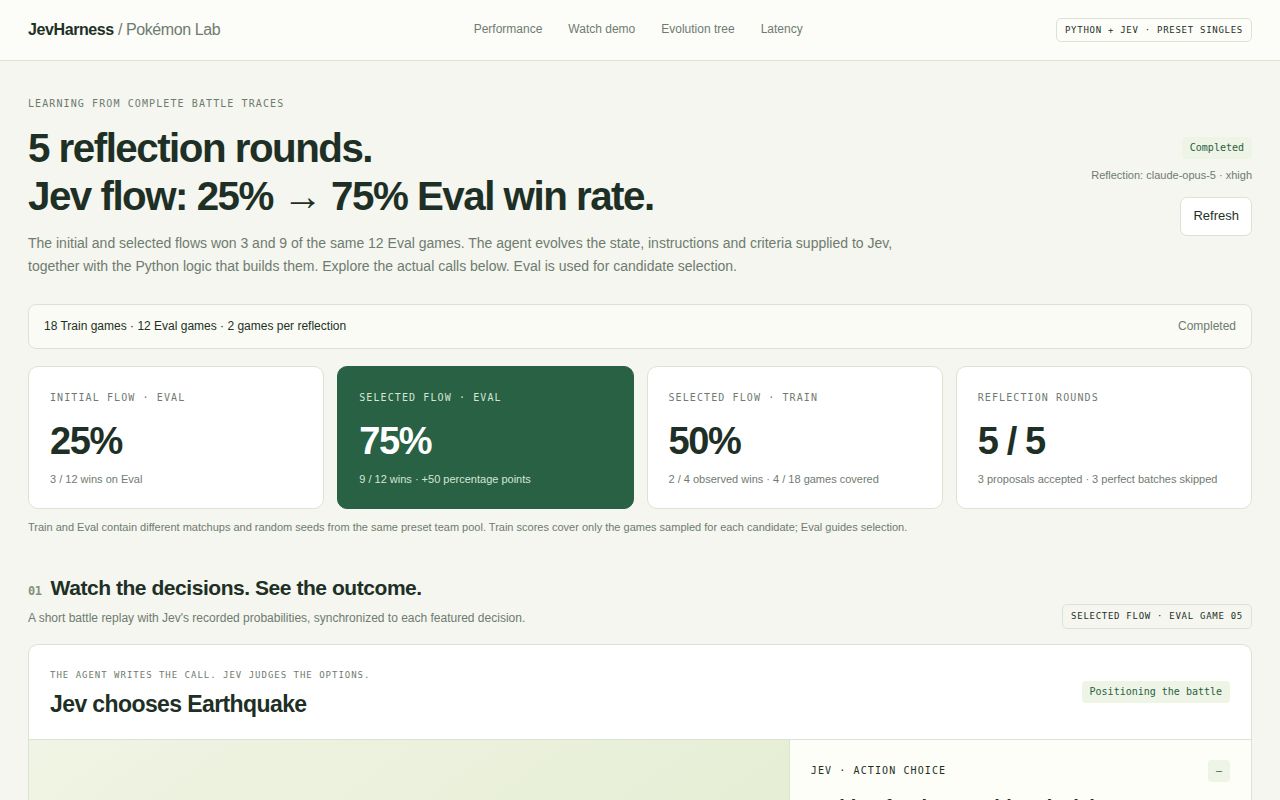
The example includes complete decision records, candidate ancestry, and rejected proposals. Its README explicitly says the evaluation set helped select the winning harness, so the result cannot independently establish performance on unseen games. That qualification is useful. You can follow how features and Jev judgments produced an action without treating an edited victory clip as proof that the approach will route your support queue correctly.
Browsing the archived website needs Node and a browser, while battle animations fetch assets from the Pokémon Showdown renderer. It requires no model credentials. Our 12-second build result does not establish animation quality, external asset availability, or fresh battle performance. For an initial inspection, the archive is still the sensible entry point: read the chosen pipeline and its failures before spending money on reflection for your own task.
September activity shows a young project with a portability question
GitHub listed 536 stars and a last push of September 21, 2026. The latest-release endpoint returned no release. The small open queue contained a Windows portability pull request updated on September 25, proposing a replacement for POSIX-only file locking. Its description explicitly leaves the macOS sandbox requirement unchanged. That combination suggests a young project with current contributor interest, while providing little release history to assess stability.
Choose LangGraph when durable stateful agent orchestration is the main requirement. Choose DSPy when you want to program and optimize model components without adopting Jev-specific judgments. JevHarness earns a trial when the saved decision strategy itself is what you want to study. Before putting that strategy in charge of real side effects, require a working isolation path on the machine that will execute it.