Four outputs sit on top of two live data sources
Jev X Sentiment Analysis takes a crypto symbol and a sample of 50 to 1,000 English-language posts from X. It fetches spot and perpetual-market data through CCXT, collects posts through TwitterAPI.io, computes local statistics, and asks TypeSafe AI's Jev model four typed questions. The browser then shows an action, sentiment band, squeeze risk, catalyst score, and calculated trade levels.
The useful design choice is compression before the model call. Python calculates engagement, author diversity, keyword polarity, and representative-post subsets. SQLite stores seen posts, and pagination stops when it reaches a known ID. The README says this cuts repeat API calls, although we did not measure vendor cost or savings. The model receives a smaller state instead of hundreds of raw posts.
Missing keys produce a demo, not an error
The source has explicit fallback paths. Without TWITTER_API_KEY, it generates simulated posts or reuses its SQLite cache. Without TYPESAFE_API_KEY, it creates a deterministic decision from market and social fields. API responses expose is_twitter_mock and is_typesafe_mock, which is better than hiding the substitution. A developer can run the interface before buying access.
That convenience can mislead anyone who ignores the flags. Kraken failures also return placeholder market data with is_fallback: true. A September fix changed the interface so an unlisted symbol no longer displays calculated levels or enables its copy button when fallback prices are in use. The failure is now visible, but production callers still need to reject mock or fallback results themselves.
What happened when we ran it
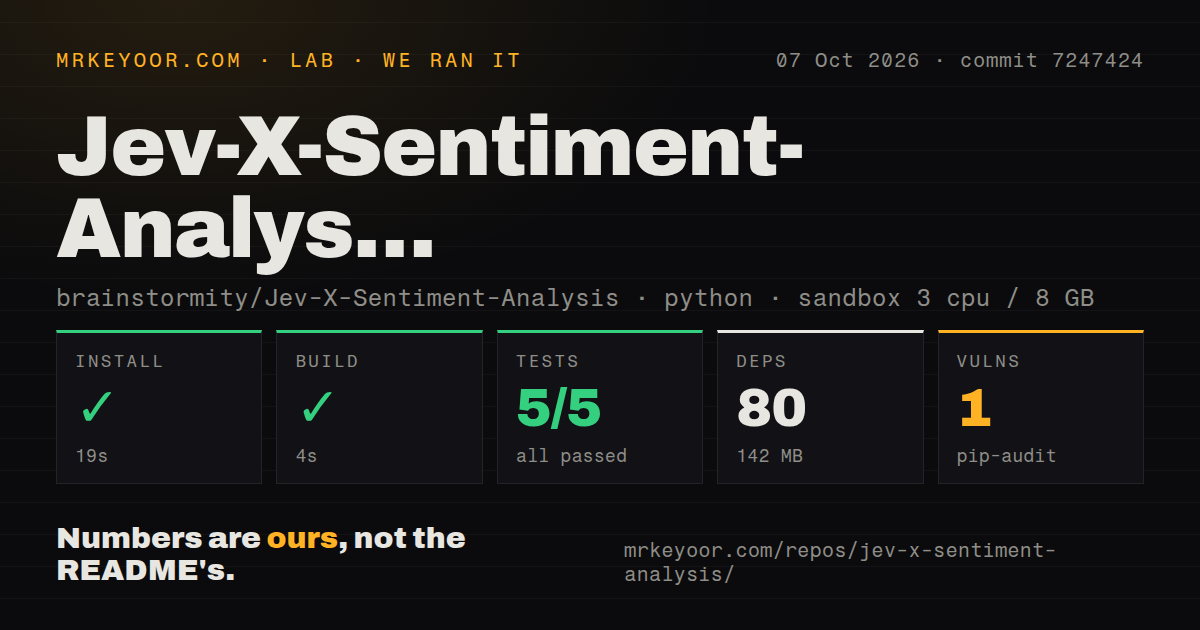
Our sandbox installed commit 7247424 in 19 seconds on 3 CPUs with 8 GB of RAM and Python 3.12. Pip added 80 packages and the environment occupied 142 MB. The build step passed in 4 seconds. The repository itself was 0.6 MB, with 22 files and about 2,010 lines of source.
Pytest completed in 28 seconds with 5 passed and 0 failed. The run used no secrets, so those passing results include the repository's no-key behavior rather than paid TypeSafe AI or TwitterAPI.io responses. The tests cover the pipeline, API validation, fallback contracts, symbol rejection, and database deduplication. They do not establish model accuracy or trading performance.
Pip-audit found 1 known vulnerability. The supplied measurement does not name its package or severity, so the defensible finding stops there. Our scan found a tests directory, zero CI workflow files, and no Dockerfile. A fresh local install works, but no visible automation reruns those 5 tests for each proposed change.
Five passing tests do not validate the trade card
The output looks decisive because it includes entry, stop, targets, confidence, and a risk ratio. Those values come from fixed arithmetic around the current price after the action is chosen. The repository does not include a backtest, walk-forward evaluation, hit-rate report, or comparison against a simple baseline. Nothing in our 28-second test run fills that gap.
Social inputs also have a narrow frame. The query builder requests English posts, excludes reposts, requires at least 2 likes, and maps a handful of symbols to full project names. That filter may reduce junk, but it also shapes whose opinions enter the sample. Author diversity and engagement speed describe the collected set. They do not prove that the set represents the market.
The README is appropriately blunt that this is educational software and not financial advice. Keep that boundary in the product, too. If you fork it, record whether each card used live posts, live perpetual data, or any fallback. Store the inputs behind every displayed level and test the decision rule on periods that were unavailable during development.
Localhost defaults still need deliberate remote security
A live setup needs Python 3.12, two paid-service credentials, Kraken network access, and a writable SQLite path. The sample environment binds to 127.0.0.1 on port 8000 and restricts browser origins. The security guide says remote operators should add TLS, authentication, exact CORS origins, and an ADMIN_TOKEN. Those are requirements once the terminal leaves one laptop.
The settings endpoint can write new keys into .env. It allows localhost requests by default or a matching admin token remotely. That is convenient for the browser, but it makes reverse-proxy configuration important. Preserve the real client boundary, lock down the endpoint, and keep the database and environment file out of backups or logs that weaker users can read.
A September 29 push is recent, but history is thin
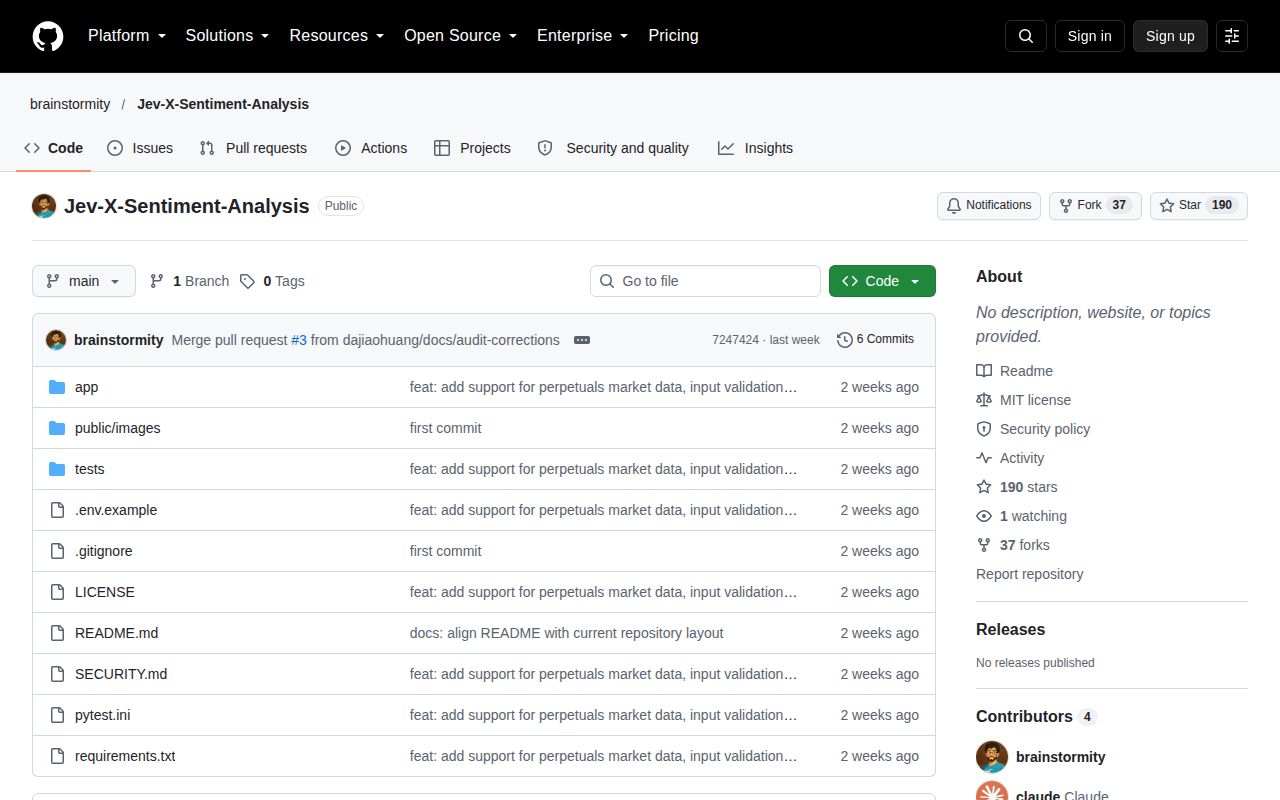
The repository was created September 19, 2026, and last pushed September 29. GitHub showed 190 stars, 37 forks, zero open issues or pull requests, and no tagged release on October 7. Its entire visible discussion history was one closed issue and two merged or closed pull requests. This is current work, but ten days of history cannot show long-term maintenance.
One of those pull requests fixed a meaningful failure: placeholder prices had reached a trade ticket while the page said the data was live. The follow-up source now fetches real perpetual funding when available and labels a separate momentum bucket. That response is encouraging. For adoption, the better signal will be whether future changes gain CI, release tags, and tests for paid-provider responses.
Jev X Sentiment Analysis is easiest to recommend as a 2,010-line teaching project. The pipeline is readable, our 5 tests passed, and mock states are exposed. The trading conclusion remains the least proven part of the app. Build evidence for that conclusion before giving its polished card any financial weight.