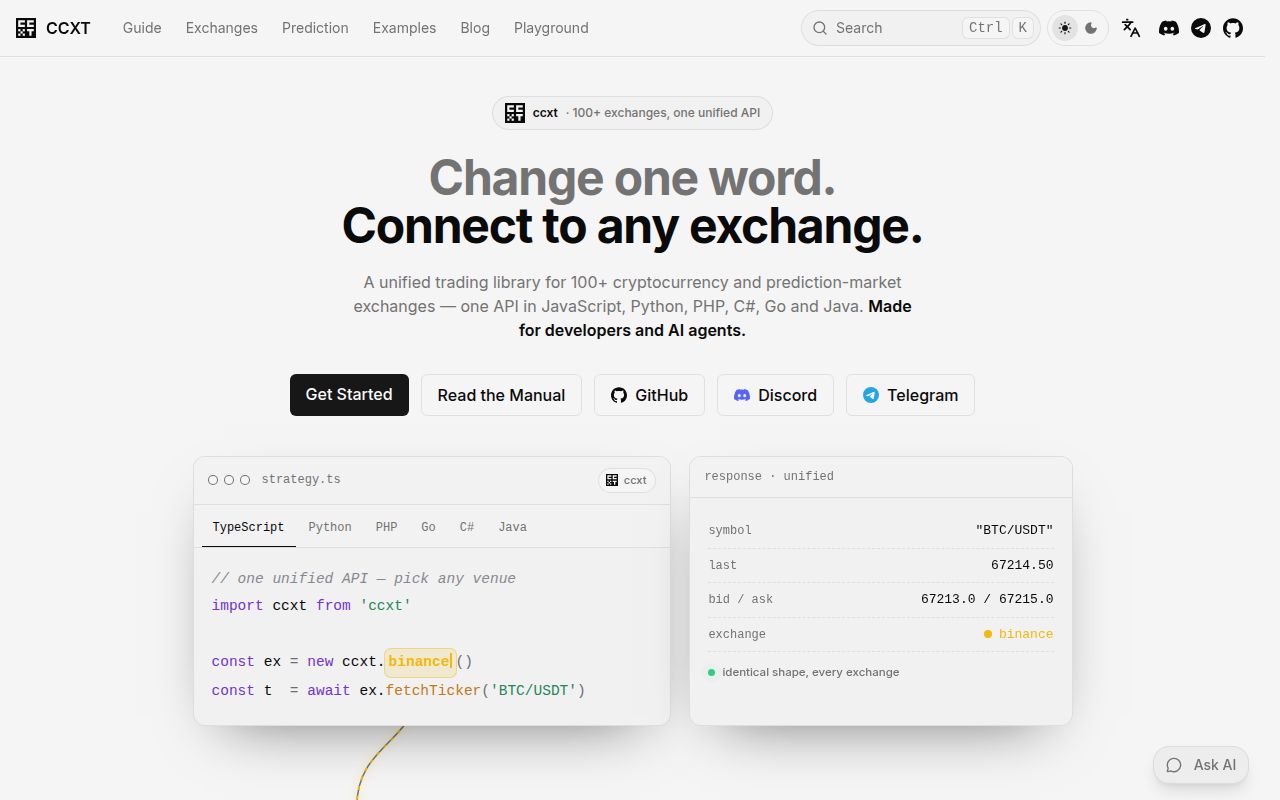
110 exchange and prediction-market entries share one interface
Version 4.5.75 gives applications common methods for tickers, order books, trades, candles, balances, and orders. The README lists 103 cryptocurrency exchange markets and 7 prediction-market exchanges. That breadth is hard to reproduce inside one product, especially when every venue uses its own authentication, symbols, response fields, and error codes. CCXT supplies public and private REST APIs, plus WebSocket access through its Pro classes.
The library reaches beyond its original JavaScript audience. Version 4.5.75 ships interfaces for JavaScript, TypeScript, Python, C#, PHP, Go, and Java, and several generated implementations originate from the TypeScript source. Public data can be used without registering or providing a key. Private calls require credentials issued by each exchange, and an exchange may require identity verification before it grants them. CCXT handles the connection; it does not create the account or decide whether a trade is sensible.
What happened when we ran it
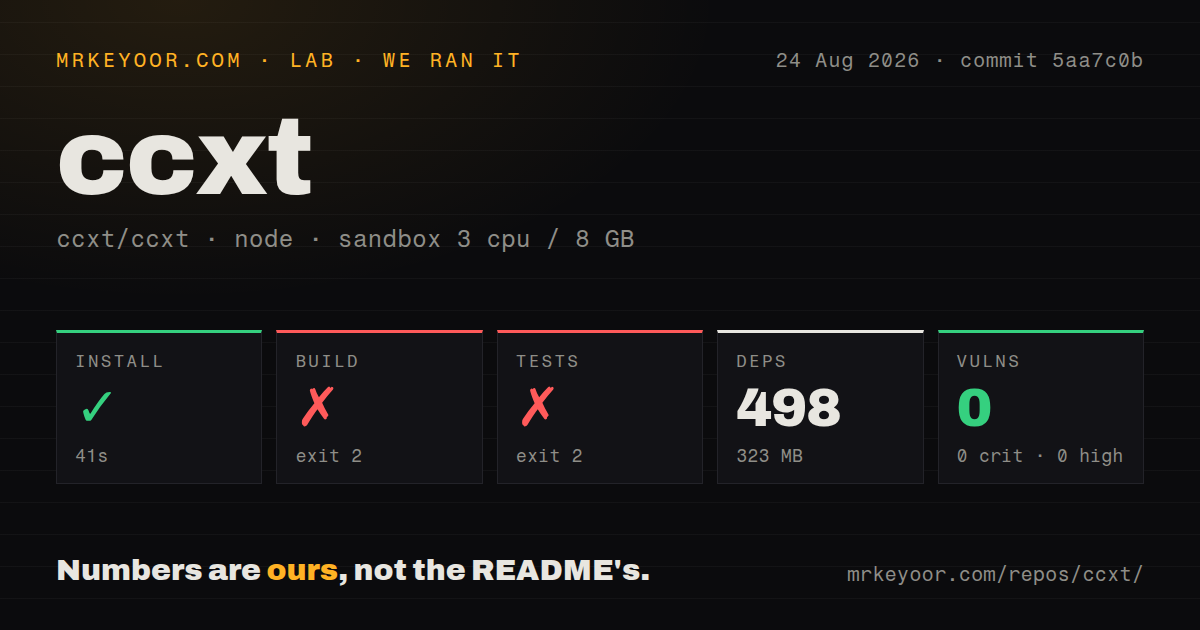
Our sandbox installed 498 npm packages in 41 seconds, consuming 323 MB on disk. The next step was decisive: npm run build failed after 20 seconds. TypeScript reported that ts/src/upbit.ts assigned a Dict value to a field typed as a List. The compiler added that the dictionary lacked array properties such as length, pop, and push. That is the full cause visible in the supplied log tail, so we cannot responsibly claim more.
The test command failed after 17 seconds because it passed through the same TypeScript build and reached the same Upbit error. We did not receive a completed test count. The checkout was also substantial: 9,625 files, roughly 5,951,638 source lines, and 392.3 MB checked out at commit 5aa7c0b. Our scan found 16 CI workflow files, a Dockerfile, and a compose file. Npm audit reported 0 known vulnerabilities across the installed dependency tree.
Public reads need no key; private calls need exchange credentials
CCXT supports Node.js 18 and newer, and public market data needs no user account. Install the package, create an exchange instance, and make a read call. The README documents synchronous and asynchronous use, a built-in leaky-bucket limiter, and an optional rolling window whose default span is 60 seconds. There are still venue-specific parameters and capabilities, so an application must inspect what each exchange supports and handle its errors rather than assume every method behaves identically.
Trading raises the stakes because private APIs can place orders, transfer funds, or request withdrawals. CCXT also participates in builder programs for the 7 exchanges listed in that section of the README; those calls add 1 bps unless the application disables builderFee. That setting deserves a configuration test. So do exchange-side permissions, symbol precision, rate limits, and sandbox behavior. A common method name reduces adapter work, but it does not turn different exchanges into the same venue.
The MCP server starts read-only and can reach live funds
The Node.js 18+ MCP server gives Claude Code and other hosts access to more than 100 exchanges through local stdio. With no configuration it exposes public market data. Adding an account enables private reads, while trading, funds, and raw write endpoints are separate capability tiers that start disabled. Live trading requires the literal live setting and a chosen per-order cap. Write actions have previews, confirmations, and an append-only journal. Those are sensible boundaries for an agent that can act on financial accounts.
The MCP security guide also states the caveat plainly: another local tool with filesystem access could read the credential file. A mode-600 file helps with other operating-system users, not an agent already allowed to read that path. Use exchange keys with withdrawals disabled and an IP allowlist, then start on a sandbox. The README's AI skills cover Claude Code, Cursor, Copilot, Windsurf, Codex, and more than 30 other assistants, but generated code still needs review before it touches a live account.
Active releases fix venue-specific mistakes every week
CCXT was pushed on August 25, 2026, four days after the v4.5.75 release. GitHub reported 807 open issues and pull requests combined, while an issue-only search returned 230 open issues. That is a large maintenance queue, yet the dates and the v4.5.75 release notes show current work. That release fixed WebSocket routing, order-side handling, withdrawal network mapping, authentication races, position parsing, and several language ports.
Those fixes explain both CCXT's value and its burden. A connector spanning 110 listed markets absorbs changes that individual application teams would otherwise chase. It also sits directly between code and money, where a wrong amount rounding or network mapping can matter. Recent open reports cover a positive amount rounding to zero on Hyperliquid, Kraken Futures rate-limit costs, and a C# WebSocket crash. Pin versions, test every used venue against a sandbox where available, and treat upgrades as trading-system changes.
Choose CCXT for connectors, Freqtrade for a finished bot
Version 4.5.75 is the broad connector here, covering 103 crypto exchange markets and 7 prediction venues. It provides the adapter layer, examples, a CLI, and agent access, while leaving strategy, portfolio logic, persistence, monitoring, and deployment to you. That separation is ideal for a team building its own trading system. It is extra work for someone who wants to configure a strategy and run a bot.
Freqtrade packages backtesting and strategy operation around a Python bot. Hummingbot is closer to a deployed trading and market-making platform. Java-only teams should compare XChange before accepting CCXT's generated multi-language repository. For CCXT itself, the consumer package is the safer starting point because our 41-second install passed with 0 known vulnerabilities. The pinned source tree needs its Upbit type error resolved before its build and test path earns the same confidence.