mrkeyoor.com_
Tue 01 Sept 17:42 UTC
Dev Toolsevaluationupdated 27 Aug 2026

iroh review

Iroh is a Rust networking library that lets an application connect to a peer by public key instead of managing changing IP addresses. It tries a direct QUIC path, handles NAT traversal, and can fall back to relays when a direct connection does not work.

+63 / 4dstars / 7d
Verdict

Our Iroh checkout installed 461 packages, but both the 20-second build and 9-second test run failed when Clang rejected the configured lld linker selection. The public-key dialing model is attractive for Rust applications that truly need to cross NATs, and the separate relay and protocol crates give serious teams room to own more of the stack. Try it if network behavior is part of your product and you can test hostile paths; skip it if you only need ordinary QUIC or expect the source checkout to work from the README's single Cargo command.

We ran it

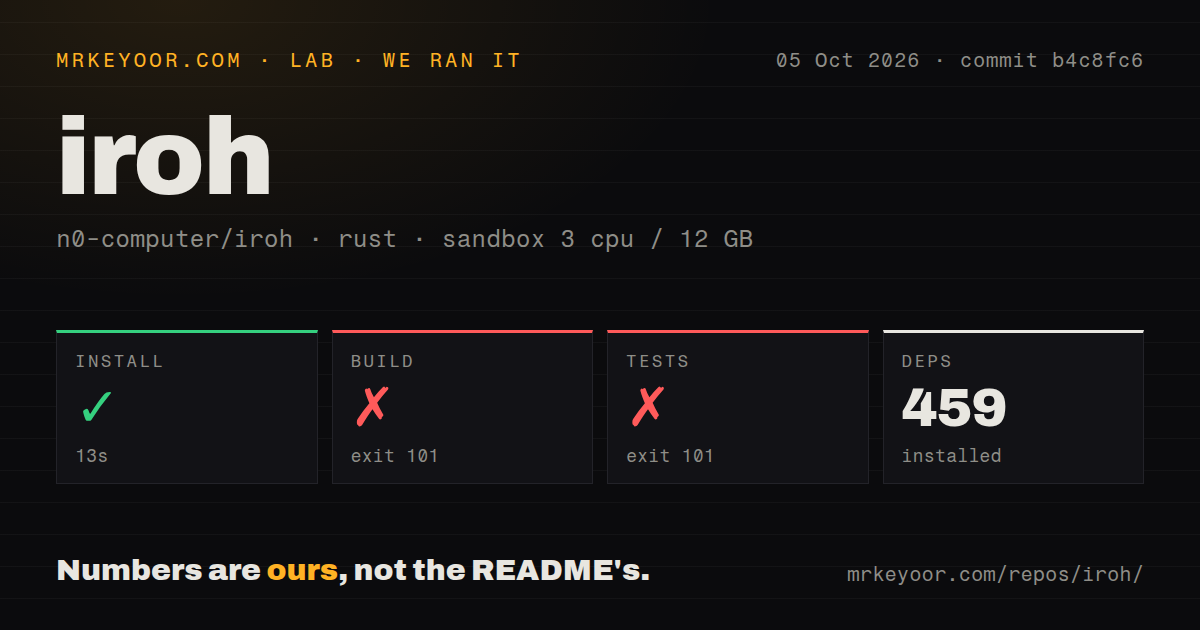
Lab card: what happened when we ran irohScreenshot of iroh (iroh.computer)
Install✓ · 49s461 packages
Build✗ · 20s
Tests✗ · 9sran, no count parsed
Repo237 files~57,495 lines of source · 3 MB · 17 CI workflows

Answers from our run

Does iroh build from source?

Dependencies installed in 49 seconds (461 packages), and the build failed. We cloned commit 3677ec6 into a clean Debian container with 3 CPUs and no project-specific setup.

Do iroh's tests pass?

The test command failed in our container, and its output did not report a pass or fail count.

Who should not use iroh?

Teams wanting a language-neutral drop-in library: the README calls Rust the easiest route and sends other languages to the separate iroh-ffi repository.

What are the alternatives to iroh?

rust-libp2p, Quinn, Tailscale. Our Iroh checkout installed 461 packages, but both the 20-second build and 9-second test run failed when Clang rejected the configured lld linker selection.

Setup2/5461 packages installed, but Clang rejected the configured linker
Docs4/5Clear API example and architecture, thin system setup guidance
Community5/512,341 stars, active pushes, releases, issues, and PRs
Maturity4/5v1.1.0 is active; recent network edge cases remain open

Discussed on

  1. hnIroh: A library to establish direct connection between peers268 points
  2. hnIroh: Peer-2-peer that just works4 points
  3. hnIroh: A toolkit for building distributed applications3 points

Who it’s for

Rust developers building peer-to-peer file transfer, synchronization, messaging, or device-control software.
Teams that want encrypted QUIC streams without writing their own hole-punching and relay selection layer.
Operators willing to use Iroh's public relay and discovery services or run the relay and DNS components themselves.
Applications that can test connectivity across the actual mobile, home, office, and container networks their users occupy.

Who it’s NOT for

Teams wanting a language-neutral drop-in library: the README calls Rust the easiest route and sends other languages to the separate iroh-ffi repository.
Applications that cannot tolerate relay dependence when direct paths fail: relay fallback is part of the documented connection model, and a recent open report describes a long-running endpoint becoming unreachable after its relay state wedged.
Linux hosts that create and remove virtual interfaces constantly without network regression testing: open issue 4488 reports unrelated veth changes causing active UDP socket rebinds.
Buyers expecting the one-line cargo add iroh instruction to cover a source checkout: our build and tests both stopped because Clang rejected the configured lld linker selection.
Teams looking for a complete file-sync product: blob transfer, gossip, and eventually consistent documents live in separate protocol crates that applications compose.

Setup reality

Our sandbox installed 461 packages in 49 seconds. The build failed with exit 101 after 20 seconds, and tests failed with exit 101 after 9 seconds. Both logs stopped while compiling Rust macro dependencies because Clang rejected -fuse-ld=lld as an invalid linker name.

The README presents cargo add iroh as the Rust starting point and requires no account or API key. Direct connections still depend on usable networking, while relay fallback and endpoint discovery use public infrastructure by default. The repository also contains relay and DNS servers for teams that want to operate those pieces.

The checkout config selects Clang plus lld for x86-64 Linux, a requirement absent from the short setup example. Non-Rust consumers need the separate FFI project. Container, CGNAT, virtual-interface, and relay behavior deserve tests on the networks where the application will run.

Iroh 1.1.0 turns a public key into a QUIC connection

Iroh 1.1.0 gives a Rust application an endpoint that dials another endpoint by public key. The library finds addresses, attempts NAT traversal, chooses a direct route when one works, and falls back to a relay when it does not. Once connected, the application gets authenticated QUIC with encrypted streams, datagrams, stream priority, and no transport-level head-of-line blocking. That is a useful boundary: product code deals with a peer identity and an application protocol instead of chasing whatever IP address a laptop or phone has today.

The commit we measured, 3677ec6, contained 237 files and about 57,495 lines of source in a 3 MB checkout. This is a focused networking workspace rather than an end-user program. The core crate sits beside relay client and server code, shared address types, and the DNS server used for endpoint lookup. File transfer, gossip, and eventually consistent documents are separate projects built on top. That split keeps the base library legible, but adopting a higher protocol means tracking another crate and its compatibility with the core.

The 17 CI workflows do not replace real network trials

Our scan found 17 CI workflow files, which is a strong sign that the maintainers test more than one happy path. Iroh still operates in a part of the stack where local success proves little. NAT type, UDP filtering, address changes, mobile handoffs, proxies, and relay reachability all affect the route selected at runtime. A team should test the same endpoint across office Wi-Fi, home routers, cellular networks, and its production container setup. The library owns connection maintenance, but the application owns the consequences when a peer briefly moves from direct traffic to a relay.

A fresh checkout installed 461 packages in 49 seconds before compilation began. The README's Rust example is concise: add the crate, bind an endpoint, connect with an application protocol identifier, and open a bidirectional stream. No hosted credential is required. That makes an API experiment easy once the compiler environment is correct. Operating privately takes more work because the default experience can use public relay and discovery infrastructure, while self-operation brings relay deployment, DNS behavior, monitoring, capacity, and upgrades into your remit.

What happened when we ran it

Our sandbox installed Iroh in 49 seconds and pulled 461 packages. The build then failed with exit code 101 after 20 seconds. Clang was invoked while Rust compiled proc-macro2, and it rejected the argument -fuse-ld=lld with the message invalid linker name. The repository's x86-64 Linux Cargo configuration explicitly selects Clang and passes that linker option. The log establishes the failed linker selection; it does not show an error in Iroh's networking code or establish which system package would have resolved the environment.

Tests also failed with exit code 101 after 9 seconds in the same 3-CPU, 12 GB unprivileged container. Their log stopped while the quote and proc-macro2 build scripts were linking, again on Clang's rejection of -fuse-ld=lld. No test cases ran far enough to produce pass or failure counts, so there is no basis for a claim about test quality. The useful setup finding is simple: the README's cargo add iroh path did not prepare this fresh Debian image for the link configuration carried by the checkout.

Open v1.0.x reports expose expensive network edge cases

Open issue 4390 reports unbounded queue growth in Iroh 1.0.1 when multiple connections reach a path identifier limit, with the reporter tracing a very large allocation to the pending-path queue. Issue 4476 describes an Iroh 1.0.3 endpoint stuck in a relay connecting state while its discovery record continued advertising the unreachable relay. These are detailed user reports, not findings from our sandbox, and neither should be treated as universal behavior. They matter because memory growth and lost reachability are costly failure modes for a long-running service.

The 20-second build failure prevented our run from exercising hole-punching, direct QUIC, discovery, or relay fallback. Issue 4424 supplies another boundary worth testing: a mobile client behind CGNAT repeatedly fell back from a direct path to a relay before reconnecting directly. A separate Linux report says unrelated virtual-interface changes can trigger UDP socket rebinds. If your host creates veth pairs for sandboxes or containers, or your users depend on cellular links, reproduce those conditions with your own application and observe route changes rather than relying only on a local echo example.

v1.1.0 shipped two days before this review

Iroh v1.1.0 was published on August 25, 2026, and GitHub recorded another push on August 27. The release added relay-connection metrics and client notification for relay rate limits, alongside fixes for relay reconnect behavior, proxy routing of network-report probes, DNS listener keepalive, and IPv4 plus IPv6 binding. It also included a breaking serialization correction for a custom address type. Those release notes show active maintenance and attention to the exact operational layer buyers should care about. They also mean version pinning and release-note review belong in every upgrade.

GitHub listed 12,341 stars and 164 combined open issues and pull requests when fetched, while our checkout carried 17 CI workflows. The combined count is not a defect total, but recent reports and recent fixes show an active feedback loop. Documentation covers the mental model, basic API, workspace layout, and related protocol crates well. System preparation is less explicit: the short starting path never mentions the x86-64 Cargo configuration that selected Clang and lld in the checkout we tested.

Alternatives

ProjectWhat it isPick it when
rust-libp2pA Rust implementation of the modular libp2p networking stack.pick this instead when protocol choice, peer discovery options, and compatibility with the wider libp2p ecosystem matter more than Iroh's narrower API.
QuinnA lower-level asynchronous QUIC implementation for Rust.pick this instead when you control addressing and want QUIC without Iroh's discovery, hole-punching, or relay layer.
Tailscale gh↗A WireGuard-based mesh network that connects machines rather than embedding peer dialing in an application.pick this instead when you can manage the participating devices and want an overlay network for existing services.

What people are saying

  1. [github-trending] n0-computer/iroh

Sources

  1. Iroh repository and README
  2. Iroh v1.1.0 release
  3. Iroh x86-64 Cargo linker configuration
  4. Pending path queue growth report
  5. CGNAT relay fallback report
  6. Relay reconnect wedge report
  7. Linux virtual-interface rebind report

More dev tools reviews

workmux · v2rayNG · SecLists · hashcat · eslint · fastfetch · the whole board →