
InfluxDB 3 Core trades Flux for SQL and InfluxQL
InfluxDB 3 Core receives event and time-series data in line protocol, persists it as Parquet, and answers SQL or InfluxQL queries. That combination is its practical identity. Existing senders using the InfluxDB 1.x or 2.x write APIs can keep their ingestion path, while new applications can query through HTTP or Flight SQL. The server also embeds Python for plugins and triggers that process data close to storage.
The branch map deserves attention before any migration. main is version 3 Core, main-2.x carries version 2, and master-1.x carries version 1. Flux appears in the older branches, not in the version 3 query-language list. A team can therefore reuse write clients without assuming its dashboards, Flux tasks, or operational procedures move unchanged. This is a new major line with selected compatibility, not a drop-in replacement for every 2.x behavior.
The official artifacts avoid the hardest part of our run
InfluxData publishes Docker images, Debian and RPM packages, and tarballs. Those are the sensible first route for an operator who wants the database rather than a contributor toolchain. Local disk is supported without a separate storage service. Larger deployments can put Parquet in S3, Azure, or GCP object storage, which shifts persistence into an external service and adds its credentials and lifecycle rules. The HTTP API listens on port 8181.
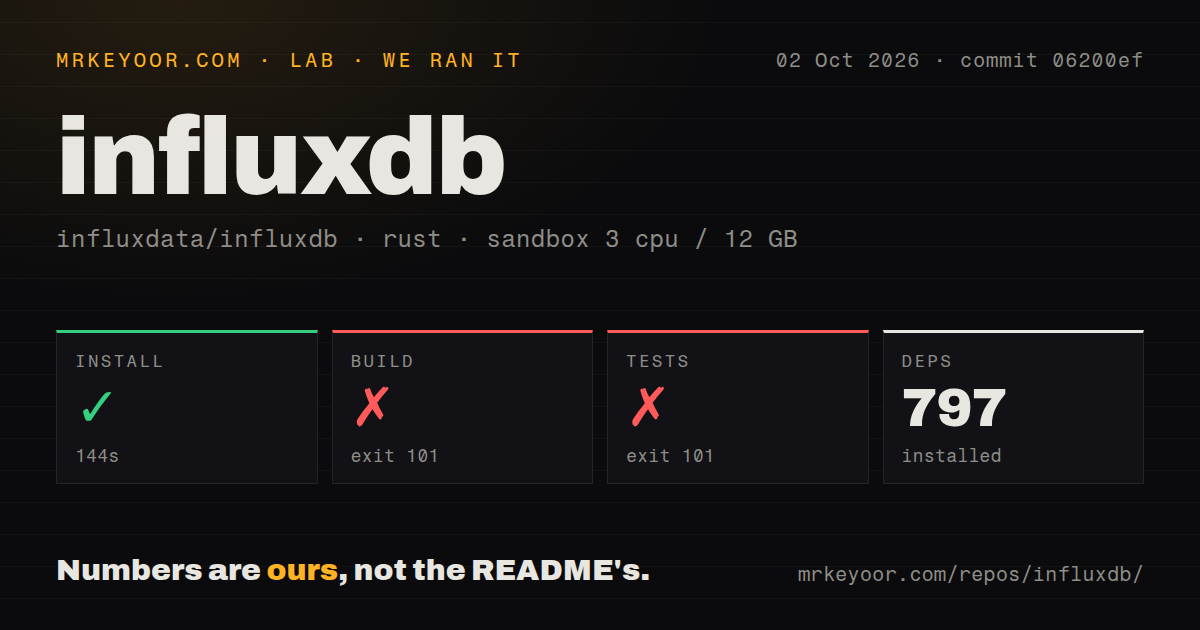
Our checkout at commit 06200ef held 1,845 files, about 409,206 lines of source, and occupied 27.3 MB. Installing the Rust dependency graph took 144 seconds and added 797 packages. That is normal evidence of a substantial database workspace, but it also makes a source build a poor installation shortcut. If you are evaluating the product, start with a published artifact and reserve the workspace for code changes or reproducible custom builds.
What happened when we ran it
Our sandbox build ran for 637 seconds and exited with code 101. The final linker message was specific: rust-lld could not find -lpython3.11, so Cargo could not compile the influxdb3 binary. The test command failed after 40 seconds with the same missing-library message and exit code 101. It did not reach a result that tells us whether individual tests pass or fail.
The container was a fresh, unprivileged Debian environment with 3 CPUs, 12 GB of RAM, no secrets, and the lab-rust:1 image. The repository’s processing-engine guide explains why Python appears in a Rust database: PyO3 detects a Python runtime during compilation, and the resulting binary links to that version of libpython. The guide names python3-dev among Debian build dependencies and says the matching runtime must remain available when the binary runs.
That evidence has a narrow meaning. commit 06200ef did not build or enter its test suite in our image because the linker could not find one named library. It does not establish a database correctness problem, and it says nothing about query speed. It does establish that cargo build is not self-contained on a plain Rust image, even after 797 packages have installed.
Embedded Python makes plugins useful and deployment-specific
The processing engine can run Python plugins and triggers inside the server. Official binaries ship with a controlled Python distribution, while local builds can link against the system interpreter or a separately downloaded Python build. Plugin environments may use a server-managed virtual environment, or operators can disable package management and prepare that environment themselves. That flexibility is handy, but the chosen Python ABI becomes part of the server artifact.
For a custom build, record the interpreter version, library path, Rust toolchain, Protobuf compiler, and plugin packages together. Moving only the binary to another host can leave it without the libpython it was built against. Our missing python3.11 link is the visible version of that coupling. Teams that prohibit runtime package installation can use the documented switch that puts virtual-environment ownership outside the server.
Recovery testing belongs in the adoption plan
Open issue 26970 concerns InfluxDB 3 Core after an unclean shutdown. The reporter found zero-byte catalog and WAL files, then described startup and write failures until those files were removed by a local workaround. The issue was still open and had 24 comments when fetched, with an update on September 24, 2026. That is a report, not proof that every Core installation will corrupt after power loss.
It is enough reason to test the failure mode you care about. Kill the process during writes, restart from local disk or your chosen object store, and verify both reads and new writes before trusting recovery. Backups also need a restore drill. For workloads where a monitoring gap is annoying, that may be sufficient. For data that cannot be reconstructed, the open report raises the cost of skipping those exercises.
October code activity offsets the large issue queue
GitHub recorded the last push on October 6, 2026, and showed 31,759 stars plus 2,172 open issues and pull requests across a repository that carries three major product lines. Recent open items included version 3 Core recovery work and current pull requests, so the queue is not simply abandoned history. The latest release returned by GitHub was v3.11.4, published September 8, with fixes for write-buffer overwrites, snapshot manifests, and cached plugin source.
InfluxDB 3 Core is a credible choice when line protocol compatibility, Parquet storage, and SQL access belong in the same service. Its easiest path is the one the project publishes: install a built artifact, then prove storage and recovery with your own data. The source route is for teams prepared to own the embedded Python link as carefully as the Rust binary.