Hy-MT2 targets translation with instructions attached
A translated sentence can read well and still break your application if the model changes a placeholder or ignores the glossary. Hy-MT2 addresses that kind of work with prompts for terminology, style, layout, and structured content. Tencent publishes an English README alongside Chinese documentation, and much of the issue discussion is Chinese. The project is worth considering when preserving the surrounding instructions matters as much as producing fluent words.
The 38 MB Python environment we measured belongs to IFMTBench, the repository's translation-instruction evaluator. It is easy to mistake that small footprint for the cost of running Hy-MT2 itself. Model weights and an inference runtime are separate choices. You can use the benchmark to assess another translator, or try the translation models without adopting the benchmark. Neither choice makes a successful Python build evidence of translation accuracy.
What happened when we ran it
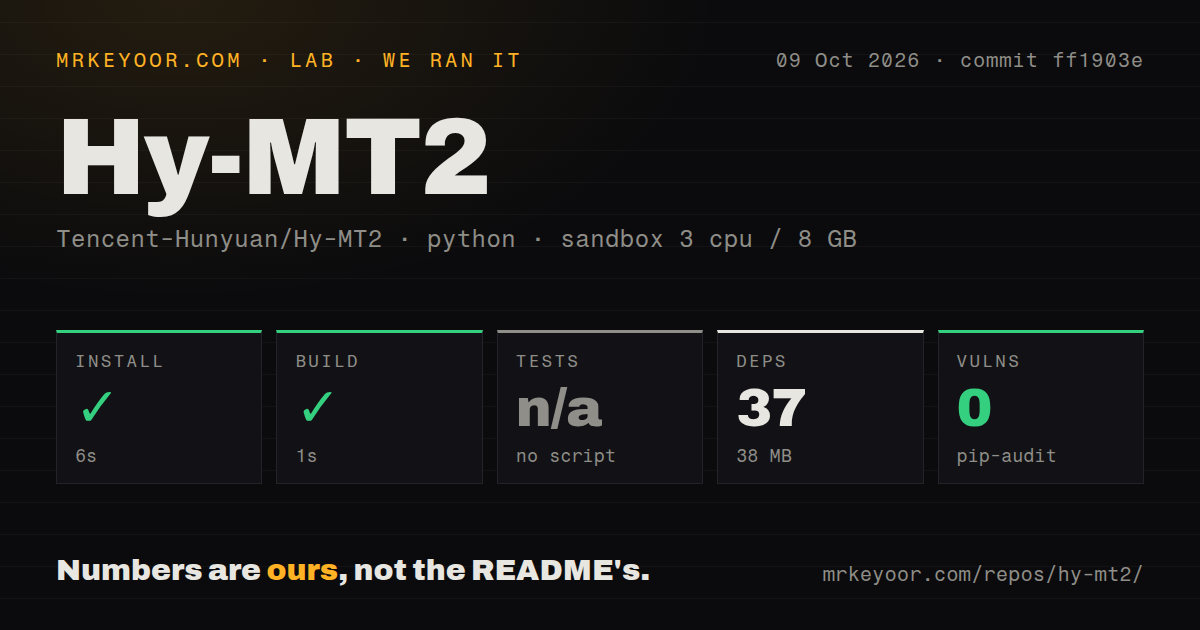
Our run installed 37 Python packages in 6 seconds and completed the build in 1 second at commit ff1903e. The measured project was in ./IFMTBench/. We ran it on October 9, 2026, in a fresh unprivileged Debian container with 3 CPUs, 8 GB of RAM, the ghcr.io/astral-sh/uv:python3.12-bookworm image, and no secrets. Installation and build both succeeded, and pip-audit reported 0 known vulnerabilities.
The repository checkout contained 56 files, roughly 4,640 source lines, and 26.8 MB of data. The installed environment occupied 38 MB. Tests were skipped because no script or target existed. Our scan found no CI workflow files, Dockerfile, or tests directory. The measured result therefore covers preparation of this Python project, with no automated test result to support claims about evaluator correctness or model output.
Model deployment needs weights and a compatible runtime
The deployment examples cover Transformers, vLLM, SGLang, and llama.cpp. Tencent publishes smaller dense models and a larger mixture-of-experts variant, plus quantized downloads. The examples choose an actual model from the catalogue and load its weights. That leaves you responsible for hardware fit, model caching, and selecting the right runtime for the artifact you downloaded. The GitHub checkout alone is not a translation server.
Our 6-second installation does not measure those deployment paths. The README specifies recent Transformers support and says its extreme GGUF quantization depends on an STQ kernel linked through a llama.cpp pull request. A familiar file extension therefore does not guarantee that your installed runtime understands that variant. Confirm compatibility before choosing a quantized model solely because its download seems convenient. We have no measured inference latency or output-quality result for any variant.
Prompt templates make the intended contract inspectable
The README's terminology template supplies reference translations, while its structured-content template asks the model to preserve keys and variable placeholders and translate visible text. That is useful documentation for a localization engineer: you can see what the model is being asked to obey. It also specifies full language names in the prompt and notes that the models have no default system prompt, so the caller must prepare the instructions deliberately.
The 1-second build does not prove compliance with any of those instructions. For a product trial, I would use your actual glossary and a localization file containing placeholders, then compare the structure before reviewing the prose. A valid-looking sentence is insufficient when the surrounding file no longer parses. Keep the exact prompt and model revision with each result so a later change in terminology can be traced to its input.
IFMTBench separates format failures from subjective judgments
The benchmark guide mixes rule checks with an LLM judge. Layout preservation and structured data use rules, while style and background interpretation rely on the judge. Glossary evaluation can fall back to model judgment. Multi-constraint scoring multiplies the pass-or-fail rule component by the average subjective score, so a format failure can nullify an otherwise good style result. That matches the practical cost of breaking a localization artifact.
The 37-package environment is only the preparation step. You must generate translations separately, save responses matched to benchmark item identifiers, and configure an OpenAI-compatible judging endpoint when the evaluation needs one. The documented skip-llm mode provides rule-only debugging. Treat that narrower output accordingly: it cannot settle the style and context questions assigned to the judge. Record the judge configuration if you want later scores to be comparable.
Open reports describe bracket confusion and glossary mistakes
Issue 12 shows the English background-context template producing unexpected output when the source contains square brackets. Issue 13 proposes a different separation between context and source after describing instruction-following and prompt-injection concerns. That proposal is not evidence of an accepted fix. These reports matter if your source material includes markup or text that resembles the template's own delimiters.
Our sandbox supplied no model evaluation, so we cannot confirm the prevalence of those behaviors. October's issue 17 also reports a glossary translation being applied to a different phrase containing a similar identifier. That is a concrete reason to check near-matches in your own terminology set. Pip-audit's 0 known vulnerabilities tells you about the inspected Python dependencies, not whether an input can divert translation instructions.
August code activity and October questions give a mixed health signal
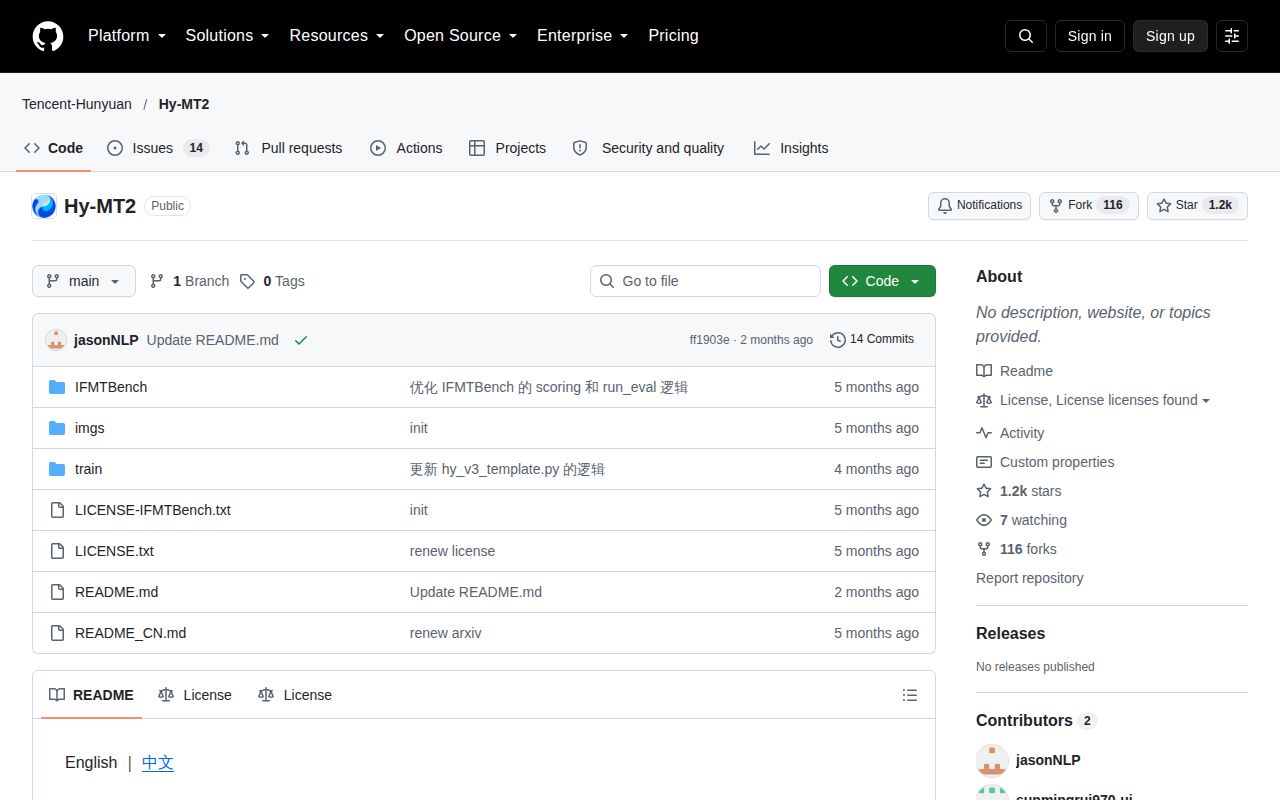
The last push was August 26, 2026. GitHub showed 1,210 stars and 14 open issues and PRs, with questions still receiving activity in October. The latest-release endpoint returned no published release. Those facts describe a research repository with a live user discussion, rather than proving either frequent software delivery or abandonment. Pin the source commit and model artifact separately when evaluating it.
LibreTranslate is a better starting point when you need a conventional self-hosted translation API. CTranslate2 suits teams operating supported Transformer models through an inference engine, without implying Hy-MT2 compatibility. Hy-MT2 earns a trial when terminology and format instructions are the difficult part of your job. The next useful evidence is a reviewed translation of your own structured content, with every placeholder still intact.