Choose the Dracula port for the application you actually use before cloning the theme collection. The main README says each theme has its own repository, with independent releases and named maintainers. That structure matters more to your decision than the result of a command in an unrelated theme folder.
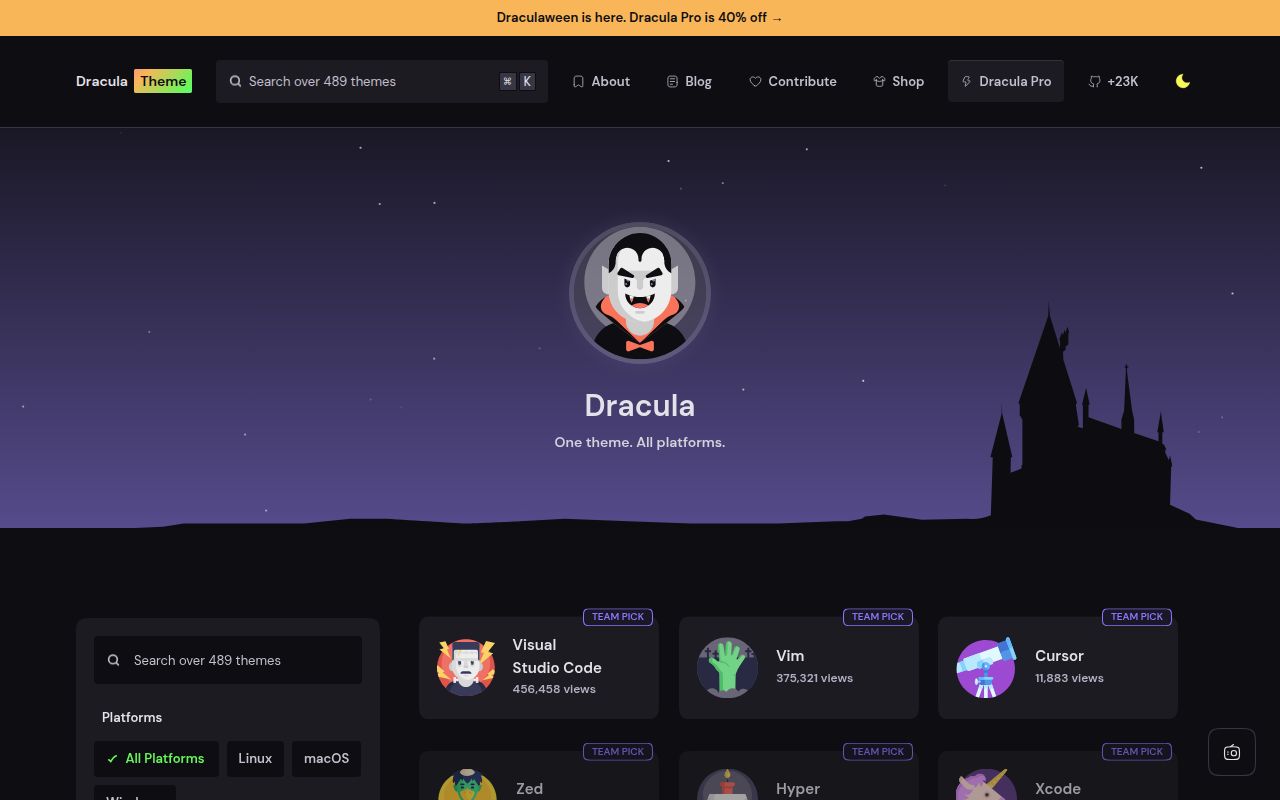
Dracula is a shared color scheme with implementations for editors, terminals and other applications. The main repository publishes its palette and directs users to app-specific instructions. I'd consider it when you want familiar colors across several tools and are willing to check each implementation. Our lab run offers no basis for recommending every port as equally polished.
What happened when we ran it
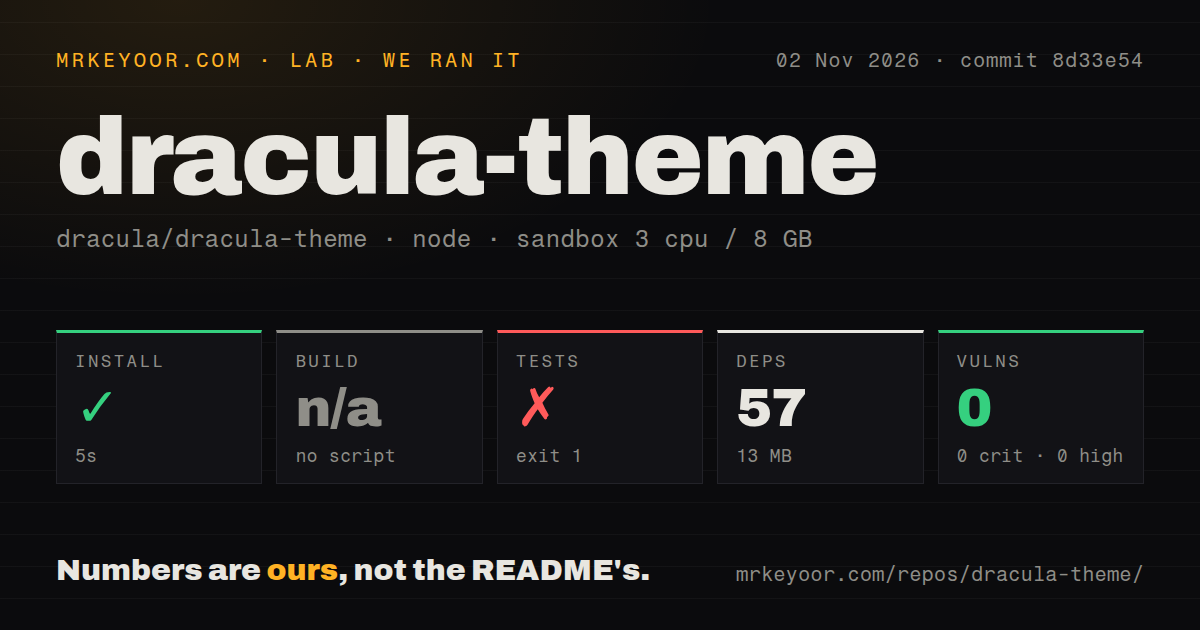
Our Dracula run completed npm installation in 5 seconds, recording 57 dependencies and 13 MB on disk, then failed its test command in 1 second with exit 1. We ran commit 8d33e54 on November 2, 2026. The Node project selected for this run lived in ./themes/adventofcode/. There was no build script or target, so the build step was skipped.
The failing log says Error: no test specified. Its command printed that message and exited 1. This is an explicit placeholder command, not a reported assertion failure in a theme test suite. The distinction matters: the command failed, but it supplies no evidence that Dracula renders incorrectly. It also supplies no passing checks of the colors or their application-specific mappings.
Our configured sandbox had 3 CPUs, 8 GB RAM and image lab-node:22. The image name does not establish the actual runtime or operating-system version. The checkout contained 19,425 files, approximately 866,739 source lines and 769.2 MB. The scan found 2 CI workflow files, no Dockerfile and no tests directory. Those are repository observations, not a requirement to download the whole collection to change an editor theme.
The recorded npm audit found 0 known vulnerabilities. That result belongs to the selected npm environment, not a security assessment of every theme or extension. We did not visually inspect an installed port, measure contrast ourselves or test compatibility with an editor release. Neither the short installation nor the failed placeholder answers those questions.
Each application has its own installation route
The README says themes have separate repositories so they can support different package managers and release independently. For a user, the practical starting point is the application listing, followed by that port's instructions. The measured Advent of Code environment does not tell you how much disk space or effort the VS Code, Vim or terminal version needs.
The VS Code installation guide tells users to open the Command Palette, choose Install Extension and search for Dracula Official. It then describes activating the theme from the Color Theme menu. This documented route asks for an existing editor rather than a hosted service or API credential. We did not reproduce it, so no installation result for the extension follows from our npm run.
Check the exact app and version you use. A terminal palette and an editor syntax theme have different surfaces to cover, even when both draw on Dracula's colors. For a team rollout, record the port repository and chosen revision separately for each tool. That gives you a specific place to report a problem and a specific change to reverse.
A shared palette does not verify every screen
The published Dracula palette uses #282a36 for the background and #f8f8f2 for the foreground. It also assigns distinct comment, selection and accent colors. These definitions explain what a port starts with. They don't establish whether every warning, selected completion or search result remains readable in your application.
The README makes a foreground/background accessibility claim. We have not audited that claim or the rendering of individual ports. A reader who requires verified accessibility should assess the actual screens and text roles they depend on. A palette-level statement is insufficient evidence for all states in an editor, particularly when extensions add their own highlighting.
The current README also publishes Alucard, a light palette. That is worth knowing if dark backgrounds are a poor fit for your workspace. It does not establish that your selected application port includes Alucard. Check the port before treating a light variant as available, and compare it using your normal files rather than a promotional screenshot.
Recent submissions show activity across separate ports
GitHub records the main repository's last push on November 1, 2026. Its recent issue activity includes a November 3 GitKraken Kepler submission and a November 2 Payload Admin theme request. These are concrete signs that people are contributing new ports. A submission is not evidence that an official port has been accepted or works in your environment.
The main README says most application themes are community contributions and identifies per-theme maintainers. I'd avoid Dracula if your rollout requires one support commitment covering every application. The evidence here does not establish that commitment. We leave numerical community and maturity ratings unassessed rather than converting repository attention into a promise of support or compatibility.
Compare palettes on the same files
Catppuccin describes a pastel theme with four flavors. Consider it when choosing among several palette variants matters to you. Nord describes a north-bluish palette. Consider it when that color direction suits your tools better. These are aesthetic and workflow alternatives, not measured winners for readability or setup effort.
Start with the Dracula port for your most-used application. Open a normal source file, inspect comments and search selections, then check warnings and diffs. If those states work for you, evaluate the next application separately. Keep your previous theme available until the screens you rely on have passed that check.