Choose the skill or the session integration
SimpleEnglish's skills-CLI route installs writing instructions without the session hook or Claude Code output style. The plugins add session loading. Choose the route according to how broadly you want the rules applied, then verify that the intended instructions loaded.
The README describes two modes. Plain mode uses direct answers, active voice and sentence-length limits. Strict mode adds STE vocabulary discipline when requested. These rules make the skill a candidate for technical instructions whose terms and conditions need to remain consistent. Our sandbox did not assess whether its rewrites preserve meaning.
The reply rules prohibit headings, bullets, bold, tables and contractions. Try those restrictions on representative chat tasks before enabling session-wide loading. The document rules form a separate register for READMEs, runbooks and other technical writing.
What happened when we ran it
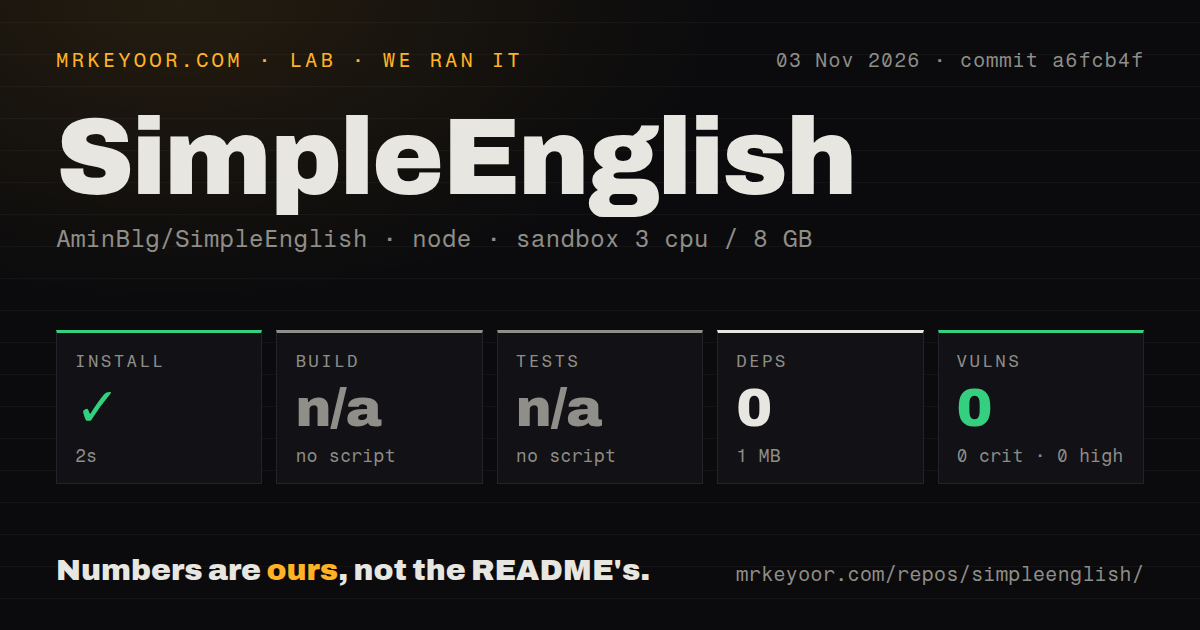
Our sandbox's npm install succeeded in 2 seconds on 2026-11-03 at commit a6fcb4f, recording zero dependencies and 1 MB on disk. The detected Node project was under src/hooks/. The harness discovered no automatic build or test target, so it skipped both steps.
That discovery does not mean the repository has no runnable tests. The hook README documents these commands from the repository root:
node --test src/hooks/simple-english-activate.test.js
python3 src/hooks/test_lint_hook.py
Neither command was run in our sandbox. They are documented checks, not passing results from this review.
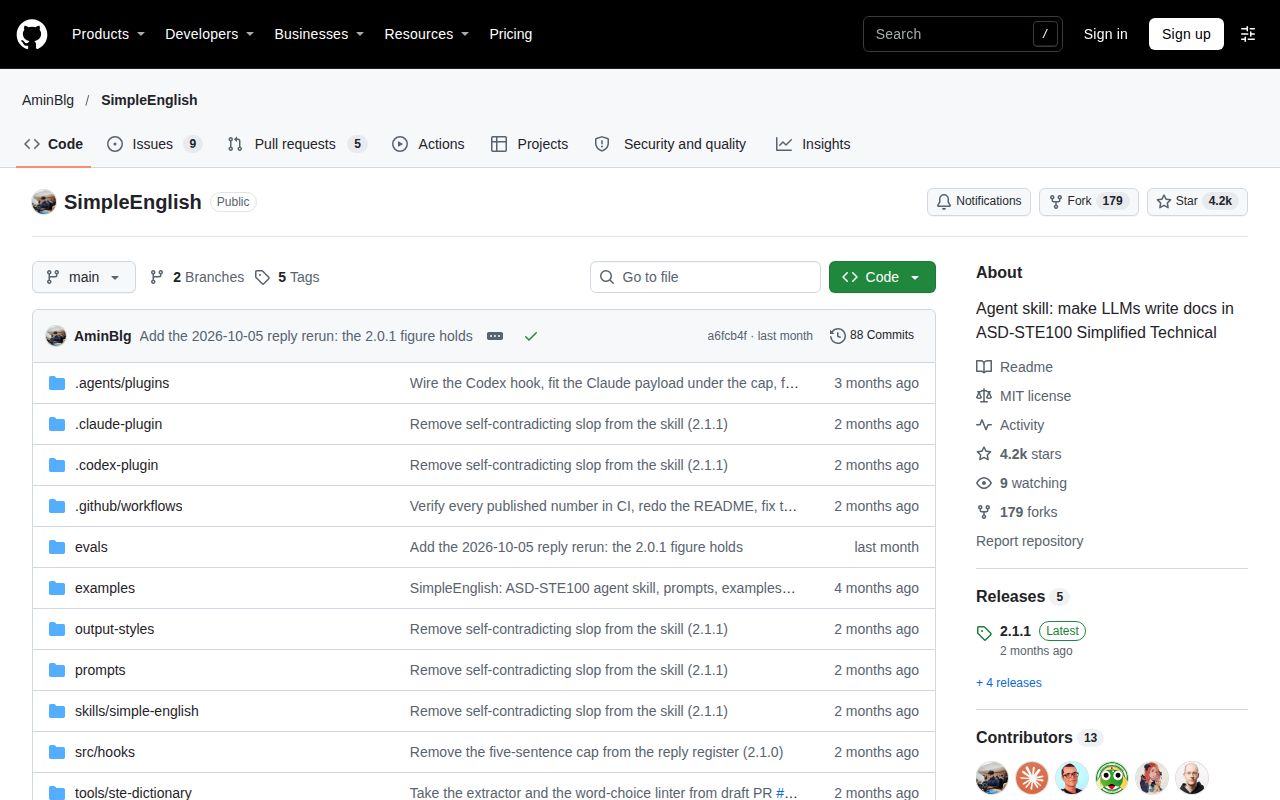
The checkout scan recorded 958 files, about 2,532 source lines and 1.2 MB. It found one CI workflow file, no Dockerfile and no tests directory. The documented test files show why a directory scan cannot establish the absence of checks.
Npm audit reported zero known vulnerabilities, with zero critical, high, moderate or low findings. That result covers the recorded Node audit, not writing quality or the complete agent workflow. The zero-dependency observation applies to the detected hook subproject.
The sandbox configuration recorded 3 CPUs, 8 GB RAM and image label lab-node:22. The image label does not verify a Node or operating-system version. This run did not validate a live plugin session, execute the advisory checks or assess an agent writing sample.
Session loading and writing checks use different runtimes
The SessionStart hook uses Node.js in both Claude Code and Codex. It sends a condensed rule block and names the full skill path. If it cannot read the prompt file from any expected location, it prints fallback rules and exits successfully. A successful session start therefore does not prove that the intended prompt file loaded.
Claude Code's additional file and reply checks use Python scripts and are advisory; neither blocks. The hook documentation identifies src/hooks/lint_hook.py for both checks and evals/ste_lint.py for Markdown linting. Codex runs only the SessionStart hook. Our run did not validate the Python checks' execution or runtime requirements, and the supplied evidence does not establish a required Python version.
For Claude Code, the README specifies the output-style name simple-english:simple-english and says the short name does not resolve. Codex asks users to review and trust the hook before its first run. These configuration steps were not validated by our npm installation.
The v2.1.1 report measures formatting
The October 5 report includes a condition using the rule block from tag v2.1.1. This contradicts the README's statement that no reply run exists for 2.1.0 or later. The README's historical 2.0.1 figures should not be presented as measurements of v2.1.1.
The report also distinguishes a bare rule block from the same instructions with the page header attached. That distinction matters when reproducing the upstream setup or choosing what to paste into an agent.
The upstream scorer counts formatting only and cannot detect facts added or dropped from replies. These evaluations are separate from our sandbox. They do not establish factual fidelity or reader comprehension. Compare a rewritten instruction with its source, especially prerequisites, conditions and exceptions.
The README says the project does not provide STE-certified output and identifies it as unofficial. Teams requiring compliance approval need a separate review process.
Check the reported Windows limitation before relying on warnings
The supplied open-issue sample includes issue #51, an unverified user report that the Stop hook produces false dash warnings on Windows for replies containing non-ASCII text. The reporter names plugin 2.1.1. We did not reproduce the report or verify its proposed cause or fix. Windows users should include representative non-ASCII replies when checking the integration.
Alternatives for checking existing prose
Vale is a command-line prose linter that turns writing guidelines into checks. Consider it when you want explicit checks in documentation workflows rather than relying on an agent to follow writing instructions.
Proselint scans existing prose and prints suggestions. Consider it when that checking workflow fits your needs without session-wide writing instructions. Neither alternative was tested in this sandbox, and this comparison does not establish better rewrite quality.
For a SimpleEnglish trial, choose a document whose meaning you can verify. Confirm session loading, run the documented checks in your environment and compare the rewritten document with its source before adopting the rules more broadly.