Four playback engines sit behind one Android UI layer
GSYVideoPlayer v13.2.1 wraps IJKPlayer, AndroidX Media3, Android MediaPlayer, and AliPlayer. The useful part is the behavior built around those engines: full-screen handoffs, list playback, floating windows, rotation, caching, ads, external subtitles, frame capture, and custom controls. If your product team has already written that machinery twice, the library can replace a large patch of app code. If all you need is one HLS screen, the wrapper may be more architecture than the job deserves.
The size of the checkout makes that trade visible. We measured 774 files, about 68,539 lines of source, and 138.7 MB at commit 1c6bace. This is a long-running Android framework with sample applications and several engine modules, rather than a small view around a decoder. You choose the Java layer, the playback kernel, and any ABI-specific native packages. That modularity lets an app avoid some binaries, but it also gives the team more combinations to verify.
v13.2.1 covers jobs that Media3 leaves to the app
The feature list is unusually practical. GSYVideoPlayer supports SRT and WebVTT overlays across three kernels, HLS and DASH quality selection through Media3, WebVTT thumbnail previews, multi-window playback, screenshots, GIF creation, and more than 20 visual filters. Version 13.2.1 moved the jUPnP and Jetty implementation into an optional casting artifact, so the default library no longer brings those pieces into every app. That is a sensible boundary for teams that never cast to a TV.
Compose support arrived as a published module in v13.1.0. It includes a wrapper for StandardGSYVideoPlayer and a controller with state plus one-shot events for native Compose controls. The README points to 24 runnable Compose activities, covering lists, floating windows, subtitles, filters, caching, and ads. Existing View-based code remains underneath. That makes Compose adoption gradual, which is helpful in an older app, though a team seeking a Compose-only playback stack should understand the boundary before committing.
What happened when we ran it
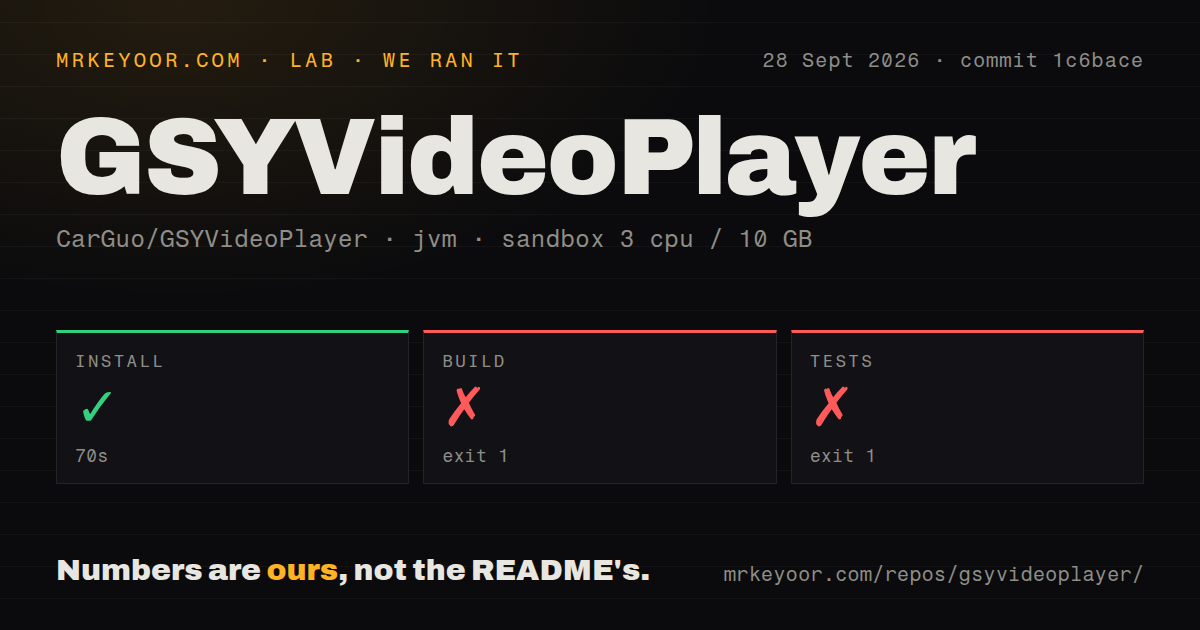
Our sandbox install stage succeeded in 70 seconds. The build failed with exit 1 after 10 seconds, and the test command also failed with exit 1 after 10 seconds. Both log tails reported the same concrete problem: Gradle could not locate an Android SDK through ANDROID_HOME or the repository's local.properties file. The failure happened while it tried to determine dependencies for :app:compileDebugJavaWithJavac. The log also warned that deprecated Gradle features will be incompatible with Gradle 9.0.
We ran commit 1c6bace in an unprivileged container with 3 CPUs and 10 GB of RAM. The 138.7 MB checkout had 3 CI workflow files, no Dockerfile, and no tests directory in our scan. Because Gradle stopped at SDK discovery, our run did not reach Java compilation or test assertions. The honest result is narrower than saying the project is broken: a fresh JVM image was enough for the install stage, but it was not a complete Android build environment.
Maven Central is the shortest route into an app
Version 13.2.1 is available from Maven Central as a complete artifact or as separate Java, Media3, AliPlayer, casting, and ABI packages. That path avoids building the repository and does not need the GitHub Package credentials described in the README. JitPack remains documented, but the project itself warns that historical packages can disappear there. For a new application, Maven Central is the least surprising source and lets the team add only the playback pieces it has chosen to support.
Repository work has a higher floor. The Compose module requires JDK 17 or newer, while its CI uses JDK 21. The core Media3 path now sets minSdk 23, and the optional casting artifact declares minSdk 26. Those numbers can rule out an integration before any code is written. A playback matrix should also name the chosen engine and ABI set, because IJK, Media3, system playback, and AliPlayer do not share identical protocol or caching behavior.
The IJK route ships FFmpeg 4.3 binaries
The README says the ex_so packages use FFmpeg 4.3 and OpenSSL 1.1.1w on arm64 and x86_64. Open issue 4255 examines the committed FFmpeg binaries and asks maintainers to address their age. The reporter explicitly did not establish that a particular vulnerability is reachable in GSYVideoPlayer's reduced build. That distinction matters. The finding is still enough to require a security review when an app parses untrusted files or network streams through the IJK path.
AndroidX Media3 is the cleaner alternative when its protocol and codec support is sufficient. GSYVideoPlayer still has a case for RTMP, custom kernels, filters, or layouts that would otherwise become product code. Its 16 KB page-size work also shows attention to current Android packaging requirements. Choose the IJK modules because a tested stream set needs them, rather than selecting the largest artifact and inheriting native libraries by default.
September 2026 activity is current, while support stays self-service
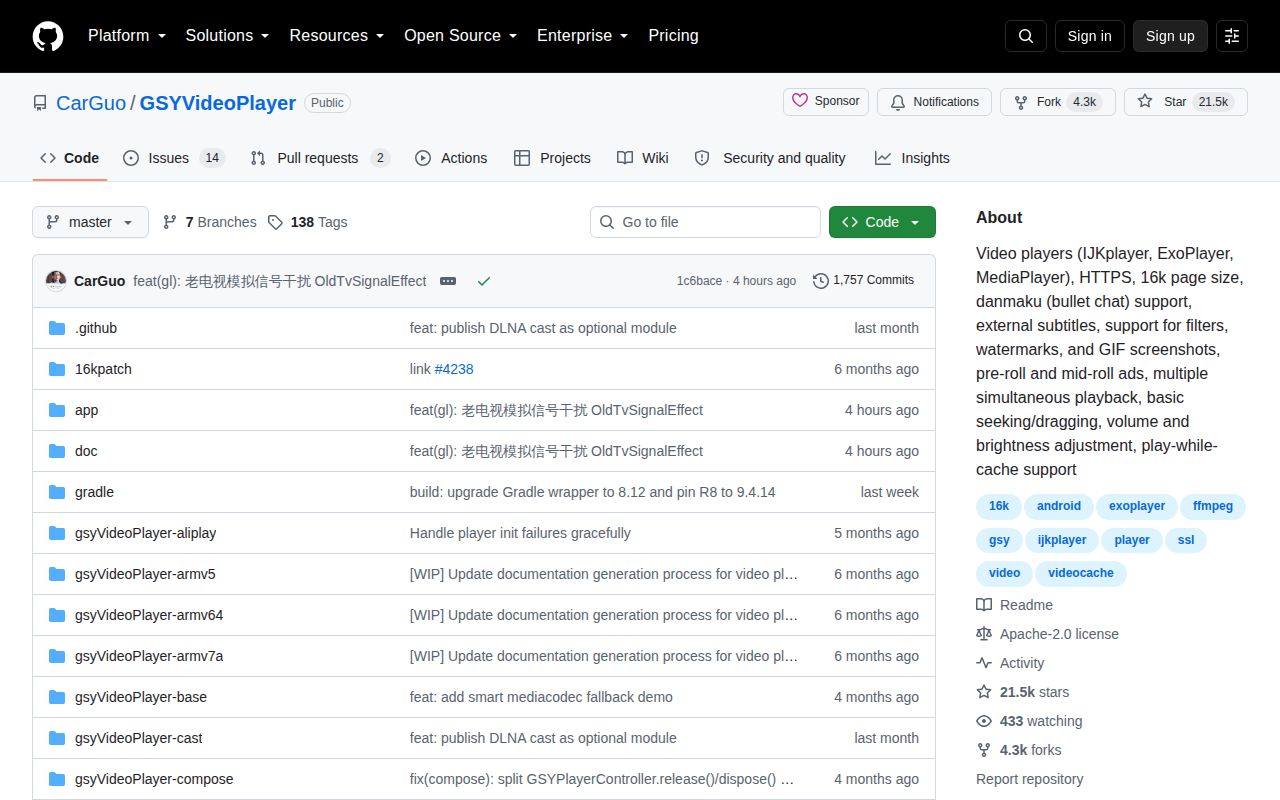
The repository was pushed on September 28, 2026, and v13.2.1 was released on August 19, 2026. GitHub listed 14 open issues and 2 open pull requests when we fetched it. Recent commits added rendering effects and updated the Gradle wrapper, while a September issue received a maintainer reply the next day. Those signals point to active development even though several long-running support threads remain open. A release tag by itself would tell less than this combination.
GSYVideoPlayer had 21,498 stars when fetched, but popularity does not buy an SLA. The README tells users to reproduce problems in the demo, include the device and Android version, and understand basic codec behavior. It also says the project does not provide technical support. Before adopting it, make a short list of required streams, Android versions, screen transitions, and playback engines. If that list uses the library's extra machinery, test those exact paths. If it does not, Media3 is the easier dependency to defend.