Typed service contracts are the reason to choose it
gRPC-Go turns Protocol Buffer service definitions into Go client and server interfaces. A method call can carry unary data or streams, and the runtime handles HTTP/2 framing, metadata, deadlines, cancellation, status codes, and connection management. That gives Go services the same wire contract used by gRPC implementations in other languages. The result is most useful inside organizations that already treat schemas as shared infrastructure rather than files owned by one service.
The library is focused. It does not decide how your application stores data, structures business logic, deploys containers, or publishes an external developer experience. GitHub showed 23,038 stars and 127 open issues and pull requests combined when fetched. The latest push was August 27, 2026, and release v1.83.2 arrived two days earlier. Those dates and the active queue support a strong maintenance assessment without pretending the combined open count is a bug total.
Importing one module is easy; designing the contract is the work
For an existing Go module, installation can be as small as importing google.golang.org/grpc and running go build, go run, or go test. The official quick start covers Protocol Buffer compiler setup and generated stubs. That first example is accurate, but production adoption also requires package naming, field evolution rules, error conventions, deadlines, authentication, retry policy, and a plan for generated files. These decisions affect every client, so they deserve review before the first service ships.
The README supports the two latest major Go releases. That policy is reasonable for an infrastructure library, though it can force upgrades in conservative environments. Our checkout contained 1,355 files and roughly 341,701 source lines, with 9 CI workflow files and a tests directory. There is no Dockerfile because grpc-go is a library, not a standalone server image. Consumers own the application image, runtime settings, and networking around it.
What happened when we ran it
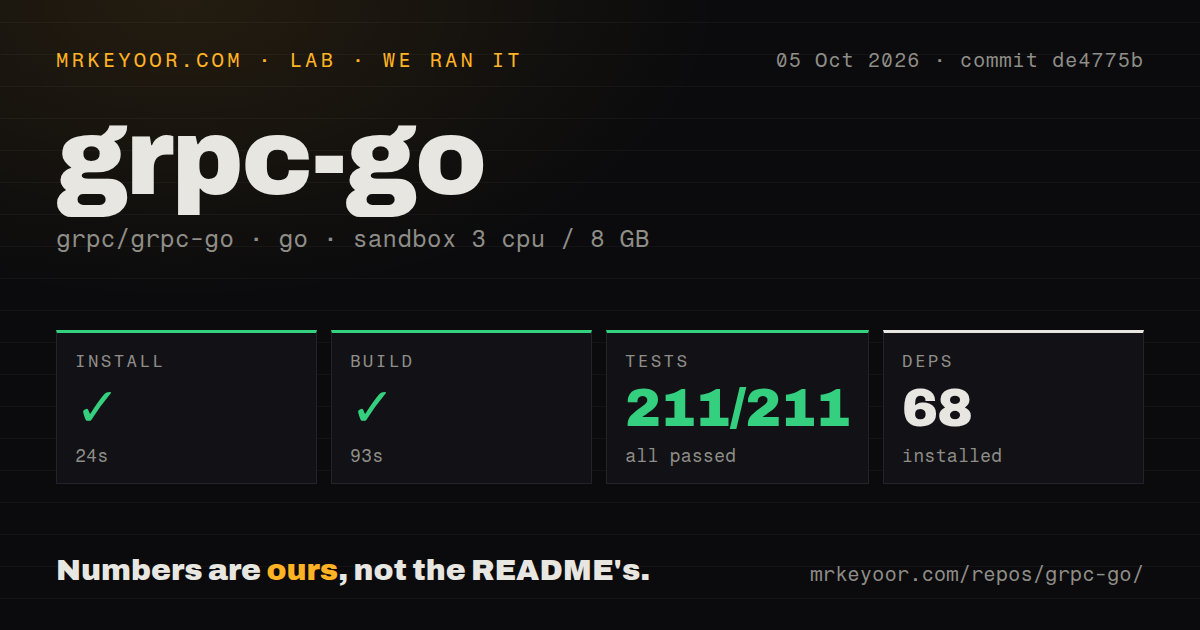
Our sandbox cloned commit 664e87d into a fresh unprivileged Debian container with 3 CPUs and 8 GB of RAM. Installing the Go dependencies succeeded in 50 seconds and fetched 87 packages. The repository occupied 14.4 MB before that work. No credentials or external application service were supplied for this harness run.
The build succeeded in 68 seconds. Tests finished in 145 seconds, and go test reported 208 passed with 0 failed out of 208. This is a clean result for the checked-out commit and stated environment. It is not a latency or throughput benchmark, and it does not prove behavior through a particular ingress controller, service mesh, DNS resolver, or certificate setup. Those components sit outside the repository test result.
A complete install, build, and 208-test pass gives grpc-go a better trial result than projects whose basic suite needs undocumented services. It also makes local contribution less uncertain. The 145-second test duration is modest enough for a developer loop on our 3-CPU box, while CI should still cache modules and separate expensive integration jobs as the project itself does.
HTTP/2 infrastructure can turn simple failures opaque
The README's transport is closing FAQ is unusually candid. An Unavailable result can follow a failed TLS handshake, disrupted bytes in a proxy, server shutdown, or connection-age settings that close a transport. The recommended diagnostic is to enable logs on both client and server because the caller often sees only the closed connection. In practice, teams also need load-balancer logs and traces that preserve RPC method, status, retry, and deadline information.
Connection policy deserves a staging test with the actual network path. A stream that works directly between two containers may behave differently through a proxy with a 60-second idle timeout. Keepalive can detect dead peers, but aggressive settings can cause their own shutdowns. Deadlines should come from the caller, and retries must be limited to operations safe to repeat. grpc-go supplies the controls; it cannot infer the business meaning of repeating a request.
Browser clients may be better served by Connect
Native gRPC uses HTTP/2 and binary messages, which is efficient for service communication but awkward for browser and command-line inspection. gRPC-Web or a gateway can bridge that gap, adding another protocol or translation service. Connect-Go supports gRPC and gRPC-Web while offering a browser-friendly protocol, making it a strong comparison when one API must serve Go services and web applications. Plain JSON over net/http remains easier for small public APIs with few methods.
Schema tooling also changes the development loop. Teams need compatible protoc plugins, reproducible generation, and checks that generated code matches the committed definitions. A 208-test pass in grpc-go does not validate your .proto evolution. Reserve field numbers after deletion, avoid changing existing field meanings, and test older clients against newer servers. Cross-language compatibility is earned through those habits rather than granted by the RPC library.
Current security fixes show why pinning matters
Release v1.83.2 contains one security change: servers reject requests missing both :authority and Host headers with HTTP 400 and an Internal status. The release was published August 25, 2026. Even a mature transport library receives security corrections at protocol edges, so applications should pin a reviewed version and maintain a routine for dependency updates rather than leaving grpc-go untouched after initial deployment.
The open work also shows depth in xDS, flow control, OpenTelemetry retry metrics, cancellation, and transport allocations. That is healthy activity around complex production behavior. grpc-go is the right default when native gRPC is already the architectural choice. If the choice itself is still open, compare it with Connect-Go and a plain HTTP API using your browser needs, proxy path, debugging habits, and schema ownership as the deciding criteria.