It turns three Grok account types into one gateway
Grok2API sits between applications and Grok Build, Grok Web, or Grok Console. It exposes OpenAI-compatible Responses and Chat Completions plus Anthropic-compatible Messages, then selects an account that can serve the requested model. The built-in admin console manages accounts, public model routes, client credentials, quotas, audits, and media. This is useful when Codex, Claude Code, scripts, and user-facing apps would otherwise each carry separate provider logic.
The repository is much larger than a thin protocol adapter. Our commit 6463c6a checkout contained 611 files and about 189,514 lines of source, with the measured Go project under backend/. Routing accounts for quota, concurrency, cooldowns, sticky sessions, and bounded failover. Image, video, speech, stored responses, and prompt-cache behavior add more provider-specific state. That breadth explains both the appeal and the maintenance burden.
Provider boundaries reduce accidental account mixing
Build uses OAuth and discovers models per account. Web and Console use SSO credentials with built-in catalogs. Each provider retains separate health, quota, cooldown, concurrency, and capabilities. The README says retries remain inside one route unless a public model name deliberately combines several routes. That separation is a sensible defense against treating unlike browser and API products as interchangeable.
The gateway still depends on contracts outside its control. Release v3.1.5, published August 25, 2026, includes fixes for empty streams, required response fields, video input, cooldown behavior, quota reconciliation, and provider prefixes. One open report on v3.1.5 describes Web image requests returning upstream_unavailable even though the account appeared usable. Another report discusses Console model-quality filtering. Neither report proves a general defect, but both show the sort of upstream drift an operator inherits.
What happened when we ran it
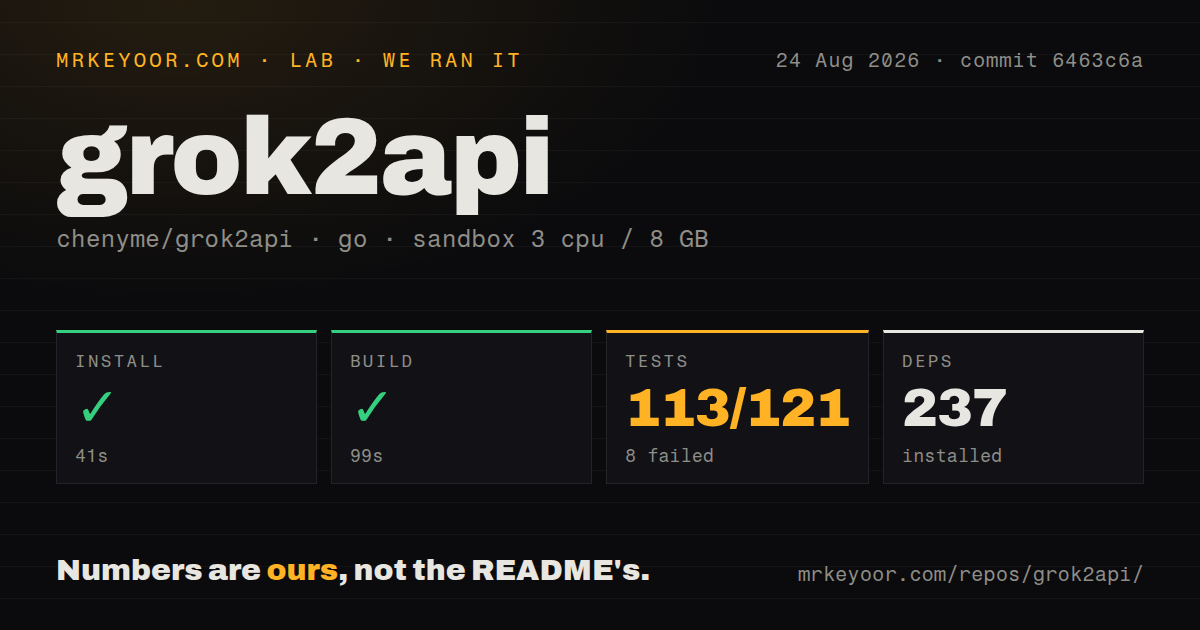
Our sandbox installed 237 Go packages in 41 seconds. The build completed in 99 seconds. Those two stages worked in a fresh unprivileged Debian container with 3 CPUs, 8 GB of RAM, no secrets, and the golang:1.24-bookworm image. The 9 MB checkout did not need live Grok credentials to reach the build stage.
Tests ran for 894 seconds and exited with code 1. Go reported 113 packages passing and 8 failing out of 121. The supplied log tail shows successful results for admin authentication, audits, client credentials, dashboard, egress, inference, media, middleware, models, settings, and system transport packages, followed only by the overall FAIL. That tail does not identify the eight failing packages or their causes, so we cannot assign the failure to missing services, network access, or code.
Secret custody is the hardest setup requirement
The Compose path starts at port 8000 after copying config.example.yaml and generating a JWT secret plus a credential-encryption key. You then set a bootstrap administrator password, sign in, connect a Build, Web, or Console account, wait for sync, inspect routes, and create a client credential. The README tells operators to change the administrator password and remove the bootstrap account from configuration after first sign-in.
Credential handling deserves more attention than the short quick start suggests. Build refresh tokens can rotate, and sharing one credential between this gateway and another active client can leave one side holding an obsolete token. The encryption key must not change after provider credentials have been stored. Backups need the configuration, database, and media together. A lost key or partial restore can make the stored account pool useless even if the application container starts.
One instance is simpler than a shared deployment
A single instance can use SQLite, process memory, and local media. The documented multi-instance design requires PostgreSQL, Redis, and a shared read-write directory. Reverse proxies need an explicit trusted proxy address or isolated CIDR so audit records contain the real client address without accepting spoofed forwarding headers. The application rejects unrestricted trusted ranges such as 0.0.0.0/0, which is a welcome guard.
Egress adds another operating layer. Grok2API can manage HTTP and SOCKS proxies, several tunnel formats, proxy pools, subscriptions, health probes, and optional FlareSolverr clearance. Hysteria and TUIC are unsupported, and FlareSolverr accepts only HTTP or SOCKS proxy URLs. A deployment using account-specific exits must therefore monitor account health, tunnel health, clearance state, and the upstream service, not just the gateway process.
Billing controls have documented blind spots
Client credentials can restrict models and set request-rate, concurrency, spend, and expiry limits. Audits retain usage for billing reconciliation. The README also states where accounting is incomplete: speech-to-text duration is known only after completion, so concurrent requests may briefly pass a spending cap. Realtime requests, video edits or extensions, and custom routes without recognized official prices are recorded as unpriced and do not consume that limit.
That caveat matters if the gateway is used as a reseller boundary or a hard internal budget control. Audit records can explain activity, but a limit that excludes callable routes is not a universal cost ceiling. The safer use is controlled access among known users, with external provider quotas and alerts behind it. The README's research-only notice and terms warning should also be reviewed before any commercial use.
The active release pace comes with compatibility work
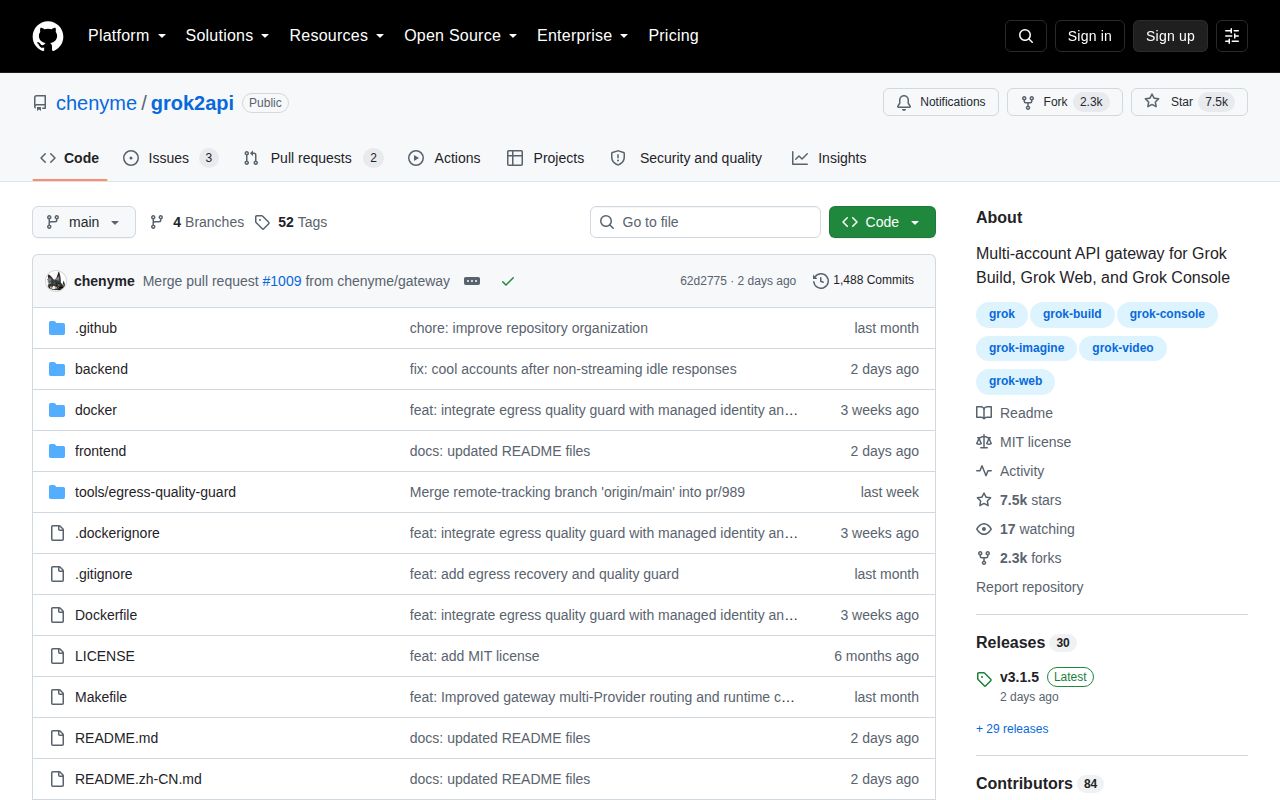
GitHub showed 7,540 stars, 5 combined issues and pull requests, and a last push on August 25, 2026. The latest release landed the same day. Those dates indicate active maintenance, while the small combined queue does not tell us how many defects exist. Recent release notes are dominated by fixes at provider boundaries, which is expected for a gateway translating changing upstream behavior.
Grok2API earns a trial when Grok-specific pooling is the requirement and the operator understands what is being stored. The 8 failed test packages stop us from recommending commit 6463c6a for immediate production use. Reproduce those failures, use disposable accounts first, verify every billed route, and keep the encryption material with the database backup. If those tasks sound excessive, an official API connection is the cleaner choice.