A 1 MB checkout does one job
Screego exists because code can become unreadable when a general meeting app lowers screen quality or falls behind. Its answer is narrow: create a room, share a screen, and let several people watch through WebRTC. There is no promise of camera calls, audio, chat, recording, or remote control. That restraint is useful. A developer who already has a voice channel does not need to deploy a second collaboration suite just to make text on a shared terminal legible.
The codebase matches that scope. Our checkout contained 106 files, about 4,709 source lines, and occupied 1 MB. The server is written in Go, the browser client handles capture and playback, and releases arrive as a single binary or multi-architecture Docker image. GPL-3.0 covers the repository. Configuration can come from environment variables or several ordered files, with the first value found winning instead of later sources overriding it.
WebRTC moves the hard part into the network
Screego v1.12.5 includes a STUN and TURN server, but self-hosting still requires a public route that browsers can use. STUN helps peers discover addresses and keeps the actual stream direct when their networks permit it. TURN relays media when stricter NAT rules block a direct path. Relay traffic then consumes server bandwidth, and Screego requires user authentication for its TURN service by default.
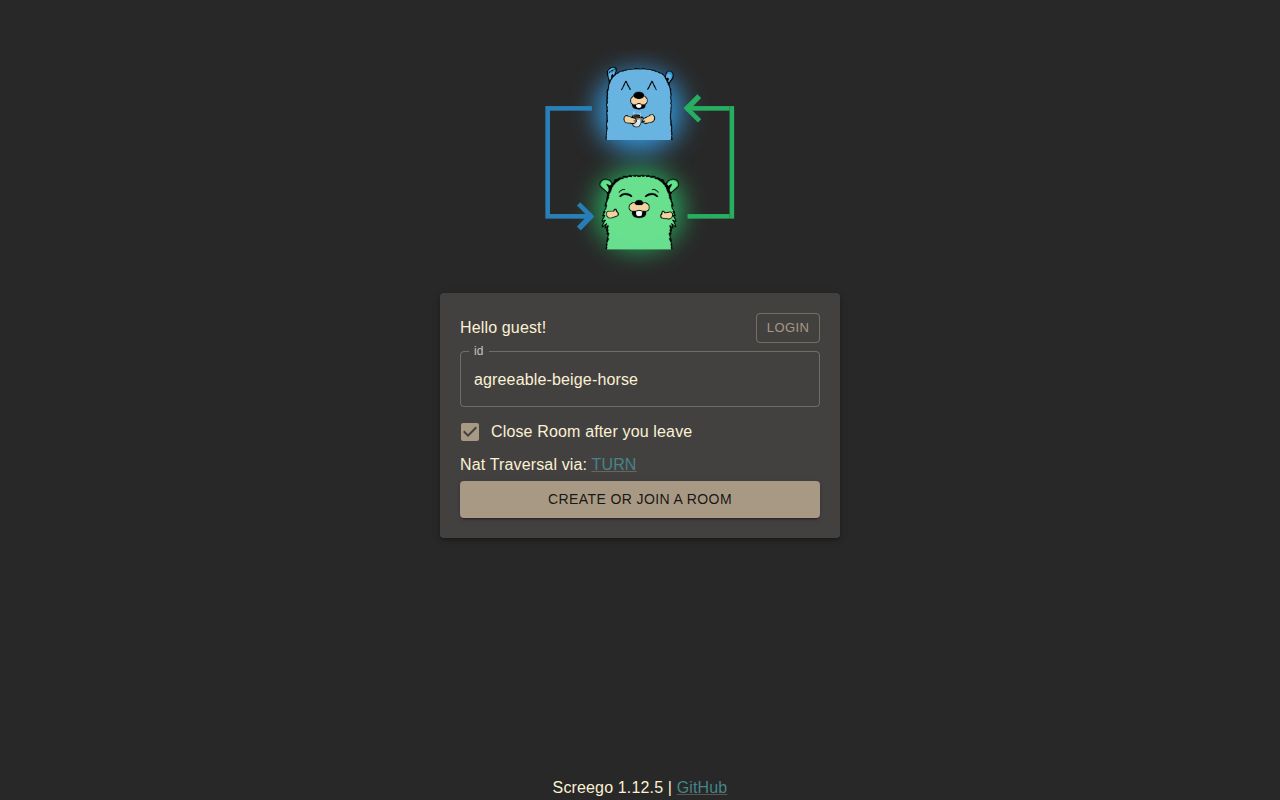
TLS is mandatory, either inside Screego or through a reverse proxy. Port 5050 is the documented HTTP default, while the built-in TURN listener uses 3478 and may need a UDP relay range such as 50000 through 50200. The Docker guide recommends host networking and warns that a mapped-port deployment may not work correctly. Issue #226 is linked from that warning, so a container that renders the login page has not yet proved that two browsers on different networks can exchange a screen.
What happened when we ran it
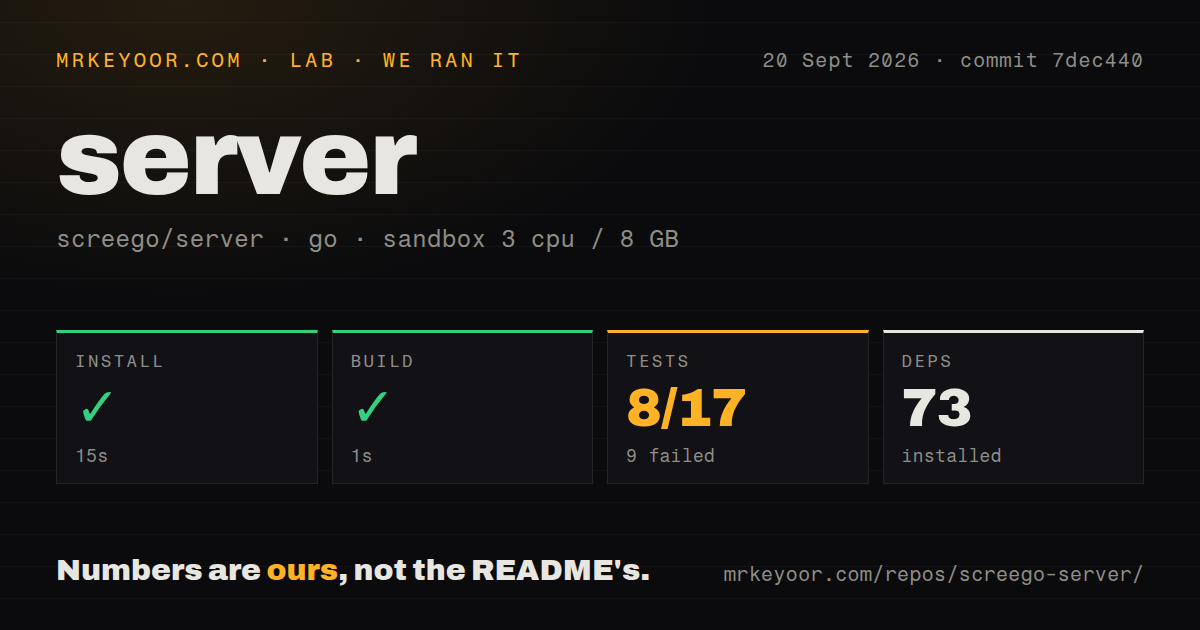
Our fresh Go 1.24 container installed 73 packages in 15 seconds. The complete source build succeeded in 1 second, which fits the small repository. Testing took 38 seconds and ended with exit code 1. The harness counted 8 passed and 9 failed packages out of 17. That is a mixed result: compilation was immediate, but the repository did not clear its own test command in our stated environment.
The tail of the test log marks the root package plus cmd, router, and ui as setup failures. It shows successful results for config, config/mode, server, and ws, while several other packages report no test files. The excerpt does not include the earlier setup error, so it cannot support a claim about the cause. A missing Debian package is possible in a fresh container, but naming one without the relevant line would be guesswork.
Our scan found 1 CI workflow and a Dockerfile, with no top-level tests directory. Go commonly keeps test files beside package code, and the 17-package result confirms that tests exist somewhere in the tree. The actionable finding is that a release-minded operator should rerun go test with the complete log, resolve the 9 package failures, and then exercise a real cross-network WebRTC session. A successful 1-second build does not test NAT traversal.
Six viewers can be a different workload from two
Open issue #160 reports the sender reaching 100% CPU while streaming to 6 viewers. The reporter asks whether the stream is encoded and encrypted separately for every person. An open pull request, #248, adds an SFU, which is the server component commonly used to forward one incoming stream to several recipients. The pull request author also says the implementation may only appear to work, so it should not be described as shipped capacity.
Small rooms should still test the actual presenter machine. Resolution and bitrate depend partly on browser WebRTC behavior, and open issues request controls for both. Release v1.12.5 addressed flaky network connections aborting a share, which is directly relevant to the product's one job. It does not turn Screego into a broadcast system. If one presenter must serve a department, compare an SFU-based product before asking every laptop to prove it can sustain that fan-out.
Authentication is local and TURN-aware
Screego accepts three documented authentication modes: always require login, require it for TURN, or never require it. Accounts live in a configured users file as a name and bcrypt password hash. A separate secret protects cookie authentication, and session lifetime is configurable. Prometheus metrics can be enabled and are protected with basic authentication from the same users file. CORS origins and trusted proxy headers also need deliberate values behind a reverse proxy.
OIDC support remains open in issue #156. That makes the local account model a practical dividing line: a small team can manage a short users file, while a company that requires centralized onboarding and removal will be building around the product. External TURN has limits too. Issue #242 asks for configurable secure turns and stuns schemes, and issue #246 asks for several TURN servers with failover. Neither request should be mistaken for a current feature.
August code and September reviews show maintenance
GitHub recorded 10,664 stars and 18 open issues and pull requests when fetched. The repository's last push and v1.12.5 release were both on August 20, 2026. The open queue contained 16 issues and 2 pull requests, with the resolution-control pull request updated on September 9. The dated push, release, and review activity together show maintenance more clearly than the release tag alone.
Screego is appealing because it refuses to become a meeting suite. That same focus means the network has nowhere to hide: HTTPS, external addressing, UDP, TURN authentication, relay ports, and browser behavior all land on the operator. Pair the small binary with a small room and it makes sense. Pair it with strict SSO rules or a large audience, and the missing surrounding systems become more work than the 1 MB checkout suggests.