This repository builds GraalVM internals, not a normal application dependency
oracle/graal is the main engineering workspace for much of GraalVM. It contains the optimizing Graal compiler, SubstrateVM and Native Image, the Truffle language framework, Espresso's Java bytecode interpreter, Sulong for LLVM bitcode, GraalWasm, a regular-expression engine, tooling, and the Ideal Graph Visualizer. Related language implementations such as GraalJS and GraalPy live in other repositories. The result is a compiler and runtime platform assembled from several substantial components, not one library to add to a Maven file.
The scale confirms that distinction. Our checkout at commit 8f1ea8c contained 20,963 files, about 3,515,494 lines of source, and occupied 266 MB before the measured setup. Most Java developers should begin with a packaged GraalVM JDK and use it like another development kit. Cloning this tree makes sense when you need to trace compiler behavior, modify Native Image, build a Truffle language, or work on a runtime component.
Native Image is the part many application teams care about. It compiles Java applications ahead of time into standalone executables, avoiding the normal managed-runtime warmup path. That can change startup and packaging behavior, but the README's performance language is a project claim rather than a benchmark from our sandbox. We did not measure application startup, memory, throughput, binary size, or compatibility, so this review does not attach invented gains to a sample workload.
Download a distribution before attempting the source build
The project's top-level instructions are a map, not a complete build recipe. User documentation lives on the GraalVM website, component documentation sits under several docs directories, and source-build instructions live in vm/README.md. That organization is reasonable for a tree with 3.5 million lines, but it means git clone followed by one universal command is not the intended newcomer path.
A Java team evaluating Native Image should install a current GraalVM distribution, compile its own application, then inspect what breaks. Reflection, dynamic class loading, proxies, resources, JNI, and serialization can require reachability information because ahead-of-time analysis must know what the program may use. The README points to a separate reachability-metadata repository for open-source libraries. Compatibility work belongs in the evaluation budget, especially for older frameworks or code that discovers behavior at runtime.
Source contributors face a broader matrix. The compiler is Java, while the repository's build orchestration includes Python tooling and component-specific dependencies. Espresso, Truffle, SubstrateVM, Sulong, and the WebAssembly backend have different development concerns. Our harness's quick build result should not be read as a complete distribution produced from every component.
What happened when we ran it
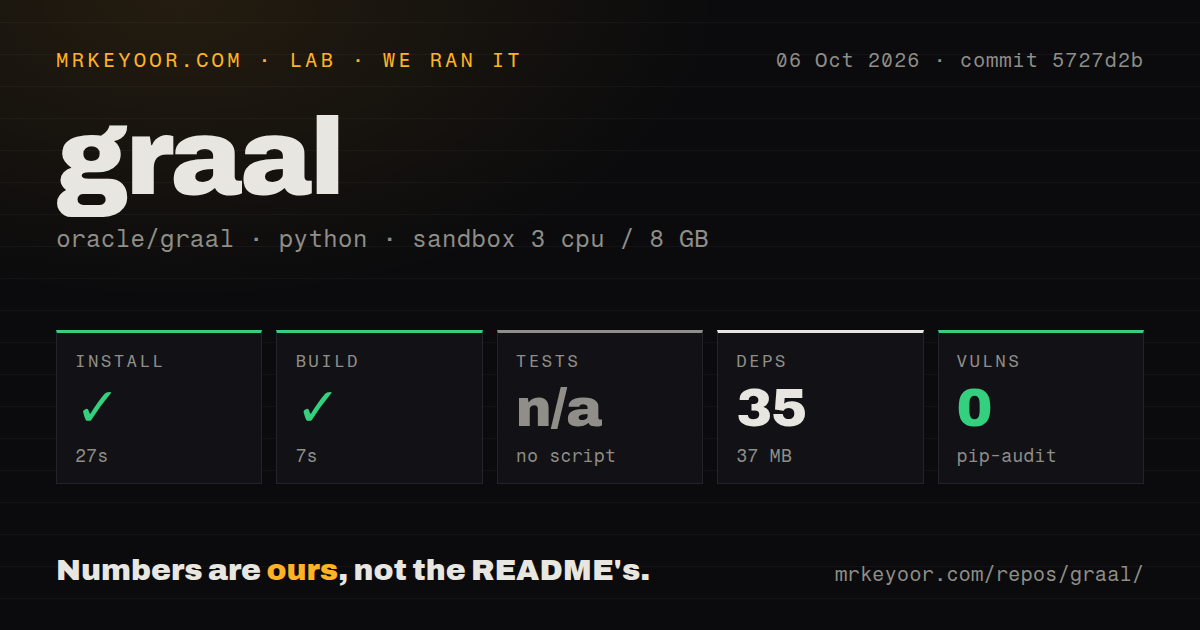
Our sandbox install succeeded in 30 seconds, adding 35 packages and leaving 37 MB on disk. The detected build step completed in 7 seconds. We used a fresh unprivileged Debian container with 3 CPUs, 8 GB of RAM, Python 3.12, no secrets, and commit 8f1ea8c. pip-audit reported 0 known vulnerabilities for the installed Python environment.
The harness found no test script or target, so it skipped tests. That is a finding about automated discovery, not a statement that Graal has no tests. The checkout had 20 CI workflow files, and recent pull requests included test work alongside compiler and runtime changes. There was no top-level tests directory and no Dockerfile. A contributor should use the component's instructions and CI configuration rather than infer a universal test command from our skipped step.
The measured repository occupied 266 MB and contained 20,963 files. Those numbers make the 7-second build result easy to misread: our command completed, but it cannot represent compilation and validation of every listed runtime, language framework, and tool. The useful conclusion is that the detected Python setup was clean. The full source-build question remains component-specific.
The release page moved, while development stayed current
GitHub's latest release endpoint returns vm-19.3.1 from 2020, titled Releases have moved. Its body directs users to the separate GraalVM Community Edition builds repository. That stale tag is routing information, not evidence that GraalVM was abandoned. GitHub recorded a push to oracle/graal on 2026-08-26, and current issues and pull requests were active across Native Image, Espresso, Truffle, security providers, memory access, and compiler behavior.
The repository showed 845 open issues and PRs, using GitHub's combined count. Recent bug reports included Native Image behavior around memory segments, generated software bills of materials, and Quarkus integration. Those reports are specific reminders that ahead-of-time compilation changes assumptions applications make at runtime. They also show maintainers and downstream users working on current integration failures rather than an archive receiving dependency bumps only.
Licensing changes by component
GraalVM Community Edition uses GPL 2 with the Classpath Exception for major areas, but the README lists different terms for individual components. Espresso, the graph visualizer, and Web Image use GPL 2; the SDK, Truffle, GraalWasm, and TRegex use the Universal Permissive License; Sulong uses the 3-clause BSD license. GitHub reports no single SPDX identifier for the repository because that table cannot be reduced honestly to one label.
For application users, the normal first decision is simpler: can your software compile and run correctly with the downloaded GraalVM toolchain? For platform engineers, this source tree is the place to understand why. Our run supports neither a blanket performance recommendation nor a green test claim. It does show clean detected dependencies and active code, while the repository structure warns that serious source work requires a narrower component target.