A voice sample gets you started, but the environment takes 7,047 MB
Our GPT-SoVITS install occupied 7,047 MB without establishing cloned-voice quality. Give it a reference recording and text, then generate speech in that speaker's voice. Its English README describes reference-based synthesis and optional fine-tuning. I would shortlist it for a dubbing workstation where someone can listen to each output and adjust the input.
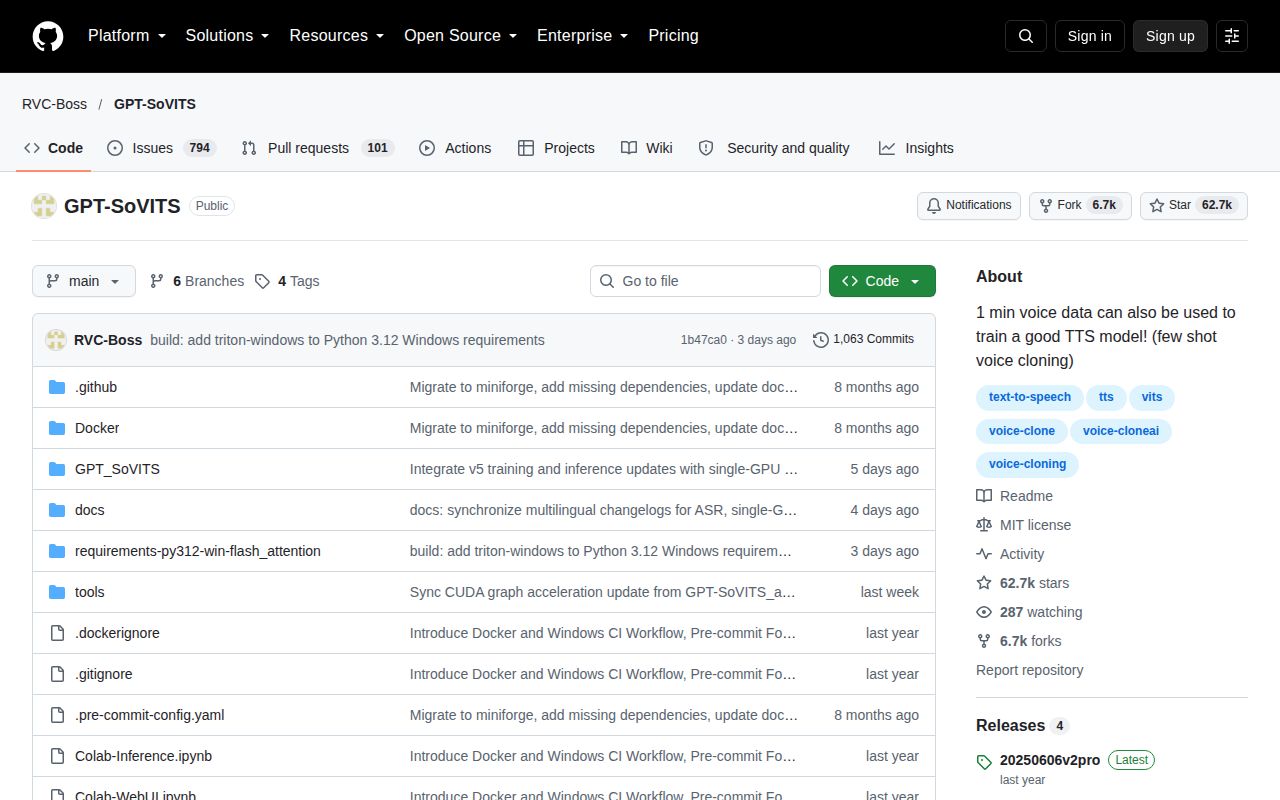
The browser interface includes vocal separation, audio slicing, transcription, and label editing. You can prepare recordings and train voice models within the same project instead of assembling separate tools. The 36.6 MB checkout leaves most of the disk cost to the installed environment. If your application only needs a stock voice to read notifications, most of this machinery has little value to you.
What happened when we ran it
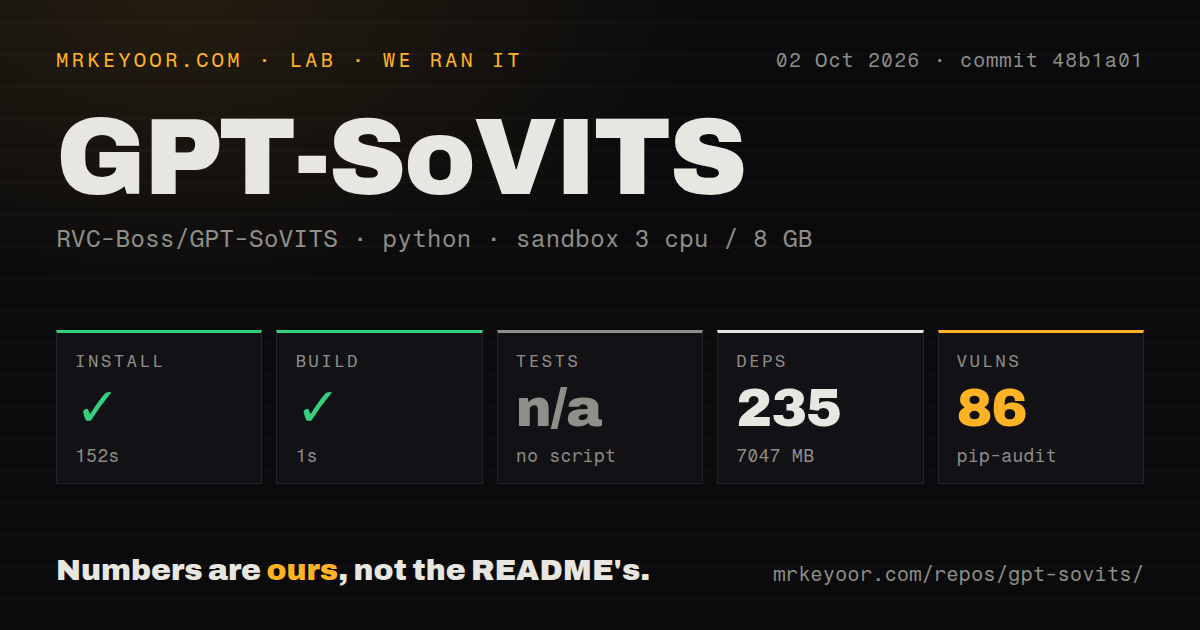
Our run installed GPT-SoVITS at commit 48b1a01 in 152 seconds, adding 235 packages and using 7,047 MB on disk. The build succeeded in 1 second. We cloned it on October 2, 2026, into an unprivileged Debian sandbox with 3 CPUs, 8 GB of RAM, Python 3.12, and no secrets. Installation and build completed, but those outcomes do not establish synthesis speed, voice similarity, or successful fine-tuning.
Tests were skipped because no test script or target was available. The scan found 2 CI workflow files and a Dockerfile, but no tests directory. Pip-audit reported 86 known vulnerabilities. The supplied results contain no advisory list, severity breakdown, or exploitability analysis, so that count supports dependency review rather than a claim that a particular endpoint is exploitable. A passing build gives us no substitute for missing test results.
Model files and audio tools remain separate setup work
The README places pretrained speech weights in GPT_SoVITS/pretrained_models and the Chinese G2PW model in GPT_SoVITS/text. Optional vocal-separation and transcription tools need their own assets. The documented local route does not request a hosted speech API key, though you need access to model download hosts. Debian instructions explicitly name FFmpeg and libsox-dev. Our successful install gives no evidence of missing prerequisites.
The 235-package environment is only the setup we measured. It does not establish that every optional model or tool was exercised. Docker adds choices of its own: Lite images omit ASR and UVR5 models, ASR assets download as needed, and Compose mounts the project directory. The README warns that image releases lag code changes. Pin the code and image together, then record the model files your actual workflow uses.
Fine-tuning still requires corrected transcripts
GPT-SoVITS asks you to slice recordings, run speech recognition, and proofread the transcription before fine-tuning. Its dataset lines contain an audio path, speaker name, language, and text. That proofreading step is the strongest reason to treat this as an attended audio tool. You must check that the words match the recording. The integrated label editor makes that work more accessible, but doesn't remove it.
Our 1-second build cannot validate the quality of that training data or the resulting speech. The README supports English, Japanese, Korean, Cantonese, and Chinese synthesis, including generation in a language different from the training material. That is useful for translated dialogue with a consistent speaker. Before committing an episode, try your actual vocabulary and reference clips. The lab results provide no listening assessment to settle pronunciation or speaker resemblance.
Short phrases and Windows AMD inference need extra scrutiny
Issue 2838 reports repeated short greetings in the V2 inference interface. The reporter connects the behavior to a hidden CUDA Graph checkbox and says disabling it stopped the repetition. This is a specific user report about V2, not evidence that every model generation has the same defect. For brief dialogue or spoken interface prompts, include short phrases in your acceptance checks instead of judging only longer passages.
Issue 2841 asks for official AMD GPU inference guidance on Windows. The Linux setup lists ROCm, while the Windows setup offers CUDA or CPU routes. Mac users also get a warning that GPU-trained models have lower quality and that training temporarily uses CPUs. With 7,047 MB already measured for our environment, I would verify the exact hardware route before investing further in weights and dataset preparation.
October activity outpaces the June 2025 release tag
The last push was October 8, 2026, and GitHub listed 895 open issues and PRs when checked on October 11. September reports concern current inference behavior and hardware support, so the project is still attracting practical use. The latest release endpoint returns 20250606v2pro, published June 6, 2025. Meanwhile, the README documents V5 models and points its upgrade instructions at the cuda_graph_accel_v5 branch. Active development and tidy release packaging are different judgments here.
The code license is MIT. Issue 2835 asks for artifact-level licensing and provenance clarification for the documented G2PW archive used in Chinese speech. That request does not establish a licensing violation, but it matters if you need documented redistribution rights for every bundled file. Between those external assets and the 86 vulnerabilities in our audit, a commercial package needs more investigation than copying the repository's license file.
Pick a narrower engine when voice preparation adds no value
The 235 packages in our run are easier to justify when you will use the recording-preparation and fine-tuning interface. F5-TTS is another reference-audio synthesis and training project worth comparing on your own recordings, though its README separates MIT code from noncommercial pretrained-model licensing. Pocket TTS suits CPU-oriented speech with cloning through a Python API or command line. Neither comparison implies a quality ranking from our sandbox.
Piper gives you local speech with downloadable voices and several programming interfaces when cloning isn't the requirement. For GPT-SoVITS, choose a supported device path, pin the matching model files, and run a short script containing the greetings and names your production will use. Listen before preparing the full dataset. A repeated greeting is cheaper to reject than an entire dubbed episode.