Shared fixtures and mocks make GoogleTest worth adopting
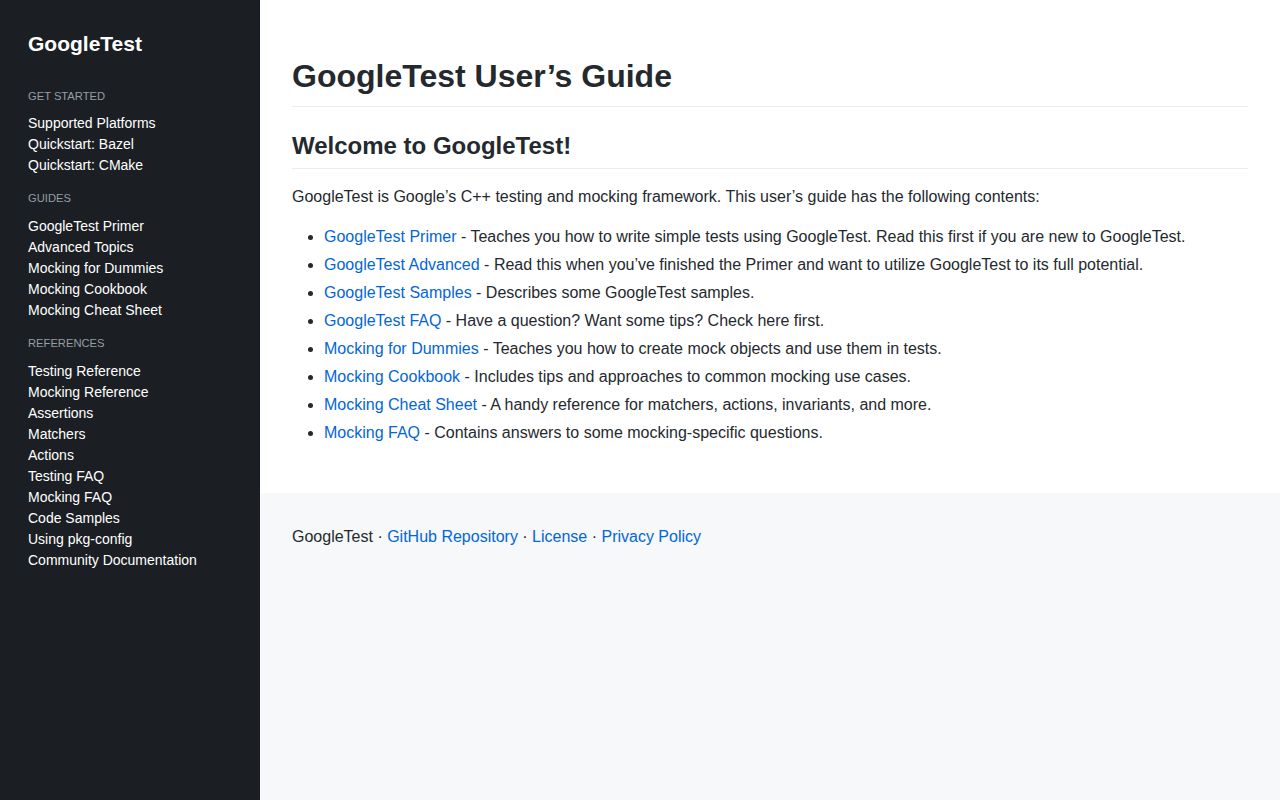
Choose GoogleTest when a C++ team needs to agree on how failures should look and how dependencies should behave in a test. The repository combines GoogleTest with GoogleMock, so assertions and mock expectations live in the same project. A parser can check its returned value, while a caller can check whether it asked a storage interface to write anything. That shared vocabulary is the main reason I'd adopt it.
Our checkout occupied 4.1 MB and contained 252 files, with roughly 95,585 lines of source. This is a library you bring into your compiler environment, rather than a service you deploy. Existing GoogleTest suites are a strong reason to stay: replacing fixtures, assertions, and mock expectations has a real maintenance cost. For a new, small library, those same conventions deserve comparison with a simpler framework.
What happened when we ran it
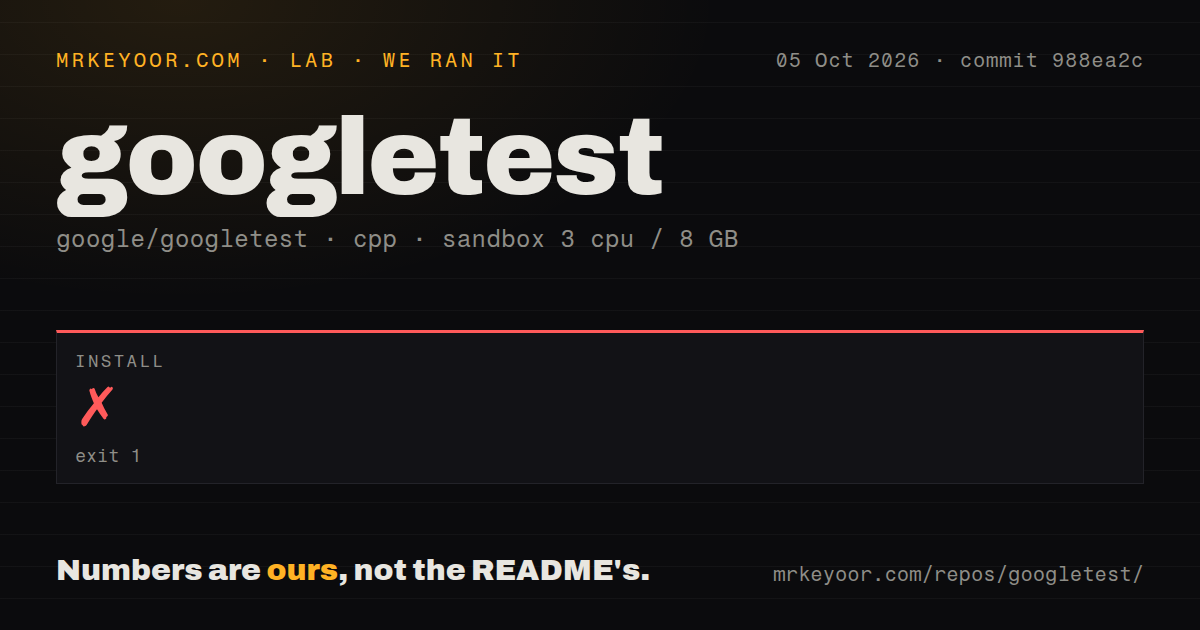
Our GoogleTest install failed after 1 second with exit code 1 at commit 988ea2c. We ran it on October 5, 2026, in a fresh Debian sandbox with 3 CPUs and 8 GB of RAM, using image lab-cpp:1. The container was unprivileged and held no secrets. CMake stopped during configuration, before we obtained a working installation.
The log says CMake could not find the package configuration supplied by Abseil, naming abslConfig.cmake and absl-config.cmake. It suggests supplying the installation prefix through CMAKE_PREFIX_PATH or pointing absl_DIR at the directory containing the configuration. That identifies the missing lookup result. It does not establish whether Abseil was absent, installed somewhere CMake couldn't see, or requested by a particular configuration choice.
The 1-second failure is enough to reject a promise of effortless setup in a fresh container. The supplied record contains no successful build or test result, so this review cannot tell you how quickly GoogleTest compiles or whether its suite passed. The next useful check for an adopter is dependency discovery in their own toolchain. Increasing CPU capacity would not answer the package-location question shown in this log.
The README's Abseil announcement needs careful reading
The root README describes an Abseil dependency as something the maintainers plan to take. Our 1-second configuration failure already involved an Abseil lookup at the measured commit. Those facts should remain separate: the announcement describes upstream intent, and the log describes our selected path. Neither tells us that every release or every configuration requires the same dependency arrangement.
There is no hosted account or API credential in the documented local workflow. You need a supported C++ compiler and a build system that can locate headers and libraries. The build guide explains both installed-library integration and including the source in your existing CMake project. Including it in the parent project lets compiler and linker settings travel together, a useful precaution when debug and release configurations differ.
Compiler and runtime compatibility can rule it out
GoogleTest's v1.18.0 release requires C++17. If your product must remain on an older language standard, the current release is the wrong starting point. The build guide also names a concrete Windows hazard: the Visual Studio runtime chosen by an application can differ from GoogleTest's default. Its gtest_force_shared_crt option addresses that mismatch. You still have to choose settings that match the surrounding program.
A 4.1 MB checkout says little about integration difficulty. A library can be small on disk and still require attention to its compiler configuration. I'd make an ordinary test executable with the actual application settings before migrating a suite. Teams looking specifically for a single-header assertion library should compare doctest. GoogleTest's documented workflow involves locating and linking libraries, which is more machinery than that requirement calls for.
Assertions are readable until object differences get crowded
The primer makes the basic distinction easy to use: EXPECT_* records a failure and continues, while ASSERT_* stops the current function. Use the latter before dereferencing a pointer that must exist. Fixtures let related checks share setup code, and GoogleTest creates a fresh fixture object for each test. These are understandable habits for a team, especially when someone else will debug the failure later.
Our clone's roughly 95,585 source lines support more than basic equality checks, including parameterized cases and death tests. Breadth doesn't guarantee pleasant output for every object. Open issue 4934 describes collection-matcher diagnostics that the reporter manually reformats to compare structured values. That is a specific reason to try a representative failure before adoption, particularly if your code deals in large records or containers.
GoogleMock also asks something of your code design. Its introductory guide starts with a mock class derived from an interface and methods declared through MOCK_METHOD. Mocking nonvirtual methods through templates is documented as more involved. If dependencies aren't replaceable in your application, adding GoogleMock won't make them so. Refactoring an interface may cost more attention than learning the expectation syntax.
Internal CI explains the missing workflow files
Our lab scan found 0 CI workflow files, no Dockerfile, and no tests directory. The README explicitly says Google uses internal systems for continuous integration. The directory signal therefore cannot establish that GoogleTest lacks checks, and the missing Dockerfile is unsurprising for a library intended to join another build. These observations describe the scanned checkout, not the quality of an unseen upstream pipeline.
The last repository push was October 3, 2026, and issue activity continued into October, including the collection-diagnostic discussion. GitHub listed 39,632 stars and 522 open issues and PRs. Release v1.18.0 arrived on August 10, with its notes recommending the latest commit and limiting changes to the release branch. That is active maintenance, with a revision-selection decision left to you. I'd pin a reviewed commit and settle the Abseil lookup before making GoogleTest the team's default.