It turns Maps research into an application, not just a script
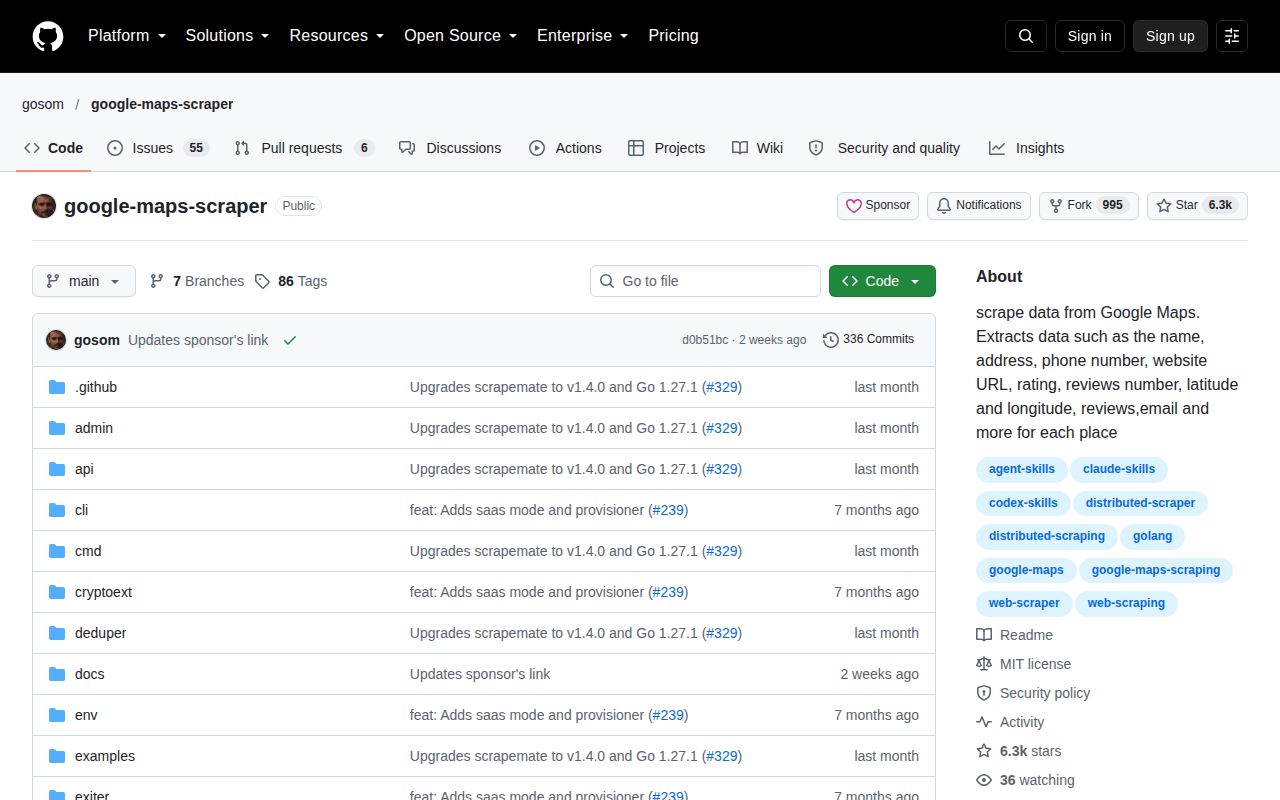
Google Maps Scraper packages a familiar but tedious job: search for businesses, open listings, and copy useful details into a dataset. The project says it can extract leads, emails, reviews, phone numbers, websites, ratings, and coordinates, then return results through CSV or JSON. That makes it relevant beyond sales prospecting. Its 5,694 GitHub stars suggest the problem resonates, but popularity is not proof that any particular crawl will stay reliable.
The strongest part of the proposition is choice across 4 entry points. The same project offers a command-line tool, browser-based Web UI, REST API, and an optional multi-user self-hosted platform. The README also offers an Agent Skills-compatible path for Claude Code, Codex, Cursor, and GitHub Copilot: install with npx skills add gosom/google-maps-scraper, describe the leads, validate a small sample, and then run the fuller local job.
Our run passed every supplied test
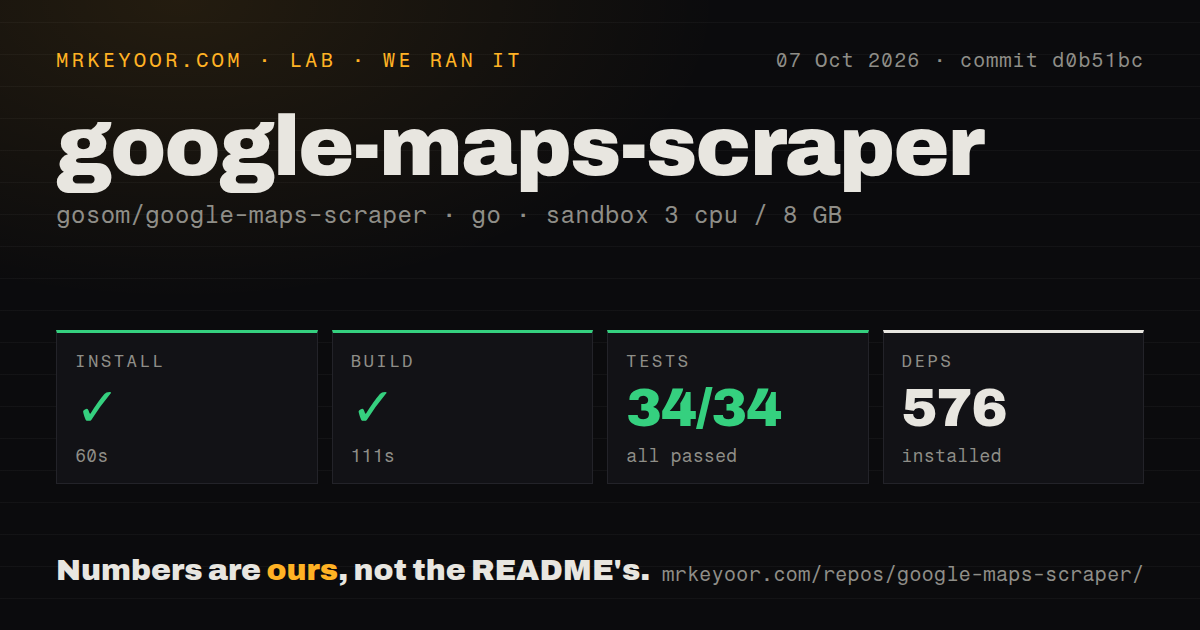
We cloned commit beca11f into a fresh, unprivileged Debian container with 3 CPUs and 8 GB of RAM. Installation succeeded in 311 seconds and brought in 549 packages. The build then completed successfully in 72 seconds. Those are our measurements, not numbers copied from project marketing.
Testing was equally uneventful on our box: go test finished in 20 seconds, with 28 tests passed and 0 failed. We found 2 CI workflow files and a Dockerfile, both useful signals for maintainers and deployers. There was no dedicated tests directory, but that does not negate the tests Go discovered and ran. We did not execute a live Maps scrape, provide secrets, or measure extraction throughput, so this result supports build health and basic test integrity only.
The interface range is the clearest reason to choose it
Many scrapers make you choose between a throwaway script and a hosted vendor. This project gives a more gradual route. A one-off researcher can write CSV or JSON, an internal tool can call the REST API, and a team can examine the documented SaaS Edition. The README also points to recipes, which is the right shape for a tool with several operating modes. Version v1.17.4 carries an MIT license, so teams can inspect, modify, and deploy the code without buying a commercial license from the repository owner.
The v1.17.4 agent workflow is practical on paper. The described sequence includes planning searches, running a small validation, starting the local scrape, and monitoring results. For larger jobs, the flow can ask for a proxy or continue without one, while proxy credentials are entered through a masked local terminal prompt rather than pasted into chat. That is a sensible boundary. Docker and Node.js are required for this route on macOS, Linux, or Windows through WSL, so it is still a developer-assisted workflow.
Setup is clean, but operations are still your responsibility
The successful 311-second install should reassure Go developers, yet it also shows that "free and open source" does not mean zero-cost operations. A headless scraper depends on a browser environment, network conditions, upstream page behavior, and sensible concurrency. At production scale, somebody must watch failures, retry policy, proxy quality, data freshness, and storage.
The README is long and action-oriented, but the sponsor-heavy opening makes the route to technical detail less direct than it could be. It promotes several proxy, extraction, and API vendors before a new operator reaches deeper guidance. That commercial context is understandable, though buyers should distinguish repository capabilities from sponsor claims. Our test installed 549 packages, another reason to review the dependency surface and container image.
Current activity looks healthy, with an issue backlog to inspect
Project health is better judged from code movement and issue load together. The latest release, v1.17.4, arrived on August 22, 2026, and the repository was pushed the same day, only 10 days before this review. That is strong evidence of current maintenance. The 72 open issues are the counterweight. The supplied data does not show response times or closure quality.
The community evidence here is otherwise limited. There is a Discord link, contribution guidance, build status, Go documentation links, and 5,694 stars, but the provided community item adds no substantive user report. We therefore would not claim proven support quality. The passing 28-test run and recent release matter more than an empty trending mention, while the open backlog means maintainers are not operating in a low-noise environment.
It fits as a collection worker behind your own controls
In a real stack, place this project at the collection edge. Feed it approved search queries, write results to a staging dataset, then validate, deduplicate, and govern the records before they reach a CRM, warehouse, or campaign tool. The REST API is useful for internal automation, while CSV and JSON are safer starting points for a human-reviewed pilot. For multi-user use, treat authentication, queueing, rate controls, retention, and audit logging as deployment questions to verify, not benefits implied by the 1.17.4 version number.
Choose it over a general crawler when the Maps-specific workflow and ready-made outputs save enough engineering time. Choose Crawlee when you need custom logic across many websites, or a managed Maps API when uptime and vendor support outrank source access. The decisive result from our run is narrow but valuable: in a fresh container, installation, build, and all 28 tests succeeded. That earns the project a serious trial, not blind production trust. Start small, compare sampled records with visible listings, and promote it only after your own checks pass.