gix is an application library before it is a Git replacement
Gitoxide is easiest to understand as a Rust toolbox for applications that need Git data. The gix crate is the main entry point, while lower-level crates cover objects, references, configuration, URLs, packet lines, transports, protocols, packs, indexes, attributes, ignore rules, revisions, status, worktrees, diffs, merges, and more. An application can use only the layer it needs instead of spawning the standard git executable and parsing text.
The repository also builds gix and ein command-line programs. The README calls gix plumbing for exercising APIs in real repositories and ein a higher-level interface. It explicitly warns that both binaries may remain unstable and should not be used in scripts. That distinction prevents the most common adoption mistake: Gitoxide is not promising command-for-command parity with Git, and its non-goals say it does not intend to replicate the full command interface.
Clone and status exist, while push and rebase do not
The high-level feature list marks clone, fetch, status, commit, checkout, object and reference access, index and config handling, pathspecs, revspecs, ignore rules, and attributes as implemented. Merge works for blobs and trees but not commits. Push, rebase, and reset remain unchecked, and commit hooks are not implemented. Applications must map their exact workflow against that list and the longer crate-status.md file.
This makes gix credible for repository analysis, history browsing, status, cloning, object databases, or custom source-control services. It is a poor choice for an application that needs to reproduce every daily Git command without fallback. A mixed architecture is reasonable: use gix for fast typed reads and supported writes, then invoke standard Git for a missing porcelain action whose compatibility behavior is too expensive to recreate.
What happened when we ran it
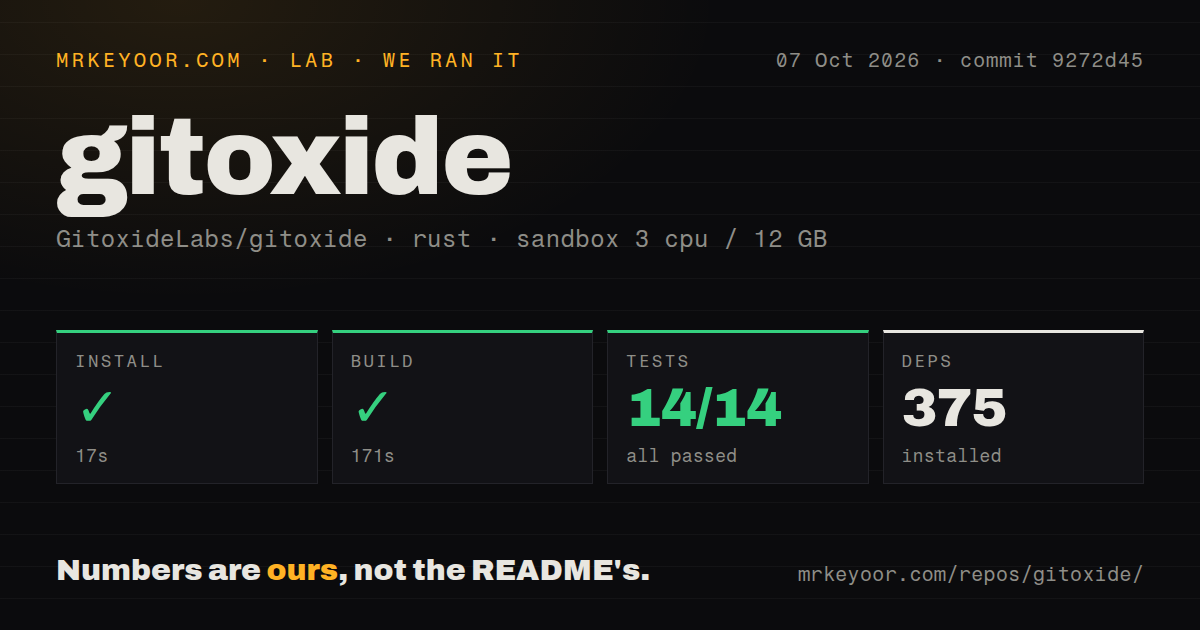
Our Rust sandbox installed 406 packages in 26 seconds at commit dda600d. The build completed in 204 seconds. Cargo test then finished in 13 seconds with 10 passed and 0 failed of 10. The measured install, compiler, and available test command all succeeded in the unprivileged container. No failure log or dependency advisory result was supplied for this Rust run.
The checkout contained 2,954 files, about 364,643 source lines, and occupied 126.3 MB. We found 6 CI workflow files, a tests directory, and no top-level Dockerfile. Ten passing cases should not be mistaken for exhaustive validation of a workspace this large; they are the cases exercised by our harness command. We did not benchmark clone speed, compare repository output byte for byte with Git, test Windows, or run the entire feature matrix.
Cargo features decide native-tool requirements
Developers can consume a published binary, install through Homebrew on macOS or Linux, or compile through Cargo. The default max feature set is described as fastest but needs CMake. The max-pure configuration works with Rust and a C compiler and is documented as a way around some C-toolchain failures. A lean configuration trades interface features for a smaller binary and shorter build.
For a library consumer, feature choices affect dependencies, behavior, compile time, and what gets audited. The 204-second build in our 3-CPU container is a more useful planning number than a vague claim that Rust compilation is heavy. Cache dependencies in CI, pin the feature set, and test the minimum Rust version the selected gix release declares. The stability guide says raising that minimum is not treated as a breaking change.
Stability is assigned crate by crate
Gitoxide does not pretend every workspace member is equally mature. gix-lock is listed at stability tier 1, gix-tempfile at tier 2, several config and reference crates are stabilization candidates, and the main gix crate is still in initial development. Other entries range from usable but incomplete to very early or idea placeholders. Semver applies, but the tier determines how quickly breaking changes may arrive.
That structure is helpful for dependency review. A tool that only needs configuration parsing may adopt a narrower, more settled crate than an application that takes the full gix surface. Read the status section for every direct dependency, not just the workspace version. Version 0.58.0 included a breaking CLI change that removed a screen option from gix tix, a reminder that pre-1.0 application surfaces continue to move.
Documented shortcomings affect real repository workloads
SHORTCOMINGS.md says protocol v1 fetches over stateful SSH, git, or file connections may hang, although clone is not affected. A mutating index operation will not write the split-index link extension. Pack files use memory maps, which can hide some I/O errors, and 32-bit systems cannot load very large packs or objects beyond their address space. Object replacement refs are read when a repository opens and later changes are not picked up.
A new issue on August 27 reported long-running Git filter children becoming zombie processes, with 274 accumulated during a 10.5-hour desktop session. A fix pull request was already open, which shows responsive maintenance but also a concrete concern for apps using long-running LFS process filters. Reproduce that path on the release you pin rather than assuming a clean 10-test lab run covers process lifecycle.
Releases are frequent and the issue queue is small
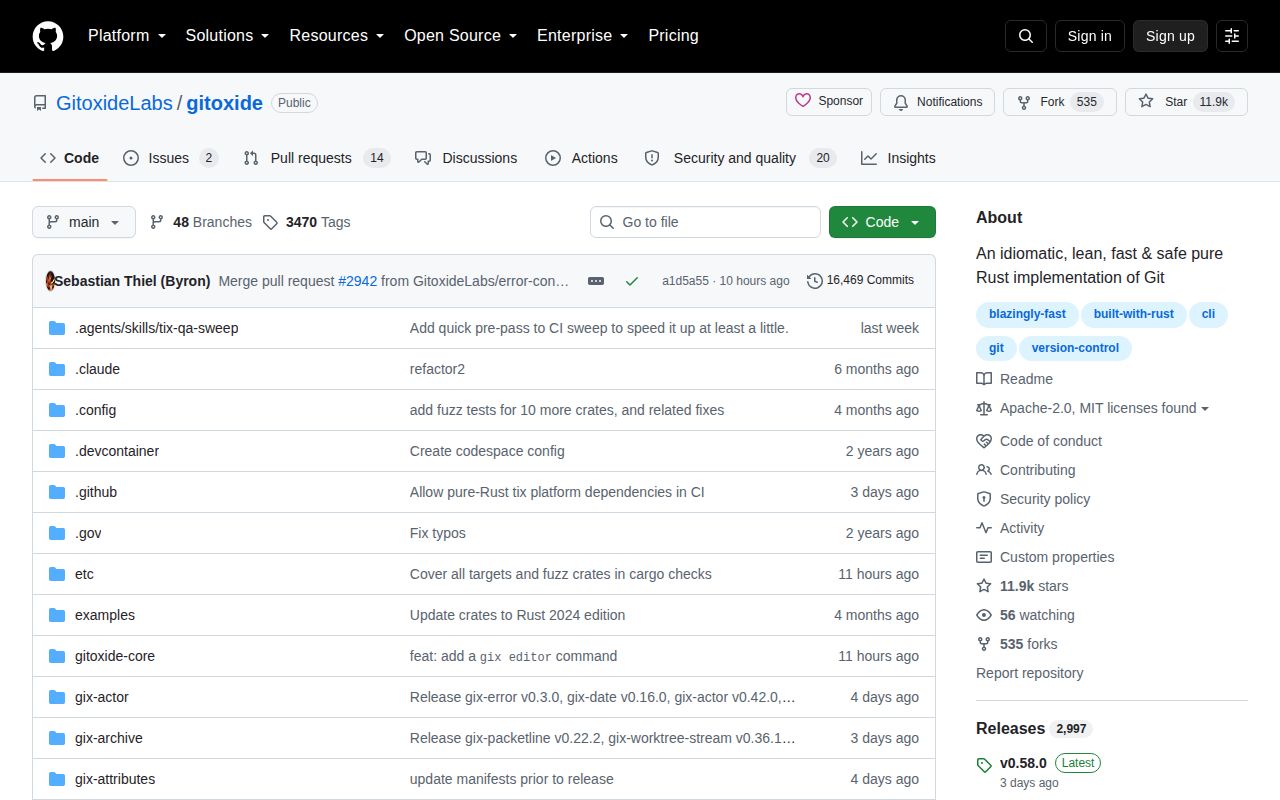
GitHub recorded 11,870 stars, 16 combined issues and pull requests, and a push on August 27, 2026. Release v0.58.0 arrived on August 24, only 2 days after its predecessor according to the release notes. Current work includes config writing, object-database changes, process-filter cleanup, and the interactive tix history view. The repository is actively maintained and candid about incomplete areas.
Gitoxide earns a serious evaluation for Rust applications because the architecture, status tables, stability policy, and shortcomings are visible. Adoption should happen operation by operation. Build a compatibility suite using repositories that contain your real submodules, filters, worktrees, odd paths, pack sizes, and authentication methods. Where gix passes that suite, its typed in-process API is compelling; where it does not, Git remains the correct fallback.