The 1,253-file repository contains GitBook's published-site renderer
GitBookIO/gitbook is the frontend used to display content that authors have already published through GitBook. The README is unusually direct about that boundary: this is the rendering portion of the product, built on Next.js, rather than a source drop of the hosted editor and knowledge-management service. A local route accepts a public GitBook site URL and renders that site through your checkout, which makes the project useful for frontend changes, bug fixes, and deeper presentation work.
That distinction decides whether this repository belongs on a shortlist. Our measured checkout contained about 112,915 lines of source across 1,253 files, so this is a substantial application rather than a theme package. Teams that already use GitBook can gain control over the reader experience. Teams looking for a standalone documentation system still need an authoring source, content workflow, permissions model, and publishing service outside this codebase.
Node 22.3 and a public GitBook space are the local prerequisites
The README requires Node 22.3 or newer and Bun 1.2.15 or newer. After bun install, bun dev starts the frontend, and /url/gitbook.com/docs shows a published space through the local renderer. The contributing guide says the source space must be public for this preview flow. No token is documented for that basic route, which keeps a frontend contribution easy to inspect once the 2,395 MB dependency tree is present.
The instructions become sparse when local preview turns into production ownership. GitBook says self-hosting is possible, then advises against it unless the operator understands the trade. The company does not promise support, maintenance, or updates for forked instances. There was no Dockerfile in our measured checkout, so the repository does not hand an operator a container recipe alongside the code. You must define deployment, monitoring, upgrades, and rollback for the fork.
What happened when we ran it
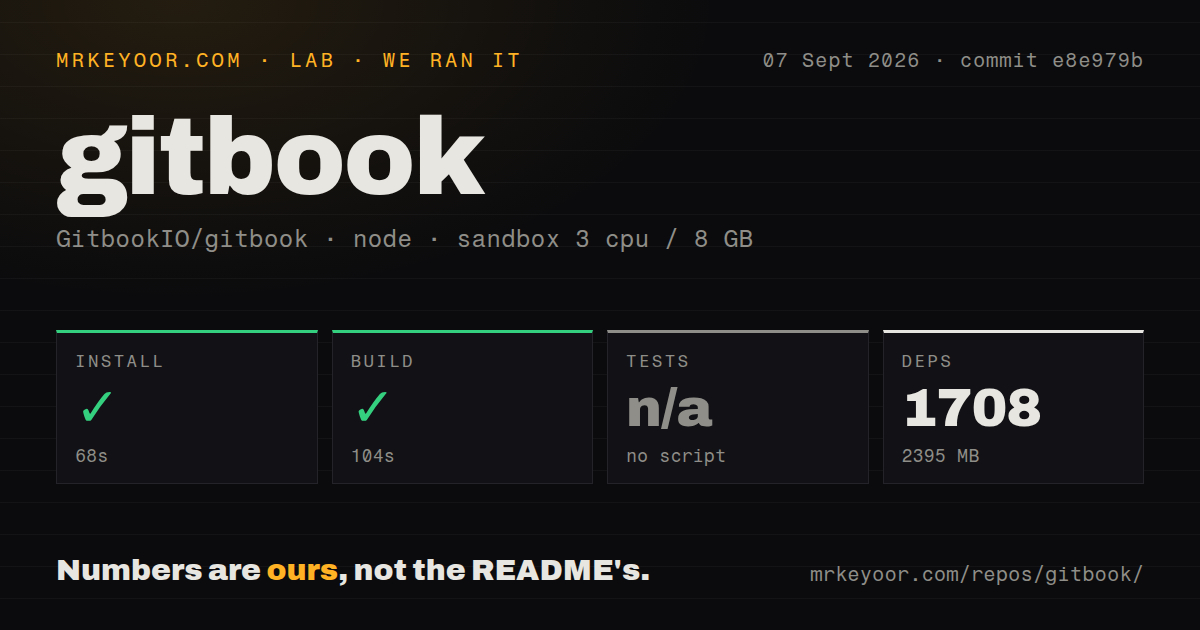
Our sandbox installed 1,708 packages in 68 seconds, leaving 2,395 MB on disk. The build completed successfully in 104 seconds on 3 CPUs with 8 GB of RAM. That is a clean build result for commit e8e979b, and it also puts a real cost on a first checkout: the installed dependencies were far larger than the 12.6 MB repository.
The test step was skipped because our harness found no conventional tests script or target. It did not report a passing suite. The repository does describe visual and performance checks for pull requests, and our scan counted 6 CI workflow files, but those facts cannot be turned into a local test result. Anyone changing the renderer should identify the relevant unit, end-to-end, and visual commands instead of treating the successful build as equivalent coverage.
The measured commit was a Bun workspace monorepo with 1,253 files and roughly 112,915 source lines. Our scan found no tests directory at that checkout. Those structural signals explain why a generic test step tells only part of the story: GitBook's development commands and checks are divided across packages and workflows. The lab result remains simple, though. Installation and build passed, while tests were skipped.
GPLv3 and GitBook's commercial terms shape private forks
The repository is licensed under GPLv3. Its README tells people distributing the code to keep the source public and directs private-repository users to a commercial license. Legal interpretation belongs with counsel, but the product decision is immediate: a company planning proprietary renderer changes needs to settle the license path before those changes become part of its platform. A public upstream contribution avoids maintaining the same patch indefinitely, although it also has to fit GitBook's product direction.
The 2,395 MB install is a smaller commitment than owning a long-lived fork. GitBook's warning assigns reliability and future merges to the self-hoster, while the renderer continues to follow changes in the hosted platform. That coupling is reasonable for custom presentation around an existing GitBook deployment. It is awkward for an organization trying to remove GitBook as a dependency, because this repository consumes published GitBook content instead of replacing the system that creates it.
Markdown and MCP routes are active, with an open image-link defect
The current code includes Markdown, llms.txt, and MCP routes for published documentation. Recent pull request 4592 fixed unresolved stable references inside HTML blocks used by Markdown pages and MCP clients. Open issue 4593 still reports that image URLs in published Markdown can appear as root-relative /files/ paths that return 404. Teams feeding these endpoints to agents should test images and links on their own domain before relying on the output.
GitHub showed 29,025 stars and 103 combined open issues and pull requests when we fetched the project. The last push was September 8, 2026, with merged and open work from the same day, so the repository is being maintained despite its latest GitHub release page pointing to a package release from October 2025. The release date alone would give the wrong impression. Current commits and issue movement show an active renderer with a public queue, including some obvious issue spam among the real bug reports.
The 104-second build supports a trial, not an independent GitBook clone
A successful 104-second build makes this code worth trying for teams that already publish through GitBook and have a specific renderer change in mind. The README gives that audience a direct loop: install, run, and proxy a public space. The 1,708-package footprint is heavy, yet the workflow itself is understandable. The licensing and self-hosting warnings deserve equal weight with the successful build.
For a fresh documentation platform, Docusaurus, VitePress, or MkDocs starts from a cleaner ownership model because the content and site build can live together in your repository. GitBook's open renderer wins when compatibility with GitBook content is the requirement. It loses when the goal is to own authoring, publishing, and hosting without GitBook's service in the middle.