Genesis World 1.3.3 puts several physics solvers in one scene
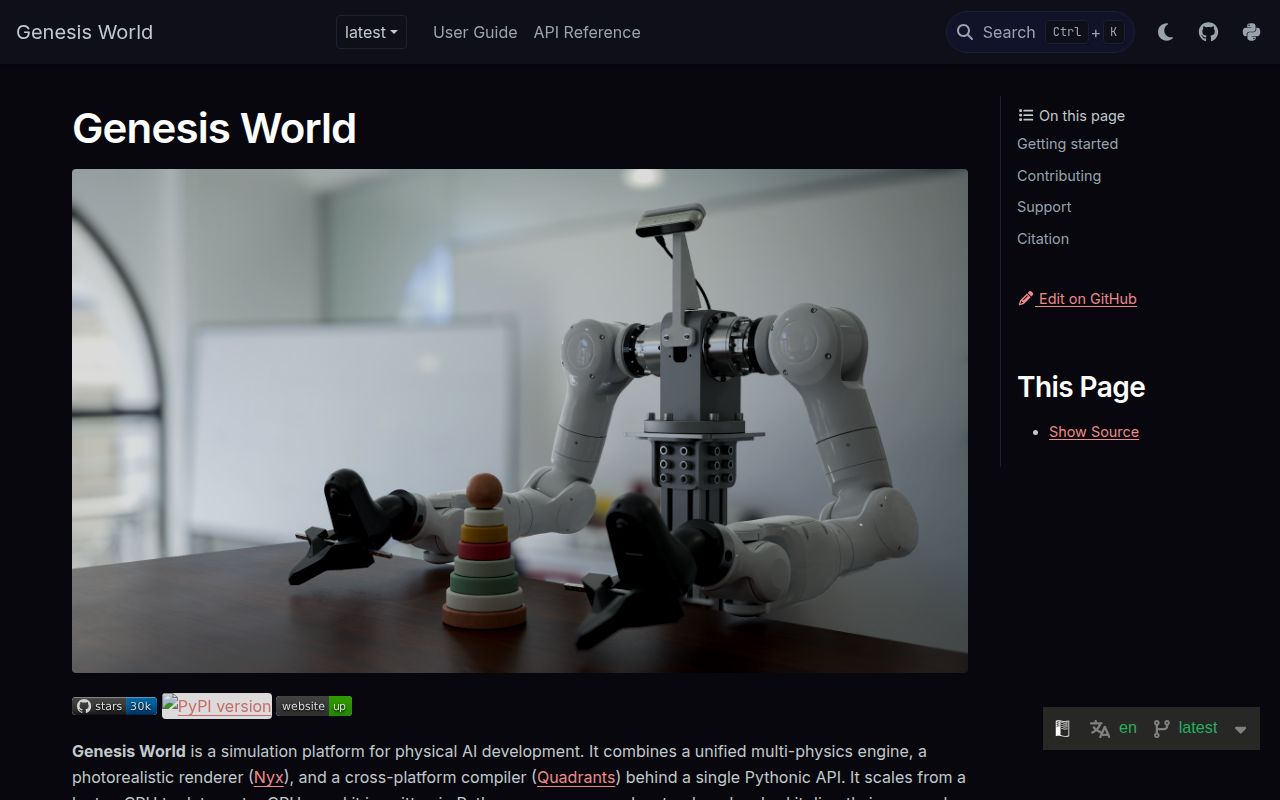
Genesis World v1.3.3 is aimed at robotics experiments that outgrow a rigid-body simulator. Its Python interface can place rigid robots beside FEM, MPM, PBD, SPH, fluid, and IPC systems, then connect them through explicit couplers. Cameras can use Nyx, Luisa, or Pyrender. The same project exposes controllers, parallel environments, a GUI, and sensors such as depth cameras, IMUs, lidar, tactile readings, and contact force. That range is the reason to consider it, and also the reason a quick install says little about scientific suitability.
The repository at commit 6a2a1f0 contained 11,077 files, about 2,134,211 lines of source, and occupied 753.8 MB. It bundles large native components, including rendering and compiler code, before Python dependencies arrive. Quadrants lowers kernels to CUDA, AMD ROCm, Apple Metal, Vulkan, x86, and ARM64. This makes one API available across several compute targets, but each target still has its own driver, compiler, wheel, and numerical behavior. A serious evaluation has to use the same backend and hardware planned for research.
Python 3.10 to 3.13 is supported, but PyTorch stays separate
The package declares Python 3.10 or newer and below 3.14. Its README tells users to install PyTorch first, choosing a CPU, CUDA, or Apple-silicon wheel that matches the machine. Then pip install genesis-world supplies the platform itself. The uv path follows the same order: sync the project, install the correct PyTorch build, and run an example. That separation is sensible for a hardware-dependent library, though it makes an apparently successful package install an incomplete setup.
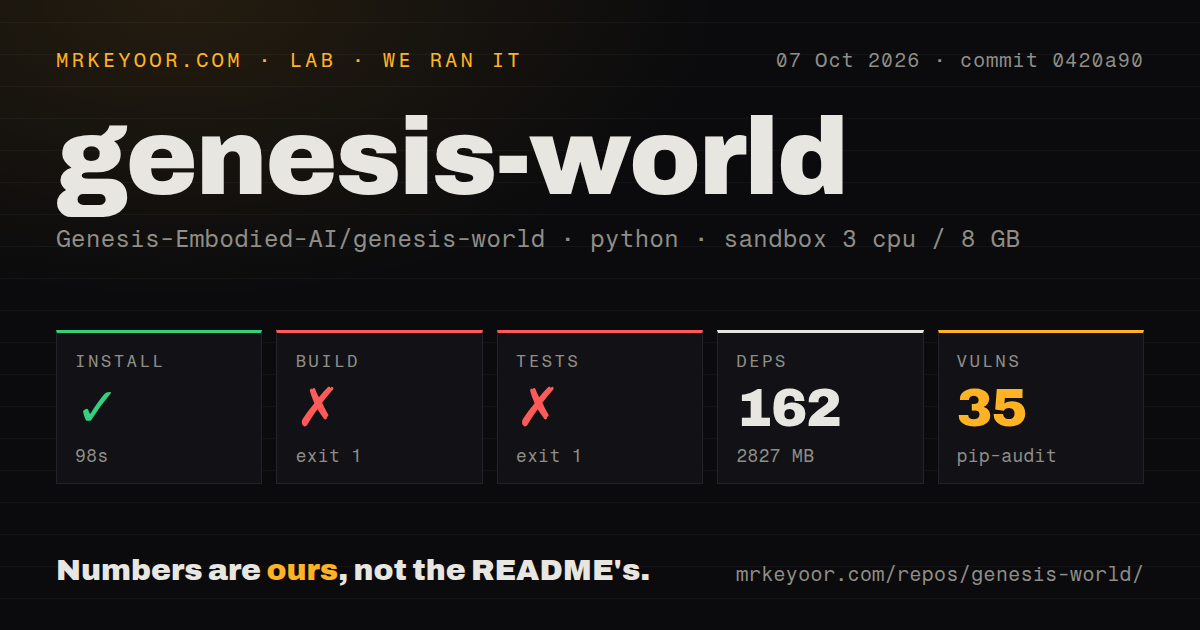
Our installed environment used 2,807 MB for 154 packages, before any separate PyTorch wheel was present. The base dependency list includes MuJoCo, OpenGL support, video and image libraries, VTK, mesh processing, collision decomposition, and the Quadrants compiler. Optional IPC support requires pyuipc on documented Linux or Windows x86 systems with an NVIDIA GPU. Nyx is another extra. Platform wheel availability matters because a fallback source build can pull CMake or other native tooling into what looked like a Python install.
What happened when we ran it
Our sandbox installed 154 packages in 63 seconds and used 2,807 MB. We cloned commit 6a2a1f0 into an unprivileged container with 3 CPUs and 8 GB of RAM, using Python 3.12 on Debian Bookworm. The checkout had six CI workflow files and a tests directory, but no Dockerfile. Our test method covered repository installation and the detected build and test commands. It did not install a platform-specific PyTorch wheel or run a robotics scene.
The build exited with code 1 after 5 seconds. The supplied tail contains SyntaxWarnings for invalid escape sequences in vendored PyAssimp, fast_float, and ZFP documentation scripts. It does not show a final exception, so those warnings are the only safe build finding from the log tail. Tests exited after 6 seconds when tests/conftest.py tried to import torch and raised ModuleNotFoundError. Pip-audit separately reported 25 known vulnerabilities in the installed environment, without severities in the measurement record.
Version 1.3.3 improves contacts, while grasp reports stay open
Release 1.3.3 fixed rigid-solver convergence regressions, added a deterministic-algorithm option for bit-exact results on one machine, and changed MuJoCo compatibility around contact patches. Those are relevant fixes for training and comparison work. They do not remove the need for a task-specific ground truth. Open issue 3257 reports that a 50 g sphere slips through a LEAP hand in version 1.3.2 and that a closed-loop run reaches NaN constraint forces, while the reporter's same setup completes under MuJoCo. Test that case again on 1.3.3 before generalizing it.
Batch failure behavior is another adoption gate. Issue 3179 reports that one invalid contact state can raise an exception for a whole batched scene, without identifying the failing environment. The report used version 1.3.1 and a 4,096-environment experiment, so it is not proof that every current batch fails. It does identify a missing recovery contract that matters for unattended training. Our 3-CPU sandbox never reached scene execution, and it provides no counter-evidence about contact stability or per-environment fault isolation.
MJCF imports and saved states need explicit acceptance tests
Issue 3277 says imported MJCF values for gravity, timestep, and impratio are accepted but silently replaced by Genesis settings, even though other unsupported fields already produce warnings. For a robot model tuned in MuJoCo, that can change contact behavior without an obvious import error. Open issue 716 covers a different workflow gap: scene state contains compiler objects that cannot be pickled, blocking a requested simulate-now, render-later pipeline. Both are concrete reasons to build a small acceptance scene before moving a dataset or policy pipeline.
GitHub listed 29,853 stars and 131 combined issues and pull requests. The latest release arrived on August 13, 2026, and the repository was pushed on August 31. Current pull requests cover inertia, ray casting, contacts, heterogeneous entities, and solver work, so issue traffic sits beside active engineering. The 6 CI workflows and large test tree show a project investing in many backends. They cannot certify the particular model, contact regime, or device that a robotics team will use.
The 2,807 MB environment earns a trial only for broad physics
Genesis World is easiest to justify when a scene truly mixes robots with cloth, particles, fluids, or deformable objects, or when one Python API across sensors and backends saves research code. The cost is a 2,807 MB pre-PyTorch environment, 25 audited advisories, a failed build, and a test suite that could not start in our stated sandbox. Install the exact backend, reproduce one known scene, compare a contact-heavy case with a trusted reference, and test how a batch recovers before committing training time.