Jeff chooses among options without writing an answer
Jeff accepts a situation and a set of choices, then returns probabilities for those choices. A support application might ask whether a message belongs with refunds or damaged parcels. Your application supplies the options and acts on the result. That is a useful boundary for a small decision model: a wrong classification has a place to be measured, and low confidence can send the request to a human or another model.
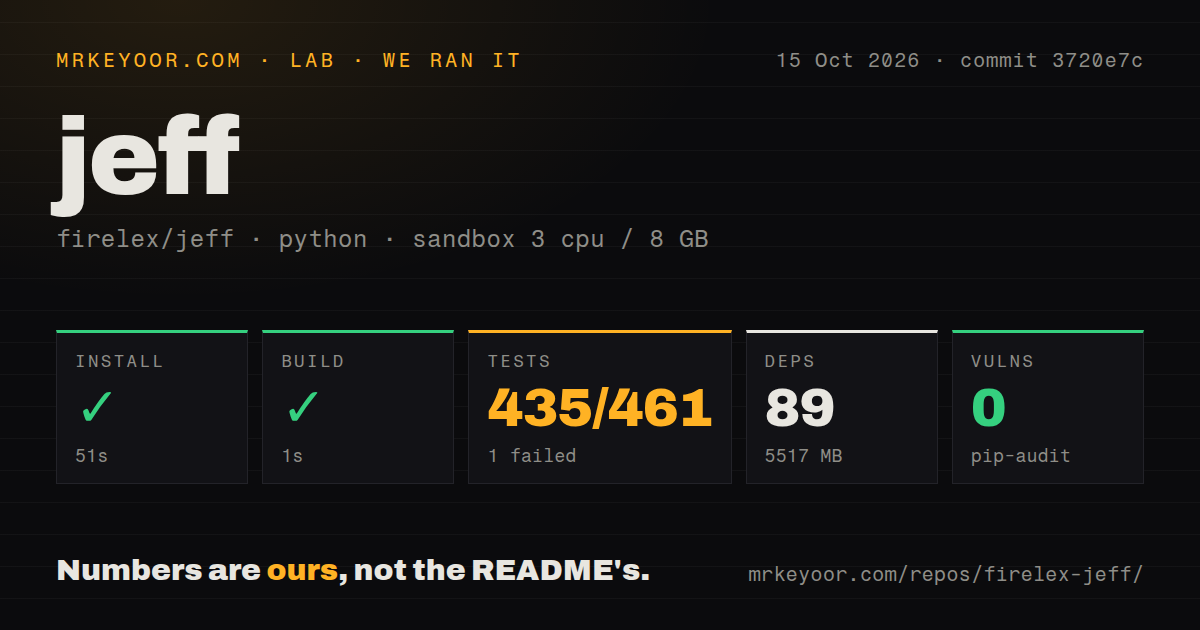
Our 6.8 MB checkout became a 5,517 MB installed environment. The small repository therefore gives a misleading impression of the disk commitment if you stop at its size. Jeff's value depends on whether a dedicated classifier improves your application enough to justify another model runtime. A chatbot that must explain a recommendation still needs a separate system to write that explanation.
What happened when we ran it
Our run installed Jeff commit 3720e7c in 51 seconds, adding 89 packages and using 5,517 MB on disk. The build step passed in 1 second. We used an unprivileged Debian container on 2026-10-15 with 3 CPUs, 8 GB of RAM, Python 3.12, and no secrets. Those results describe the package environment, not the latency or accuracy of a decision made by a loaded model.
The test step failed with exit 1 after 93 seconds. Pytest reported 435 passed, 1 failed, 2 skipped, and 25 collection/setup errors out of 461. The named failure was tests/test_smoke_import.py::test_cuda_available, where an assertion returned false. The log tail also repeatedly directs users to obtain Hugging Face repository permission through login or a supplied credential. It does not identify the affected repository in the supplied excerpt or explain every setup error individually.
Pip-audit reported 0 known vulnerabilities. Our repository scan found a tests directory, no Dockerfile, and 0 CI workflow files. The passing cases show that much of the suite ran, while the CUDA assertion and access messages show why this wasn't a clean result in our sandbox. Calling the project broken on every platform would overstate the evidence. Calling the build a validated inference deployment would do the same.
Model downloads and adapter pairing need explicit configuration
The quick start downloads a base checkpoint and chosen adapters from Hugging Face. JEFF_CHECKPOINT points to the base, and JEFF_ADAPTERS identifies the adapter directory before you start jeff-serve. The README's current path uses v1.3 weights, and adapters must match that base version. A copied directory of older adapters is not automatically a compatible upgrade.
The 89-package environment we measured is larger than a thin HTTP client. The documented serving route excludes default dependency groups, then adds LoRA support and optional platform extras. NVIDIA and Apple Silicon use different extras, with MLX selected explicitly on the Mac. The README also warns that even text serving needs torchvision because of the model processor. None of those route choices has a separately measured footprint in our lab results.
Overlapping requests get a retry response by default
Jeff's server handles one request at a time. The README says a request arriving during another receives HTTP 529 by default, with a retry header. You can configure a bounded wait through JEFF_QUEUE_MS. An application that sends several classification requests together needs a queue or retry policy before deployment. A single successful client example does not establish behavior under concurrent traffic.
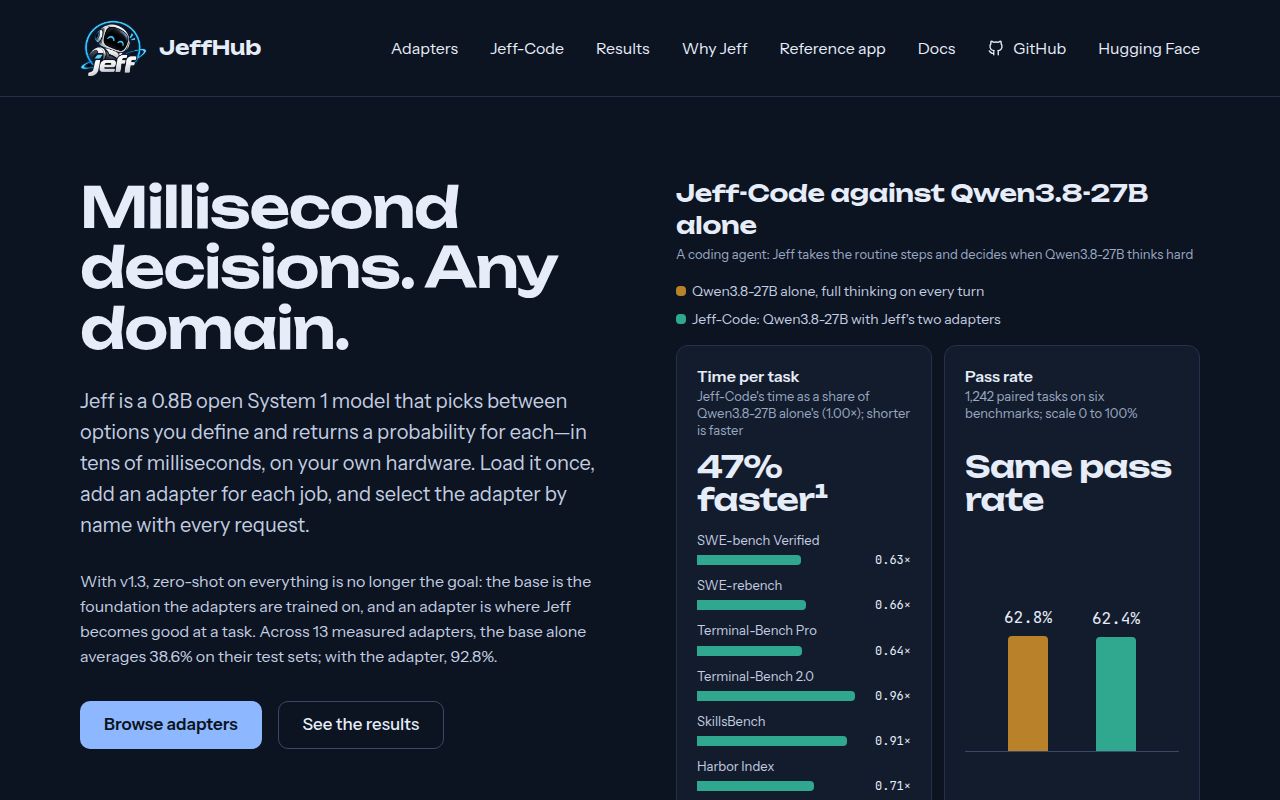
Our 435 passing tests do not provide a throughput figure for that server. The README publishes its own latency and accuracy comparisons, with hardware and sampling details, but our sandbox results do not independently reproduce them. For adoption, collect representative messages with known answers and measure both decision quality and the wait your users experience. Choose a fallback threshold using those examples, especially when a confident wrong answer would trigger an unwanted action.
Adapter licenses can rule out a commercial deployment
The README identifies the code as MIT and the base weights as Apache 2.0, then lists exceptions among adapters. In the v1.3 catalog, sanctions and security-alert adapters carry non-commercial terms, while other adapters have their own data-source conditions. Check the exact adapter you intend to ship. The repository's top-level code license is insufficient evidence that every downloadable decision model fits your use.
A 161-file checkout containing about 21,878 source lines still leaves important reproduction material elsewhere. The project publishes weights and evaluation material but withholds training data, and the README says its data-source document has not caught up with v1.3. That limits teams that need to rebuild the released model from the original examples. It also makes per-adapter documentation part of due diligence rather than optional background reading.
English inputs and bounded choices define the fit
The README limits Jeff to English text and explicitly warns against expecting multi-step reasoning. Qwen-based models accept bounded option lists, and the default input limit rejects oversized questions instead of silently shortening them. Raising the configured limit permits longer inputs, but the README says accuracy beyond the trained length is unmeasured. A multilingual document assistant would exceed several documented boundaries at once.
The last push was 2026-10-07, while an open server pull request received activity on October 13. GitHub listed 2 open issues and PRs. The latest GitHub release was v1.2, although the README already describes v1.3 weights and their compatibility rules. Those facts suggest ongoing work and a need to pin artifacts carefully. I'd trial Jeff for a bounded English decision task, budget the 5,517 MB environment we measured, and compare it with SetFit when a task-specific classifier is enough. AutoJev is the closer alternative when you want to work with the upstream decision-model training approach.