The 174-file checkout separates measurement from manual line layout
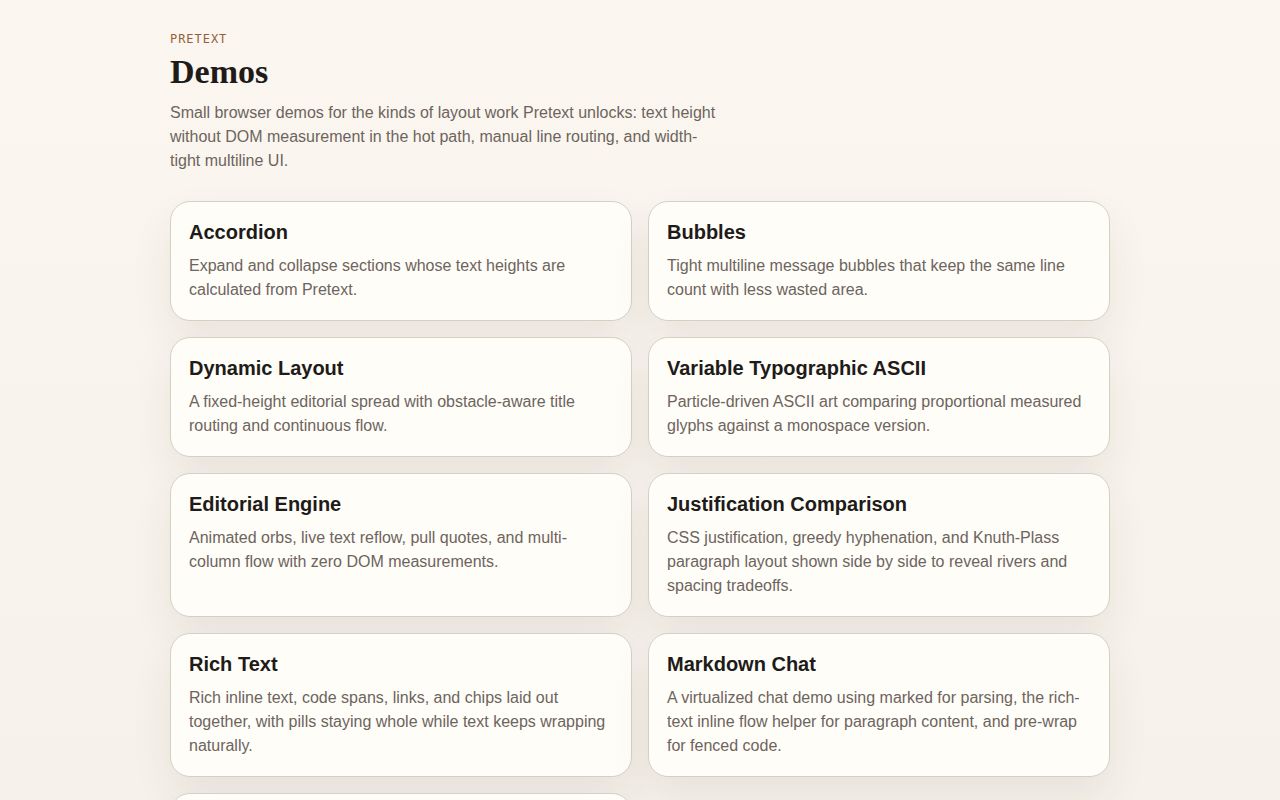
Pretext has 2 main use cases. The short path prepares text once, then calculates height and line count for each width without touching DOM layout again. The richer path returns line text, widths, and cursors for callers drawing into Canvas, SVG, or WebGL. That split makes sense for a virtualized chat or feed: preparation handles segmentation and width measurement, while repeated resize calculations become arithmetic over cached data. The application still owns rendering and scroll behavior.
The a28b542 checkout contained 174 files and about 25,754 source lines, which is more than a tiny measureText wrapper. The code normalizes whitespace, finds break opportunities across scripts, tracks grapheme positions, and handles soft hyphens. A rich-inline entry point adds items with separate fonts, atomic breaks, and caller-supplied chrome width. It remains intentionally flat. The README says it is not a nested markup tree or a general CSS inline formatting engine.
Version 0.0.9 covers a defined slice of CSS text
Version 0.0.9 supports normal and pre-wrapped whitespace, normal and keep-all word breaking, break-word fallback, numeric pixel letter spacing, and browser-style tab sizing. Soft hyphens can be inserted before preparation, then appear only when a line chooses that break. Automatic hyphenation is absent. This is a useful boundary because language-aware hyphen insertion has its own dictionaries and policy choices, none of which Pretext pretends to provide.
The runtime also leaves several CSS controls outside its model. Font optical sizing, feature settings, and standalone variation settings can change browser output without an equivalent Pretext option. Its bidirectional metadata is approximate, and segment widths are not exact glyph positions for Arabic or mixed-direction drawing. If an interface only needs height and line count, those limits may be acceptable. A custom editor that places carets or selection rectangles has a much harder accuracy requirement.
What happened when we ran it
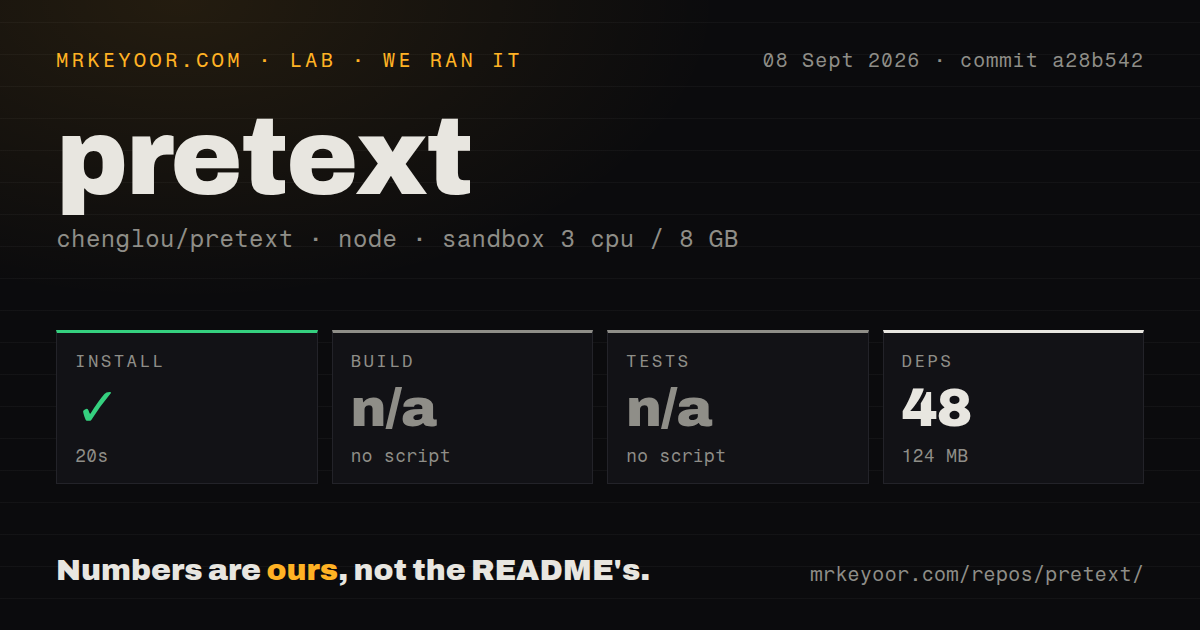
Our sandbox installed Pretext in 20 seconds, adding 48 packages and occupying 124 MB. We ran commit a28b542 in an unprivileged container with 3 CPUs, 8 GB of RAM, no secrets, and the lab-node:22 image. The repository itself was 7.3 MB before installation. Those figures make trying the dependency inexpensive compared with a browser automation stack, though they say nothing about layout speed or browser accuracy. We did not invent either result from install timing.
The lab skipped build and tests because it found no standard script or target for either step. That result needs the right reading: the repository has a tests directory and one CI workflow, while its development guide documents named Bun commands for checking, package building, and browser comparisons. Our generic runner did not execute those project-specific commands. There is therefore no passing build or test result from our run, and no test count to treat as evidence.
A 56-character font case can still choose different breaks
Issue 195 supplies a 56-character Shantell Sans example where browser DOM layout and Pretext pick different line boundaries in Chrome and Firefox. The report traces the mismatch to contextual font spacing rather than a simple whole-run width error. Pretext's own caveat list names that font and warns that generic or system fonts can resolve differently between Canvas and DOM. Consumers should compare their actual font files, weights, languages, and narrowest supported widths before trusting a predicted row height.
Rich text has another boundary. Issue 151 lists 5 selection interactions that differ in the demo, including triple-clicking, vertical dragging, keyboard extension, resizing, and zooming. That does not make the line-range API defective; selection is extra behavior a custom renderer must implement. It does make Pretext a poor shortcut for teams expecting a painted editor to inherit native DOM selection. Use the rich-inline helper for measurement, then plan selection as a separate feature with browser-specific tests.
Canvas and Intl.Segmenter rule out a plain Node server today
The 7.3 MB project still depends on 2 browser capabilities at runtime: Intl.Segmenter and Canvas 2D text measurement. The README says browsers or runtimes missing the segmenter are unsupported, while issue 34 asks for a custom measuring function suitable for terminal cells and server font metrics. Server-side output is described as eventual in the README, not as a current delivery promise. A Node service would need a compatible Canvas environment and the same fonts, or another library.
Font loading is part of correctness. Passing 16px Inter before Inter is available lets the Canvas choose a fallback, and the prepared widths then describe that fallback. Pretext also expects the numeric letter spacing and later line height to match CSS. Cache reuse is the point, but cached preparation becomes wrong after a font or locale change. The library provides cache clearing and locale selection; the host application must call them at the right moment.
50,255 stars accompany current code and open accuracy work
GitHub reported 50,255 stars, 84 combined issues and pull requests, and a last push on September 9, 2026. Open work included font kerning, zero-width spaces, pre-wrap rich inline behavior, and browser disagreement. That mix is healthier than judging the project by popularity alone: commits are current and the issue queue discusses the same accuracy boundaries the README documents. The combined GitHub count should not be read as 84 confirmed bugs.
The GitHub latest-release endpoint returned no release, but the checked-in changelog records 0.0.9 on September 7, 2026. The version number is still pre-1.0, and the changelog shows frequent corrections to obscure wrapping cases. Pretext is worth a controlled trial for virtualization or custom drawing because its limits are written down. It should enter production only after a fixture set proves that its predicted lines match the browsers, fonts, scripts, and widths your interface actually uses.