The book pipeline is more useful than any single voice model
Ebook2Audiobook handles work that a bare speech engine leaves to you. It accepts EPUB, MOBI, PDF, text, HTML, office documents, images, and older ebook formats, then can add chapters and metadata to M4B or export common audio formats. OCR covers pages stored as images. The browser interface suits one-off jobs, while headless mode accepts a book, a directory, or raw text for repeatable conversion.
That pipeline is the reason to consider it. Parsing a book, retaining chapters, splitting long text, resuming interrupted work, and assembling the audio can take more engineering than calling a model. The CLI also supports per-book voice mappings, translation, device choice, custom models, and delivery to Audiobookshelf. A session option preserves work after an interruption, which matters when a book takes many generation passes.
The 1,158-language claim still needs listening tests
The README advertises support for 1,158 languages through its model catalog. Its feature list names XTTSv2, Bark, Fairseq, VITS, Tacotron2, Tortoise, GlowTTS, and YourTTS, while the roadmap also marks Piper as available. Those lists describe reach, not equal quality. Model compatibility, pronunciation, sentence splitting, and available voices differ by language and engine.
Voice cloning accepts a reference recording, and custom models arrive as ZIP files containing engine-specific assets. SML tags insert fixed or ranged pauses and switch voice files within the text. That can help with dialogue and pacing, but it adds editorial choices to every export. The README asks speakers of supported languages to help improve sentence splitting, a candid sign that 1,158 entries should not be read as 1,158 production-ready narrators.
What happened when we ran it
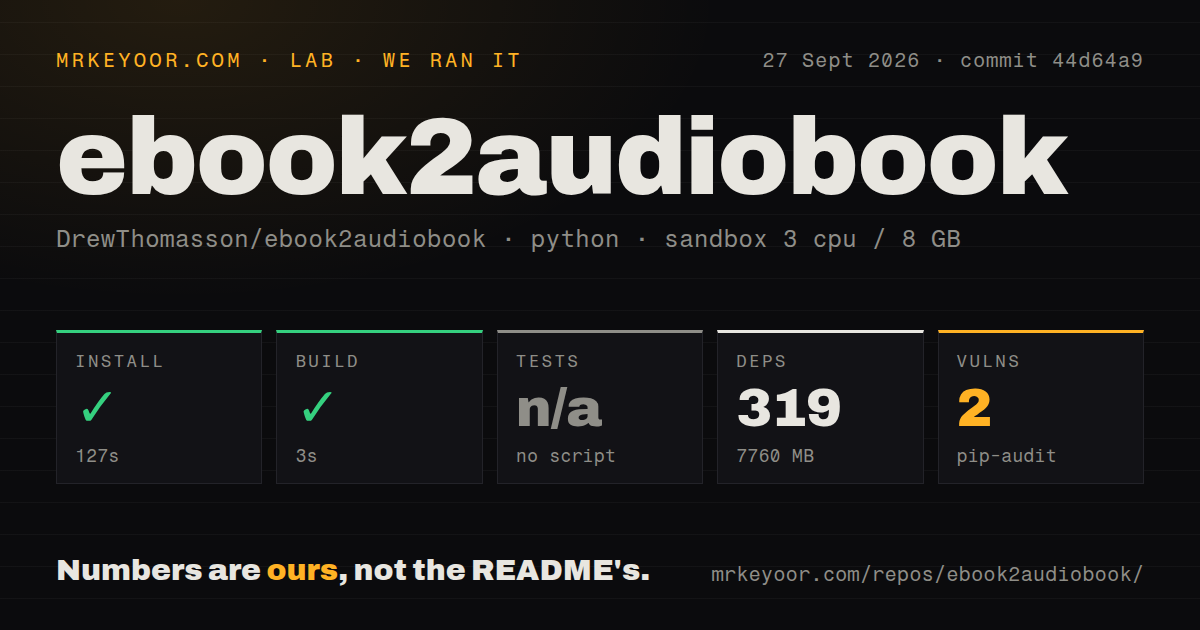
Our sandbox installed commit 44d64a9 in 127 seconds. The run used a fresh unprivileged Python 3.12 Debian container with 3 CPUs, 8 GB of RAM, and no secrets. Installation succeeded with 319 packages and occupied 7,760 MB on disk. The repository itself was much smaller: 339 files, about 21,377 lines of source, and a 35.9 MB checkout.
The build completed successfully in 3 seconds. The repository exposed no test script or target, so the harness skipped tests. That gives us no passing count for ebook parsing, OCR, chapter detection, resume state, model selection, or final audio assembly. A successful build only shows that the supplied build step cleared our container; it does not stand in for a regression suite.
Pip-audit found 2 known vulnerabilities in the installed environment. The measurement does not name the packages, advisory IDs, severity, or reachable code paths, so this review does not assign blame or claim exploitability. The repository scan also found 8 CI workflow files, a Dockerfile, a Compose file, and no tests directory. Review the full audit report before processing sensitive manuscripts or opening the interface to other users.
EPUB cleanup remains part of every serious conversion
The README says EPUB has no standard structure for chapters, paragraphs, or prefaces and advises removing unwanted text before conversion. Open issue 2126 gives that warning a concrete shape: a nonfiction book's footnote numbers were spoken aloud and repeatedly broke the narration. Calibre and a Kobo reader recognized those footnotes, according to the report, but the converter did not skip them.
A completed audio file can therefore be technically valid and still unpleasant to hear. Preview the extracted blocks, test a representative chapter, and listen for footnotes, page furniture, names, numbers, foreign phrases, and abrupt splits before running the whole book. Our 3-second build says nothing about those outcomes because the lab did not synthesize or score audio.
CPU, CUDA, ROCm, XPU, and Jetson take different routes
The README lists a 2 GB RAM and 1 GB VRAM minimum, with 8 GB RAM and 4 GB VRAM recommended. It supports CPU, CUDA, ROCm, Intel XPU, Jetson, and Apple Silicon paths, but warns that modern speech engines are very slow on CPU. It suggests lower-quality engines for CPU use. Those are project statements, not speed results from our sandbox.
Docker examples use separate images or tags and different device mounts for each hardware family. Local launchers can install missing software through Homebrew on macOS or Scoop on Windows. Release v26.9.27 also moved Python environment management from Miniforge3 to uv, added CUDA 13.2 compatibility, and upgraded to Gradio 6. Pin the release and rehearse the same device path you will keep using.
Two open issues and an October 2 push show a small active queue
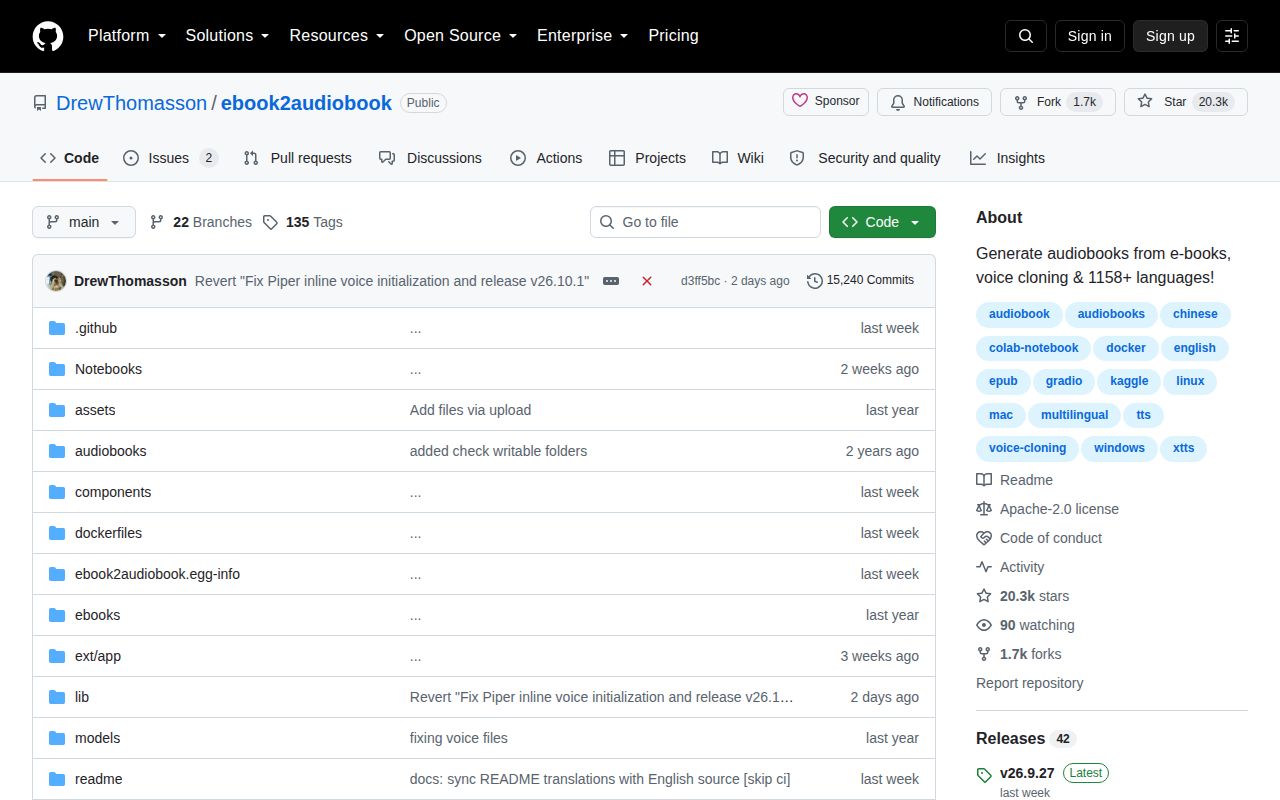
GitHub showed 20,269 stars and 2 open issues on October 4, 2026, with no open pull requests in the search result. The repository was pushed on October 2, five days after v26.9.27 shipped. One open report concerns Piper SML processing; the other concerns spoken footnote numbers. Both sit close to the actual conversion path rather than project housekeeping.
Ebook2Audiobook is strongest as a local workstation for someone willing to inspect text and listen to output. EPUB to Audiobook is narrower if one input format covers the job. Piper makes sense when you only need a speech engine, while Audiobookshelf solves storage and playback after audio exists. Here, the trade is clear: the 7,760 MB environment buys a wide book pipeline, but the missing test target and 2 audit findings keep it out of unattended public-service territory.