mrkeyoor.com_
Wed 16 Sept 05:23 UTC
Webevaluationupdated 16 Sept 2026

django-rest-framework review

Django REST Framework adds API views, serializers, authentication, permissions, routing, and a browser interface to Django applications. It solves the repetitive work between Django models and an HTTP API while leaving database access and policy decisions in your code.

Verdict

Our Django REST Framework build passed in 2 seconds, but pytest stopped after another 2 seconds because dj_database_url was missing before collection began. That setup miss does not outweigh DRF's fit for a Django team that wants conventional serializers, views, and permissions, but it prevents us from calling the measured checkout fully green. Choose a typed ASGI alternative when Django itself is optional, or when DRF's explicit query and authorization work feels heavier than its conveniences.

We ran it

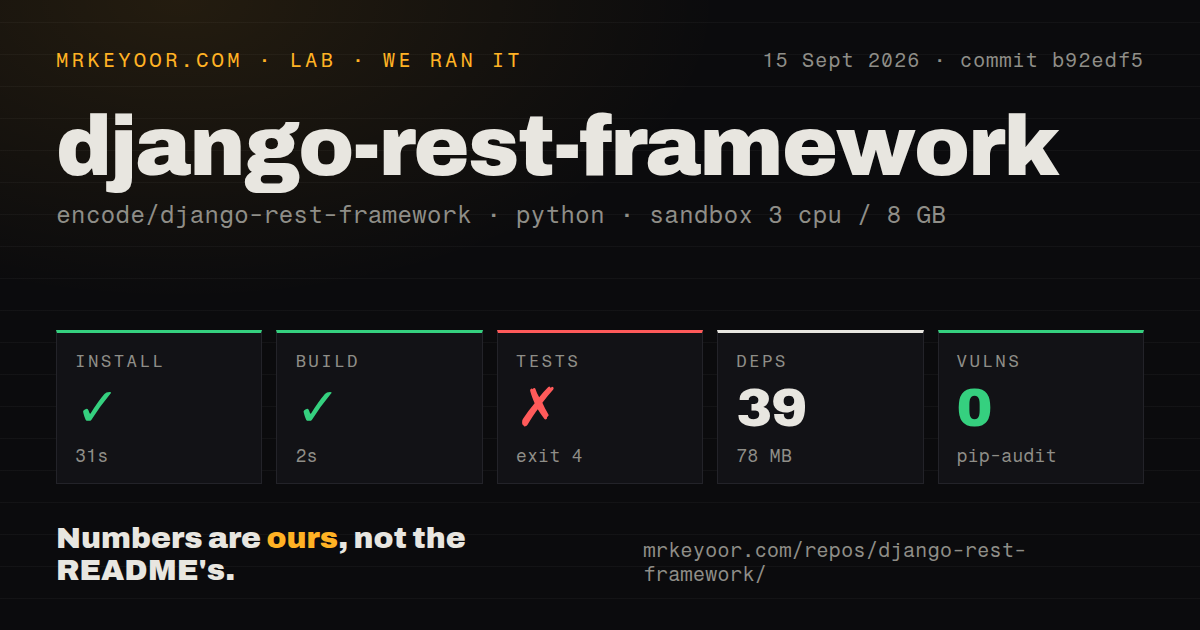
Lab card: what happened when we ran django-rest-frameworkScreenshot of django-rest-framework (www.django-rest-framework.org)
Install✓ · 31s39 packages · 78 MB
Build✓ · 2s
Tests✗ · 2sran, no count parsed
Known vulns0(pip-audit)
Repo585 files~42,184 lines of source · 15.5 MB · 4 CI workflows · tests dir

Answers from our run

Does django-rest-framework build from source?

Dependencies installed in 31 seconds (39 packages), and the build succeeded in 2 seconds. We cloned commit b92edf5 into a clean Debian container with 3 CPUs and no project-specific setup.

Do django-rest-framework's tests pass?

The test command failed in our container, and its output did not report a pass or fail count.

Does django-rest-framework have known vulnerabilities in its dependencies?

pip-audit found none in the dependency tree at the time of our run.

Who should not use django-rest-framework?

Projects that are not already committed to Django: version 3.18.1 requires Django 5.2 or newer, and much of its value comes from Django's ORM, auth, settings, and request stack.

What are the alternatives to django-rest-framework?

Django Ninja, FastAPI, Litestar. Our Django REST Framework build passed in 2 seconds, but pytest stopped after another 2 seconds because dj_database_url was missing before collection began.

Setup4/5App setup is short; our source test environment missed one dependency
Docs5/5Detailed guides state query, permission, and throttle limits plainly
Community5/530,182 stars, a recent push, and active September 2026 releases
Maturity5/5Version 3.18.1 follows 15 years of Django API maintenance

Who it’s for

Django teams building JSON APIs around existing models, authentication, and settings.
Developers who want serializers, generic views, viewsets, and routers that can be replaced piece by piece.
Internal-tool teams that benefit from an API interface people can inspect and use in a browser.
Projects that value long release history and detailed reference documentation over a smaller API surface.

Who it’s NOT for

Projects that are not already committed to Django: version 3.18.1 requires Django 5.2 or newer, and much of its value comes from Django's ORM, auth, settings, and request stack.
Teams expecting serializers to prevent N+1 queries: the relations guide says queryset optimization with select_related and prefetch_related remains the programmer's job.
APIs that assume object permissions filter lists or protect creates automatically: DRF documents that list querysets need separate filtering and create checks belong in the serializer or view.
Operators treating built-in throttles as brute-force or denial-of-service protection: the throttling guide explicitly limits them to application policy and basic over-use controls.
Contributors seeking a home for large new features: the contributing guide calls DRF essentially feature-complete and says maintainers would prefer not to accept new features.

Setup reality

Our commit b92edf5 checkout installed 39 packages in 31 seconds and used 78 MB. The build passed in 2 seconds. Pytest then failed with exit 4 after 2 seconds while loading tests/conftest.py: Python could not import dj_database_url. Pip-audit found 0 known vulnerabilities.

Application setup is short: Python 3.10 or newer, a supported Django release, pip install djangorestframework, and rest_framework in INSTALLED_APPS. Core use needs no external credential or separate service. Your Django database, authentication choices, and optional OAuth packages determine the remaining configuration.

Source testing has a separate dependency group. The measured commit lists dj-database-url>=3.1.0 there, and tox installs that group before pytest. Tests use in-memory SQLite without DATABASE_URL; PostgreSQL-specific cases need that variable and a database. The supported Django lines are 5.2, 6.0, and 6.1.

Django 5.2+ teams get an API layer that still feels like Django

Django REST Framework 3.18.1 turns Django models and ordinary Python objects into HTTP APIs through serializers, views, authentication classes, permissions, and content negotiation. Viewsets and routers can remove repetitive URL and CRUD code, while function-based views remain available when those abstractions are too broad. The browser interface is more than decoration for an internal API: a developer can inspect responses, authentication behavior, forms, and errors without first building a separate client.

The measured checkout was 15.5 MB before installation, with 585 files and roughly 42,184 lines of source. That is substantial middleware rather than a thin JSON helper. It covers model and non-model serializers, generic views, pagination, filtering hooks, versioning, schemas, and several authentication styles. The trade is a vocabulary of fields, mixins, viewsets, renderers, parsers, and settings that a team must understand when a default stops matching its API.

What happened when we ran it

Our sandbox installed 39 packages in 31 seconds and occupied 78 MB on disk. The build completed in 2 seconds at commit b92edf5. We used an unprivileged Debian container with 3 CPUs and 8 GB of RAM. The repository scan found 4 CI workflow files and a tests directory, but no Dockerfile. Pip-audit reported 0 known vulnerabilities in the installed Python packages.

Pytest failed with exit 4 after 2 seconds while importing tests/conftest.py. The final error was ModuleNotFoundError: No module named 'dj_database_url', so the suite stopped before it could report passing or failing cases. The same commit lists dj-database-url>=3.1.0 in its test dependency group, and tox selects that group. Our run proves the tested install path lacked the module; it does not show how the REST Framework assertions would finish after that dependency is present.

Version 3.18.1 removes boilerplate, not database decisions

DRF 3.18.1 can derive serializer fields from a Django model, validate incoming data, and connect a viewset to generated routes. That is a large reduction in repeated endpoint code. It also makes nested representations and related fields easy to express. The framework does not pretend those declarations are free. A serializer may touch relations while producing each item, and the API author still controls the queryset that feeds it.

DRF 3.18.1 explicitly declines to add select_related or prefetch_related automatically because doing so would introduce hidden behavior. Its relations guide warns that a field crossing an ORM relation can cause another database hit for each object unless the queryset is prepared. That is the right design for predictability, but it means performance review belongs beside serializer review. A concise ModelSerializer can still back an expensive list endpoint.

Version 3.18.1 permissions do not filter every object for you

In DRF 3.18.1, object permission checks run when a generic view retrieves one object through get_object(). The documentation says generic list views do not call the object check for every row because of the cost. You must filter the queryset so users cannot see objects outside their scope. Object checks also do not protect creation automatically, so create policy belongs in the serializer or perform_create() implementation.

Built-in throttling has a similarly clear boundary. DRF says its cache-based counters use non-atomic operations, so request rates may be fuzzy under concurrency. The project does not present them as protection against brute force or denial-of-service attacks because clients can spoof origin addresses. Use them for product tiers and basic over-use policy. Put hard traffic controls, abuse detection, and capacity protection at a layer designed for hostile traffic.

Version 3.18.1 is current, while the core is feature-complete

Release 3.18.1 shipped on September 7, 2026 with fixes for duplicate IP validation errors, negative integer OpenAPI formats, list serializer uniqueness, and non-finite float values. Version 3.18.0 had arrived one month earlier with Django 6.1 support and dropped Django 4.2, 5.0, and 5.1. That pace shows active compatibility work. It also means teams upgrading a mature application should read release notes for changed validation and error formats.

GitHub showed 30,182 stars and 50 combined open issues and pull requests when fetched, with 27 of those entries being issues. The last push was September 15, 2026, and current pull requests were still being updated that day. The contributing guide describes the project as essentially feature-complete and discourages new features. Read that as maintenance focus, not neglect: Django compatibility and bug fixes continue, while a speculative extension may belong outside core.

The 78 MB install earns a Django trial, not a framework migration

Our 78 MB environment built in 2 seconds, so trying DRF inside an existing Django application is inexpensive even though the test dependency path needs care. Its strongest case is continuity: Django models, authentication, permissions, and settings stay in charge while DRF handles API representation and request flow. Do not move a non-Django service onto Django only to obtain DRF. For a Django codebase, start with one real endpoint and inspect its SQL, list visibility, create permissions, and edge throttling before standardizing on it.

Alternatives

ProjectWhat it isPick it when
Django NinjaA Django API framework centered on Python type hints and generated OpenAPI schemas.pick this instead when you want to stay on Django but prefer typed endpoint functions and a smaller abstraction layer.
FastAPI gh↗A type-hint-driven Python API framework built on ASGI components.pick this instead when the service does not need Django's ORM or admin and async request handling is central.
LitestarAn ASGI framework with typed routing, dependency injection, and OpenAPI support.pick this instead when you want an ASGI-first framework and are willing to assemble data access outside Django.

What people are saying

  1. [velocity-scout] encode/django-rest-framework

Sources

  1. Django REST Framework repository and README
  2. Django REST Framework 3.18.1 release
  3. Serializer relations and queryset optimization
  4. Object-level permission limitations
  5. Application throttling limitations
  6. Django REST Framework contributing policy

More web reviews

gin · components · docs · docusaurus · react-admin · engine · the whole board →