Dex v0.10.0 puts ordinary handlers around durable state
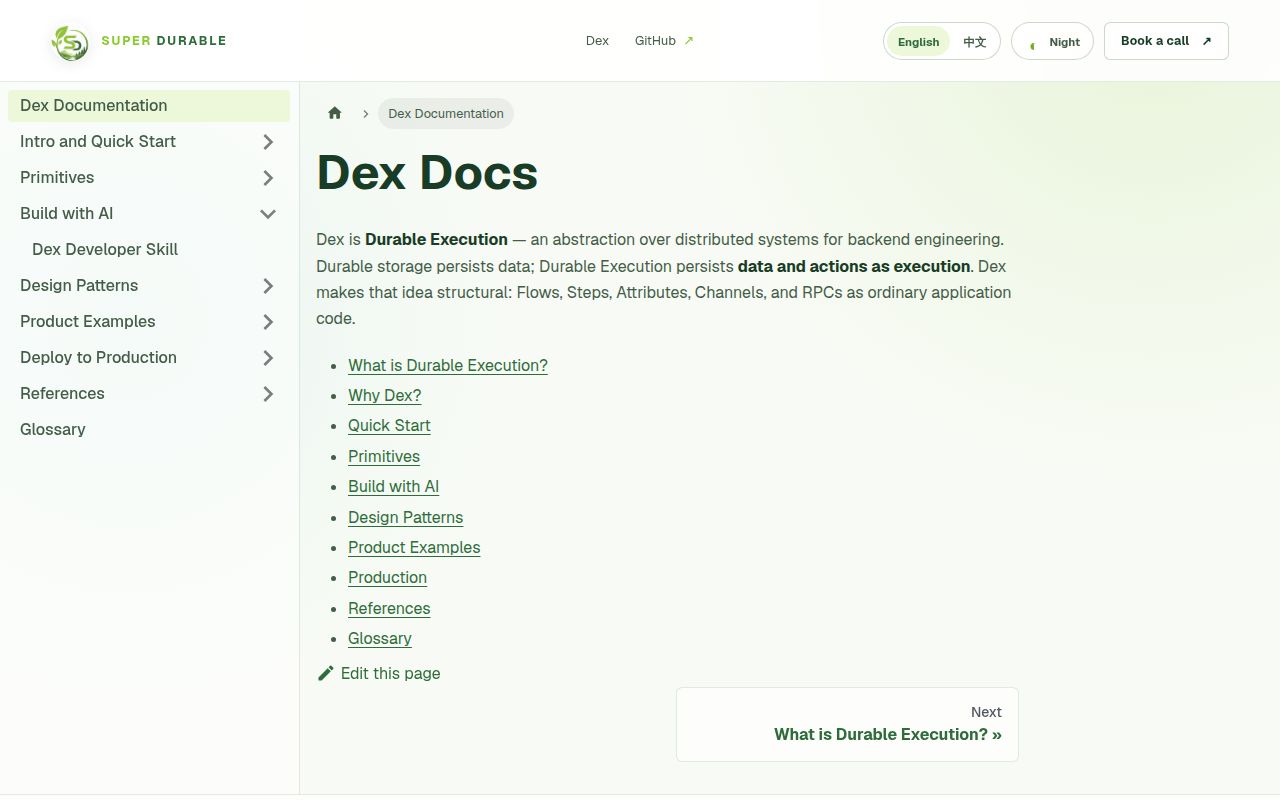
Dex v0.10.0 treats a long-running process as a Flow made from Steps, Attributes, RPCs, Channels, and Timers. A Step can wait for a message or timer, run application code, and choose what happens next. Dex Server saves the state and sends work to application Workers. That is a useful model for an order that may pause for seller approval, retry shipping, and issue a refund after the original process has restarted.
The quick start shows the same order flow in 5 languages: Python, Go, Java, TypeScript, and Rust. Your payment and shipping calls stay inside normal handlers, while Dex owns retries, waits, state, and resumption. This is the project's main appeal compared with replay-based engines, which place stricter rules around workflow code. The trade is a new server and programming model in the middle of your application.
The v0.10.0 local route starts a four-service stack
The v0.10.0 quick start begins with dexcli dev, which starts Dex Server, Dex Web, Temporal Server, and Temporal Web. Defaults place the server on port 8801 and the web interface on 8802. The application still starts its own SDK Worker. If those ports are occupied, another local stack chooses free ports and gets a separate SQLite database, which is handy for testing two flows without hand-editing configuration.
Local persistence needs more attention than the one command suggests. Values larger than 1 KB go into a blob directory beside the SQLite state, while the in-memory Stream Store discards its messages when the CLI exits. You can point Dex at an external Temporal namespace or configure an attribute store such as PostgreSQL. Those are optional for a trial, but production use means owning their retention, credentials, and failure behavior too.
What happened when we ran it
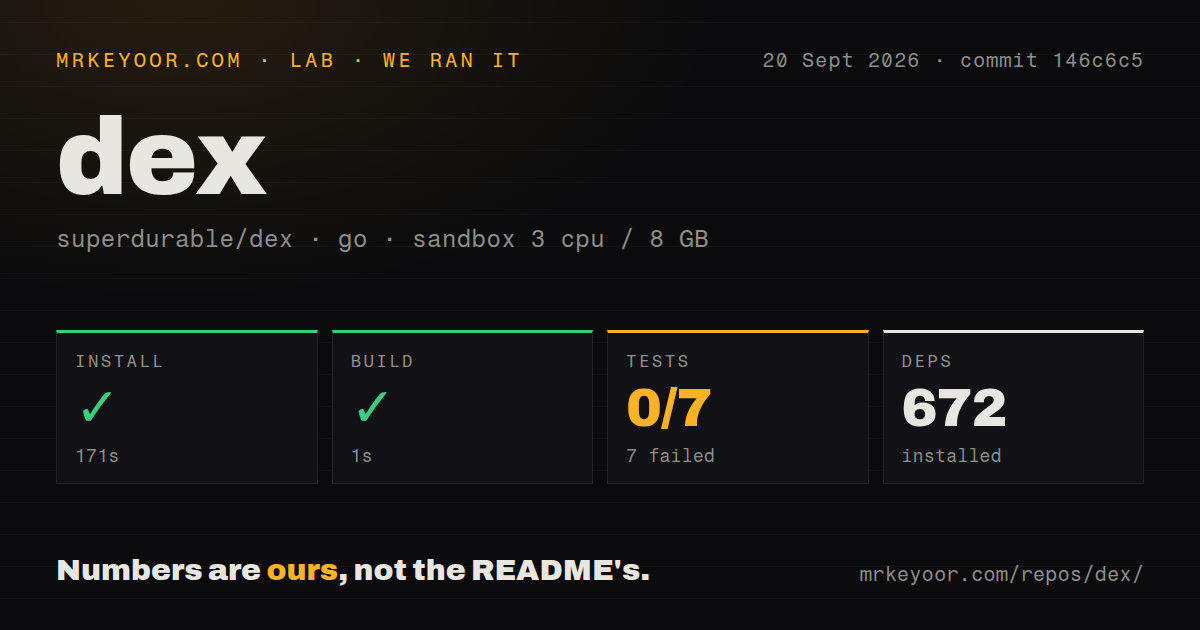
Our sandbox installed the CLI project in 171 seconds, pulling 672 packages. The build succeeded in 1 second. We measured a checkout of 2,902 files, about 561,064 source lines, and 89.9 MB before installation. The repository also contained 30 CI workflow files, no Dockerfile, and no top-level tests directory. That is a large platform repository even though the released CLI aims to make the first local start feel small.
The test command failed after 12 seconds with exit code 1. Go reported 0 passed and 7 failed out of 7. Each shown setup failure ended at web/assets/embed.go, where the embed pattern all:dist matched no files. The command and log establish that the checked-out commit lacked the expected generated web path for this test run. They do not establish why it was absent, so we would not blame a missing system package or a broken generator without more evidence.
The v0.10.0 README still promises breaking changes
Dex v0.10.0 was released on September 18, 2026, and the repository was pushed again on September 21. The pace is high, but the README opens with a pre-launch warning: testing is welcome and breaking changes may land before formal launch. Recent merged work bears that out. One September pull request intentionally made earlier workflow histories unsupported after internal names changed, and another changed how Go RPCs are registered.
Sustainable Use License 1.0 covers most material owned by Super Durable. It permits internal business use and noncommercial personal use, then limits distribution and commercial reuse. The docs/ and examples/ directories keep their existing license status, and legacy material keeps its original terms. A company can evaluate Dex internally, but a team planning to redistribute it or build a competing hosted product should read the actual terms before treating this repository like Apache-2.0 infrastructure.
Six open issues and pull requests include real data limits
GitHub listed 6 open issues and pull requests on September 21, 2026: 4 issues and 2 pull requests in the open API result. Issue 357 documents a sharp AttributeMap limit. An indexed map uses an explicit index key rather than indexing every instance, and writes from separate instances can replace the same search field. If your support tooling expects to query arbitrary map entries, the current behavior does not provide that.
Issue 146 describes another cost decision: blobs remain until the complete workflow history is deleted, including runs created through continuation, reset, or ID reuse. That preserves time-travel behavior, but it can retain more storage than an operator wants. The issue discusses earlier cleanup as a tradeoff, not a shipped setting. These limits affect data design and storage policy.
The 89.9 MB checkout contains a full platform
The 89.9 MB repository includes a server, web interface, CLI, protocol definitions, examples, and SDK work across several languages. That breadth explains both the 672-package install and the operational surface. Dex Web can inspect running flows, while the CLI returns JSON for humans and coding agents. The pieces fit together, yet adopting them means tracking compatibility across server, CLI, SDK, workflow backend, and stored history during a period that still permits breaking changes.
Temporal is the safer comparison when you want the established replay model and its ecosystem directly. Restate is worth a trial when durable service handlers match your application shape. DBOS Transact is narrower for Python teams that prefer database-backed workflows. Choose Dex only when its structural Flow model solves a specific problem for your team. The Sustainable Use terms must fit, and you should expect migrations before formal launch.