Most users need one package, not the 288.6 MB repository
DefinitelyTyped's 62,655-file checkout is the source and review queue behind npm's @types scope. If a JavaScript library lacks declarations, its users can install a matching package such as @types/node and gain compiler checks plus editor completion. Scoped names are flattened, so declarations for @babel/preset-env live under @types/babel__preset-env. Consumers should first inspect the original package for a types or typings entry, since bundled declarations make a second source unnecessary.
The repository has an exit path for packages that start shipping their own types. Contributors remove the old definition and publish a stub pointing users to the library. That keeps implementation and declarations on one release track. DefinitelyTyped remains useful when upstream cannot or will not own that work, but cloning the entire workspace into an application solves nothing.
What happened when we ran it
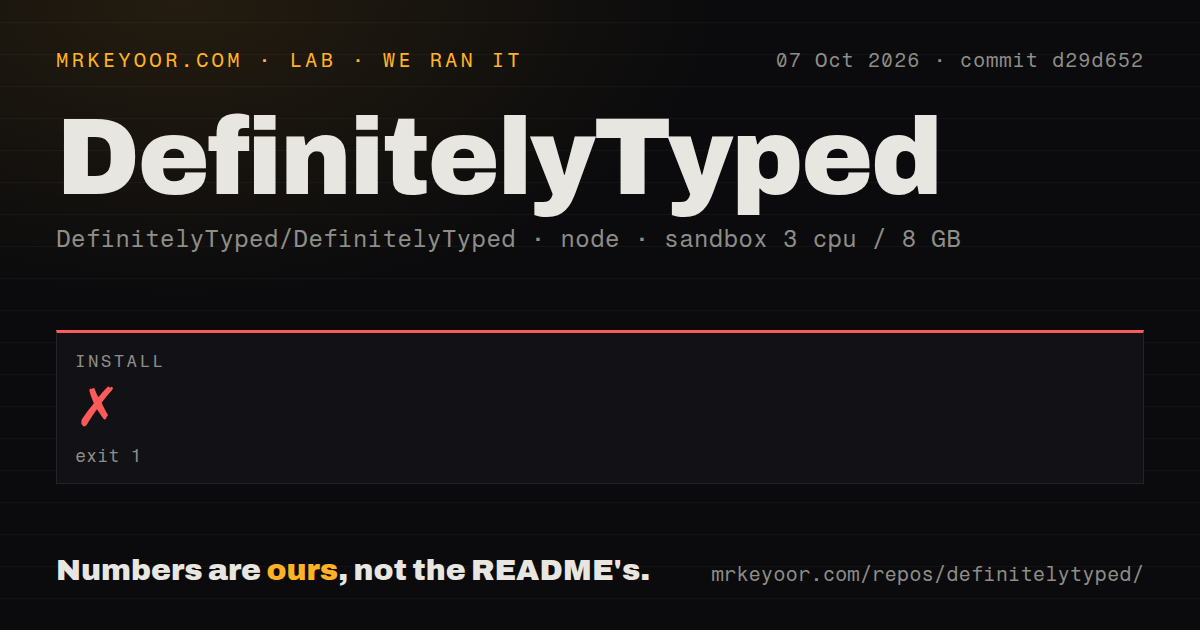
Our sandbox cloned commit d29d652 into an unprivileged Debian container with 3 CPUs, 8 GB of RAM, Node 22, and no secrets. The checkout occupied 288.6 MB before installation, contained 62,655 files, and held about 5,465,163 lines of source. Our scan found 7 CI workflow files, a workspace monorepo, no Dockerfile, and no root tests directory.
The npm install stopped after 72 seconds with exit code 1. Its final lines told us to use pnpm install and named npx only-allow pnpm as the failed command. That message is specific enough to act on: npm is the wrong package manager for this contributor workspace. The log does not show a dependency defect or a missing Debian package, so we would not label it as either.
Because installation failed, our run has no build or test result. That leaves a clean boundary around the finding: commit d29d652 rejected the command our Node harness selected. The repository's own status badges may show upstream CI health, but they do not turn our failed local setup into a pass. A contributor following the current README should start with pnpm.
One agent-authored pull request is the stated limit
DefinitelyTyped permits a coding agent to submit 1 pull request only after the user confirms the definitions are for personal use. The title must include [auto-generated]. The same policy rejects searches for popular untyped npm packages followed by bulk submissions. That is unusually direct governance, and it gives maintainers a concrete reason to close definition work that has no real consumer behind it.
Each package directory combines declaration files, metadata, compiler configuration, and sample TypeScript. Those examples are type-checked; they do not execute the JavaScript library. The README tells authors of a new definition to build and run real code first. A declaration can satisfy TypeScript while promising a function, export shape, or return value that the runtime never supplies.
Definition owners are listed in package metadata and receive review requests from the bot. Popular packages require support from their owners plus maintainer sign-off, while new definitions receive manual review. With 557 open issues on October 8, 2026, a narrow patch with a matching test has a much clearer path than a broad rewrite.
Current packages cover less than 2 years of TypeScript
DefinitelyTyped tests current packages against TypeScript versions less than 2 years old. Older compiler releases may still have compatible npm tags, but the active declaration line can adopt newer syntax as that window moves. Teams supporting an old enterprise branch should pin TypeScript and @types together, then check the published tags before upgrading either side.
Package versions also need careful reading. The major and minor numbers track the JavaScript library, while the declaration package's patch number advances independently when types are fixed. Matching @types/foo@5.4.x to foo@5.4.x is meaningful; expecting their patch numbers to describe the same release is not.
The October 8 push matters more than the 2019 release
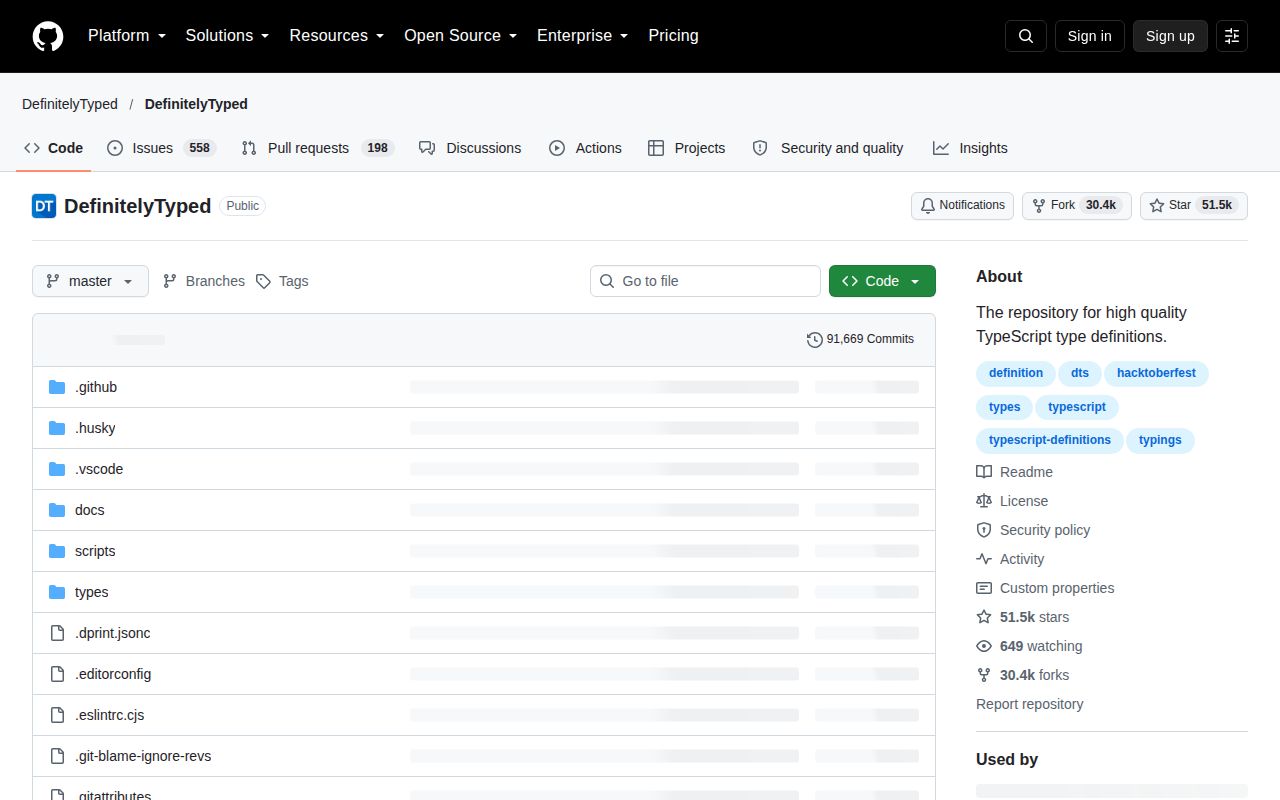
GitHub recorded a repository push on October 8, 2026, with 51,456 stars and 756 combined open issues and pull requests. A separate issue search returned 557 open issues. The latest GitHub release is version 0.1.450 from September 2019, but the README says the master branch is automatically published to individual npm packages. That old tag is therefore a poor maintenance signal for this project.
Use DefinitelyTyped as a consumer when the upstream package leaves a type-shaped hole in your project. Contributors should use the pnpm path, install only the relevant workspace slice, and prove the declaration against the matching runtime version. If you maintain the JavaScript library, bundling its declarations is the cleaner destination because code and types can change in the same release.