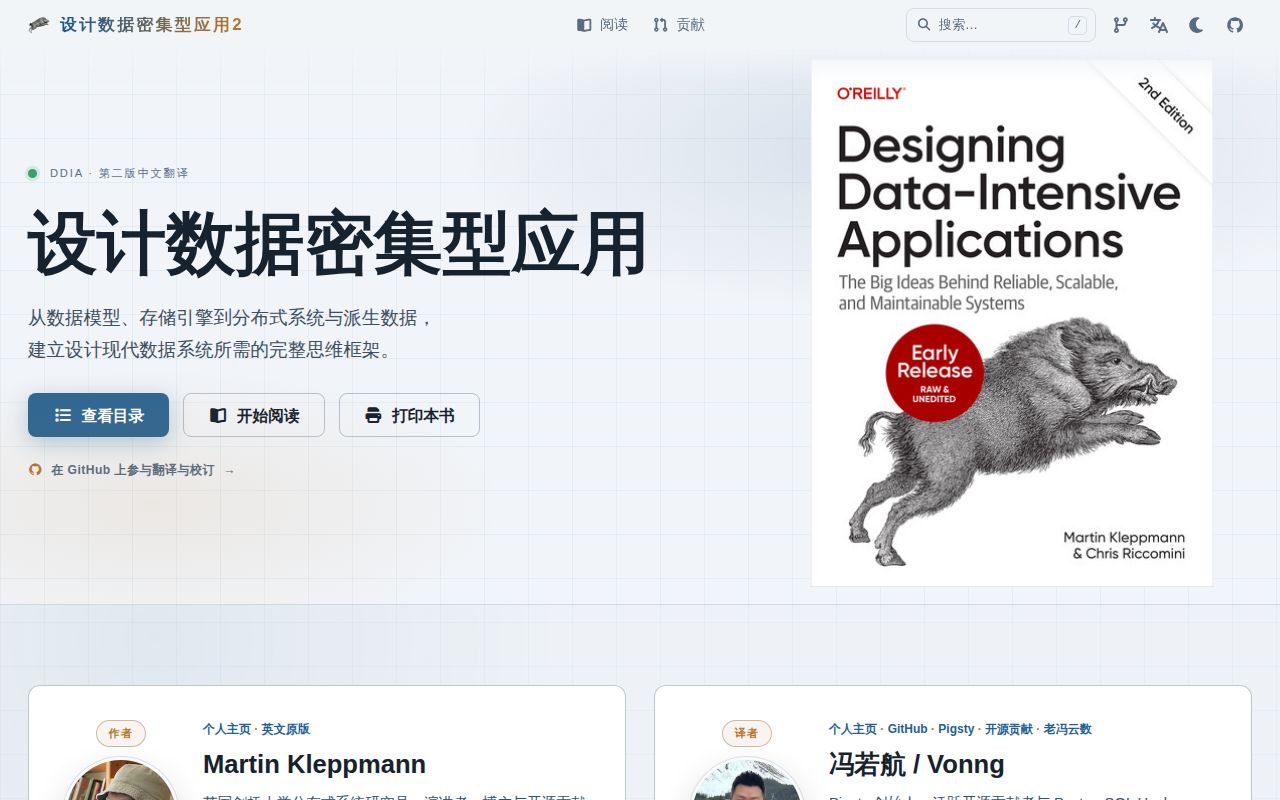
Fourteen second-edition chapters are available in Chinese
Vonng/ddia publishes a Chinese translation of Designing Data-Intensive Applications, including the first edition and all 14 chapters listed for the second edition. The material covers data-system tradeoffs, requirements, data models, storage, encoding, replication, partitioning, transactions, distributed-system failures, consensus, batch processing, stream processing, and social responsibility. The repository is for reading and translation work; it does not implement the databases or algorithms discussed in the book.
The main site supports sequential reading, stable figure numbers, cross-references, whole-book printing, Markdown, llms.txt, and EPUB export. A Traditional Chinese tree accompanies the Simplified Chinese text. The README and book content are primarily Chinese, with no English documentation path inside the repository. English readers are better served by the original book, while this project is useful to readers who want established systems vocabulary explained in Chinese.
Hugo and OINK 1.0.0 produce the reading site
The repository is a Hugo publishing project. Its go.mod pins the OINK theme at version 1.0.0, and the Makefile exposes development, production build, warning check, figure, translation, and EPUB commands. The development target can replace the pinned theme with a local OINK checkout; regular builds keep the module version. That split is helpful for theme contributors, though ordinary readers can ignore it and use the hosted site.
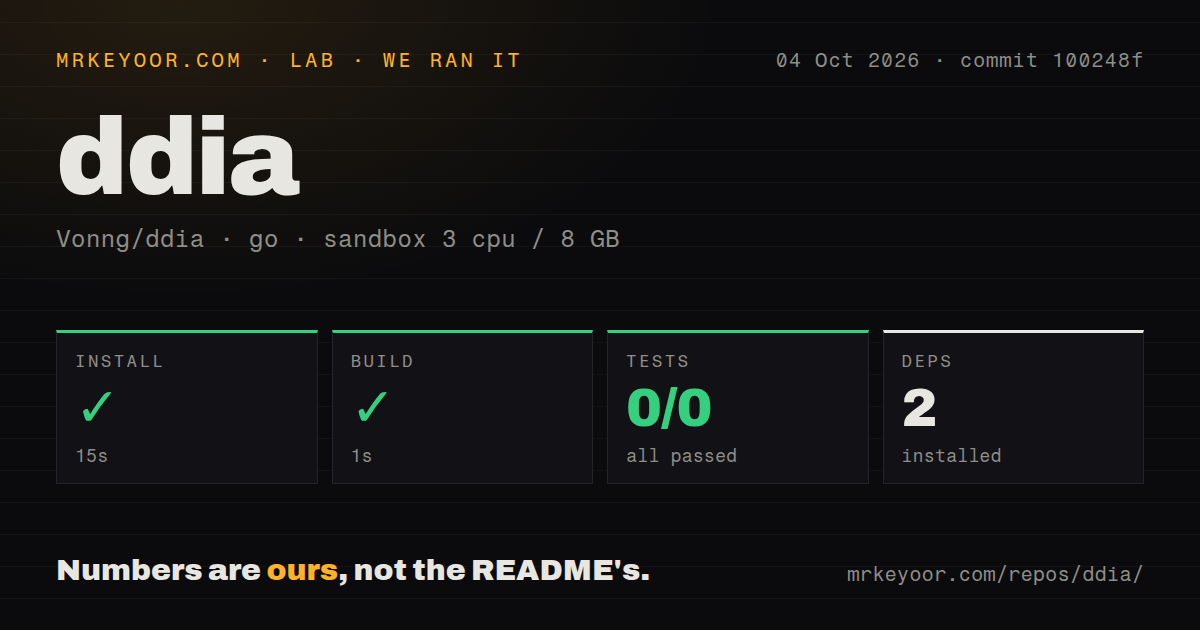
GitHub currently identifies Python as the leading repository language because helper scripts handle jobs such as Traditional Chinese conversion, figures, and EPUB checks. Our lab classified commit 70280ec through its Go module and installed 2 packages. Neither label turns DDIA into an application. The meaningful artifact is generated HTML and book output, while most of the repository's value sits in translated Markdown, figures, references, and editorial corrections.
What happened when we ran it
Our sandbox installed 2 Go module packages in 25 seconds. The build completed successfully in 7 seconds using the supplied project configuration. The checkout contained 369 files, occupied 34.2 MB, and had roughly 1,340 lines counted as source. Those numbers describe the publishing machinery and repository footprint, not the size of the translated prose or the effort needed to verify a technical translation.
The test command failed with exit code 1 after 7 seconds. Go printed a warning that ./... matched no packages, followed by no packages to test. The result was 0 passed and 0 failed out of 0. This is not evidence of broken book content, but it is a real absence: the checkout supplied no Go package suite for the harness to run. Our scan also found no tests directory, CI workflow, or Dockerfile.
A useful local check still exists outside go test. The Makefile's check target verifies the Go module and asks Hugo to build with path and translation warnings enabled, treating warnings as fatal. We did not receive a separate result for that target in the supplied lab block, so we do not claim it passed. Editors considering changes should run the project's documented content checks and inspect the rendered chapter, figures, links, and EPUB rather than inventing a green software-test count.
The rights notice is narrower than the CC BY badge
The repository displays a CC BY 4.0 license and includes the full license file. Its README also says the translation was made for study and personal interest, may not be publicly distributed or used commercially, and leaves other rights subject to the original author and publisher. Those statements do not give an organization one simple redistribution answer. A GitHub license detector cannot resolve rights in a translated commercial book.
For personal study, the intended use is plain: read the website, follow the citations, and buy the original if you can read English. A company that wants to mirror chapters, package the EPUB, train on the text, sell access, or quote substantial passages should ask the relevant rights holders or obtain legal advice. The repository is valuable as a reading edition; that does not make every downstream use safe merely because a CC BY badge is visible.
August 2026 edits show active editorial maintenance
GitHub recorded the last push on August 30, 2026. The repository had 23,409 stars, 4,538 forks, and 0 open issues or pull requests when fetched. Its README credits 210 contributors and lists years of fixes covering terminology, typography, chapter references, Traditional Chinese conversion, figures, and EPUB behavior. The zero open count is a current queue snapshot, while the last-push date shows that corrections have not stopped.
There is no latest GitHub release, so tags should not be used as the health signal. The live second-edition chapters and same-day repository push provide better evidence of current work. That maintenance matters for a translation of a technical book, where one wrong term can change the meaning of a consistency model or transaction guarantee. Readers should still compare disputed wording with the original English text and primary sources cited by the book.
Read it online unless you plan to edit the translation
The best way to use Vonng/ddia is the hosted site. It avoids the 25-second module installation, the Hugo toolchain, theme resolution, and a local build that most readers do not need. Clone the repository when you want offline source, EPUB work, a correction, a figure fix, or a local edition with reviewed changes. Do not approach it as a sample database system just because go.mod is present.
For Chinese-speaking engineers, this is an unusually accessible route into a demanding systems book, with both editions and active corrections. Our 7-second build shows the site can be produced from the measured checkout, while the empty Go test result keeps the evidence honest. Read it for concepts, verify subtle passages against the original, and resolve the rights question before distributing anything beyond ordinary study use.