Dashi PPT trades a blank canvas for constrained editing
Dashi PPT is a skill file plus a local JavaScript presentation runtime. A compatible agent reads the source document, chooses from the provided layout system, writes slide content, and renders an HTML deck. The output is also its editor: users can change text in place, swap media, move pages, change layouts, adjust module counts, and switch palettes before exporting.
The primary README is Chinese, and the English version mirrors the detailed setup and feature guide. It lists 12 themes, 1,020 layout pages, 20 page roles, and 8,576 adjustable controls. Those numbers describe the included design library, not the number of layouts an agent should use in one deck. The fixed system is the point: it reduces design choices so a report gets to an editable draft quickly.
Claude Code support still leaves judgment to the model
The repository names Claude Code, Codex, Doubao, and several other local agents as tested hosts. Cursor and similar tools can work if they read SKILL.md, write files, and execute shell commands. A plain web chatbot is not a match because generation and export depend on a local Node.js project. The skill coordinates the workflow; the chosen agent still decides structure and wording.
That distinction explains issue 31, where a user says two attempts consumed an agent plan and did not follow a prepared document. It is a report from one model and workflow, not a measured result for the skill. The README itself estimates roughly 100,000 tokens for a 10-page deck, with variation from document length and revision rounds. Give the agent a page-by-page brief and review facts before polishing visuals.
What happened when we ran it
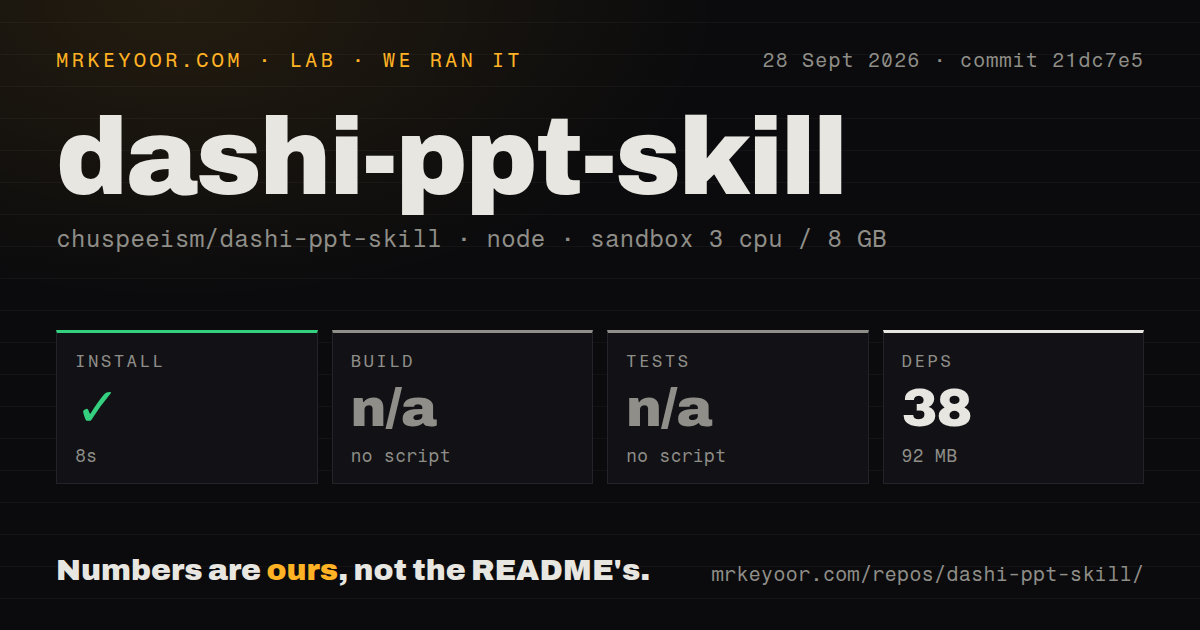
Our sandbox installed 38 npm packages in 18 seconds and used 92 MB. There was no build script or target, so our build step was skipped. There was also no test script or target, so the lab did not run tests. These measurements cover commit 7cb2334 in an unprivileged Debian container with 3 CPUs, 8 GB of RAM, no secrets, and Node 22.
The measured project is under ./skills/dashi-ppt/project/, rather than at the repository root. The checkout contained 185 files and about 209,876 source lines across the skill, runtime, themes, and layouts. Our scan found 0 CI workflow files, no Dockerfile, and no tests directory. A successful 18-second install therefore proves dependency resolution, not a valid deck, browser preview, PDF, or editable PPTX.
Export requires Chrome, Chromium, or Edge on the host, with CHROME_PATH available when automatic detection fails. The runtime package has explicit commands for scaffolding, rendering, validating copy and variants, starting previews, and exporting. Those scripts are useful internal checks, but none was wired to a build or test target in the lab contract. Run a representative deck through every final format before relying on it.
The preview server exposes static slides to the LAN by default
Both preview entry scripts default the host to 0.0.0.0. The launcher prints a LAN URL, while the export authorization module restricts sensitive export calls by origin and loopback rules. Static deck files remain available to devices that can reach the preview port. The server searches from port 4178 and can scan further ports when one is busy.
For confidential presentations, set DASHI_PPT_PREVIEW_HOST=127.0.0.1 before startup and verify the listener. The README says document content is not uploaded by the runtime, apart from npm installation and a version lookup that do not send deck content. Local-only processing does not cancel local-network exposure. Also inspect any images supplied to the deck and the agent provider handling the original prompt.
v0.4.11 has a reported content-replacement regression
Open issue 38 reproduces a serious problem on macOS with Chrome, Safari, Chromium, and WebKit. In the report, page 1 displays generated content, but navigating to later pages or presentation mode shows the theme's built-in demo text. The reporter says v0.4.5 did not have the same behavior and warns that editing a fallback page can write demo content into deck state.
Issue 33 separately reports a black directory slide and template layers covering content on Windows 11 with Codex. These reports do not establish that every theme or host fails. They do make visual inspection mandatory on v0.4.11. Check every slide in normal navigation and presentation mode, then open the exported PPTX in the application that will be used during delivery.
Licensing splits the skill from its export engine
The repository is AGPL-3.0, which matters to teams distributing modifications or offering a modified network service. The README carves out project/packages/html-deck-to-pptx as a proprietary component licensed only inside this skill. It says versions through v0.2.7 had an MIT grant, while the current component cannot be extracted, copied, or redistributed on its own.
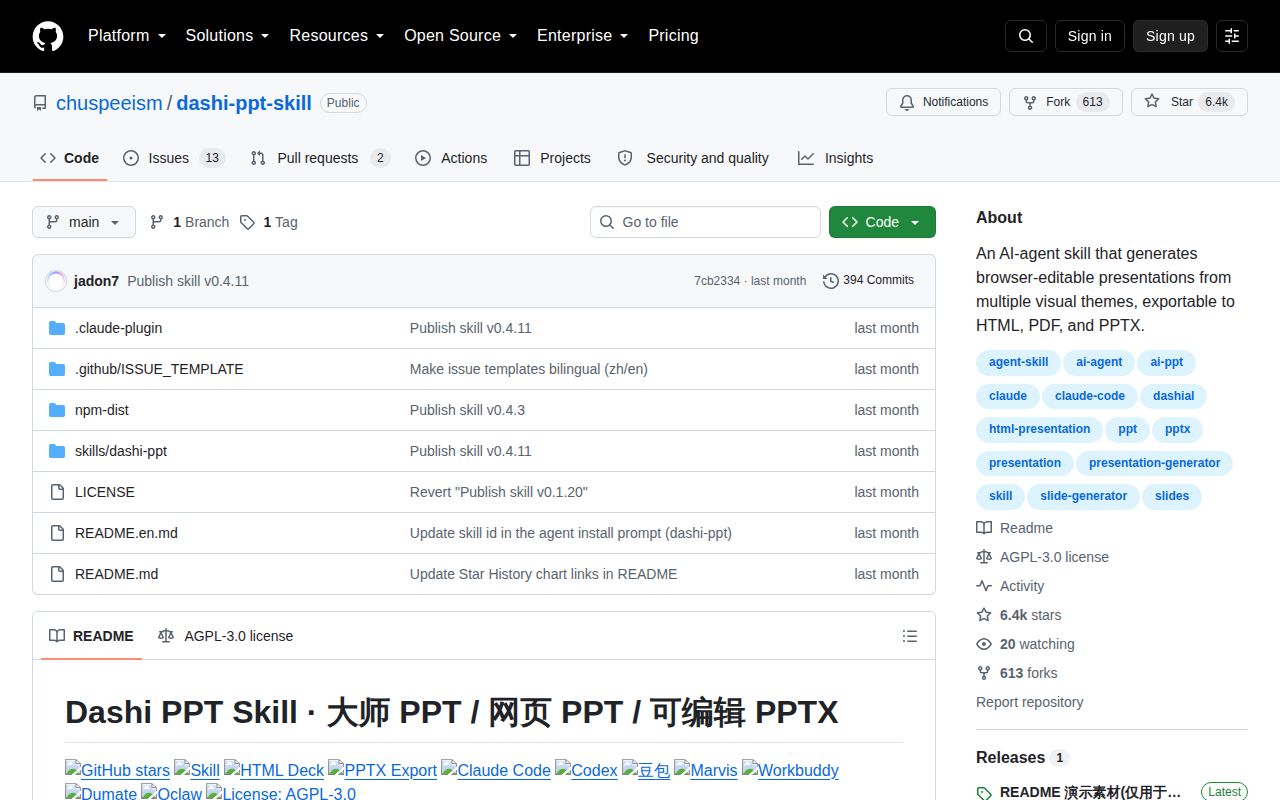
GitHub showed 6,375 stars, 15 combined issues and pull requests, and a last source push on July 30, 2026. The listed GitHub release from July 7 is explicitly an image-hosting release, not a software version, so it says nothing about code freshness. Active August issues show continuing use. The absence of a build and test gate keeps this in trial territory despite the large layout library.