The textbook is stable sooner than the surrounding tools
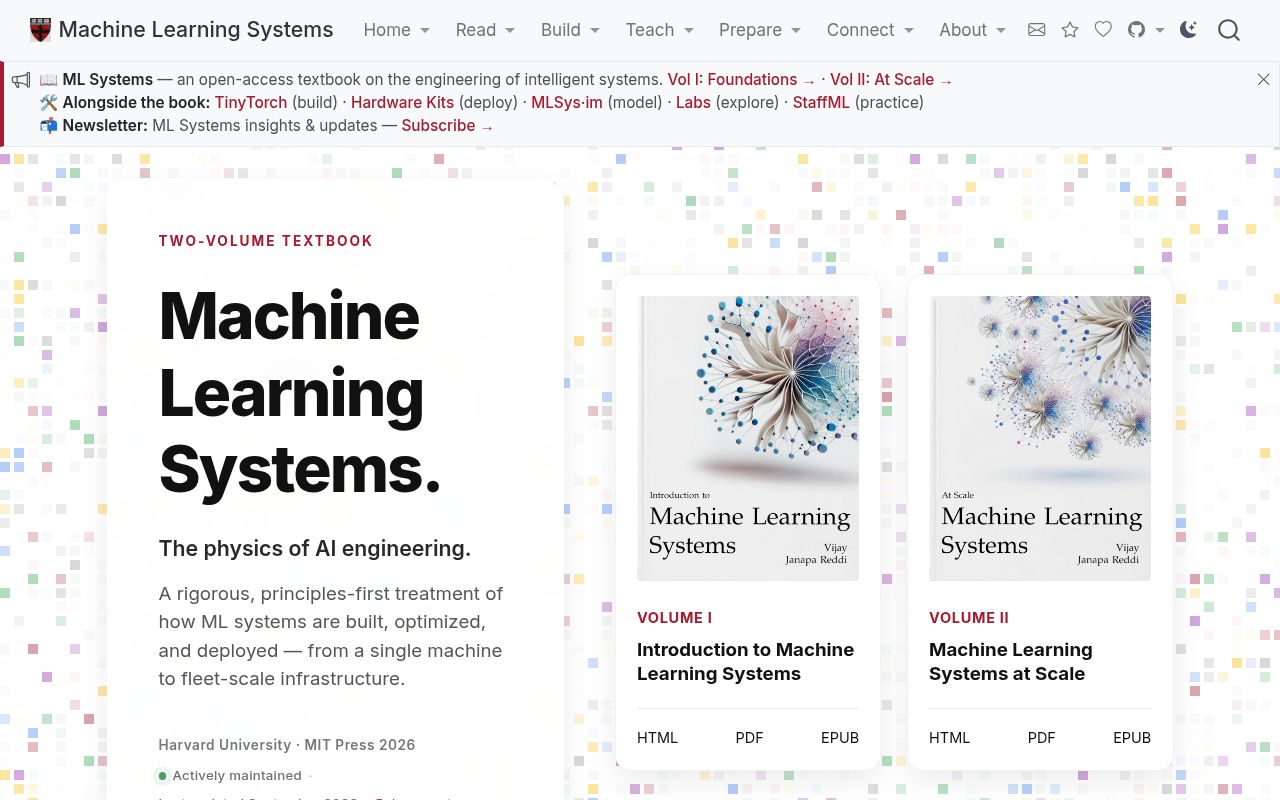
CS249r Book teaches machine-learning systems as an engineering subject. Volume I covers one machine, while Volume II addresses distributed training, fleet operation, inference, and governance. The FAQ expects Python and basic machine-learning knowledge. Students still learning models and optimization should begin with an introductory course.
The repository is much larger than two volumes. commit 16f8401 contained 17,926 files and about 549,232 source lines in a 1,003.3 MB checkout. TinyTorch teaches framework internals, browser labs model trade-offs, and MLSys·im covers infrastructure constraints. Hardware kits, interview practice, slides, and instructor guides fill out the curriculum.
Reading online avoids the 1,003.3 MB checkout
Both volumes are free on the project website, and the labs run through Marimo and WebAssembly in a browser. A reader can choose one volume without configuring the rest. The quick start likewise routes learners to a particular component rather than asking them to run the entire repository.
Local setup differs by directory. Labs use Python requirements and an editable MLSys·im package, while TinyTorch has its own CLI. The root package declares Puppeteer and no scripts. Our root npm install expanded to 105 packages and 55 MB, yet it did not install every Python, document, simulator, or hardware dependency in the checkout.
That distinction prevents one root result from being mistaken for curriculum readiness. The 27-second npm install exercised the Puppeteer tree only. It did not open a Marimo notebook, run TinyTorch, render either volume, or flash a hardware kit. Each selected component needs its own setup and verification before a class depends on it.
What happened when we ran it
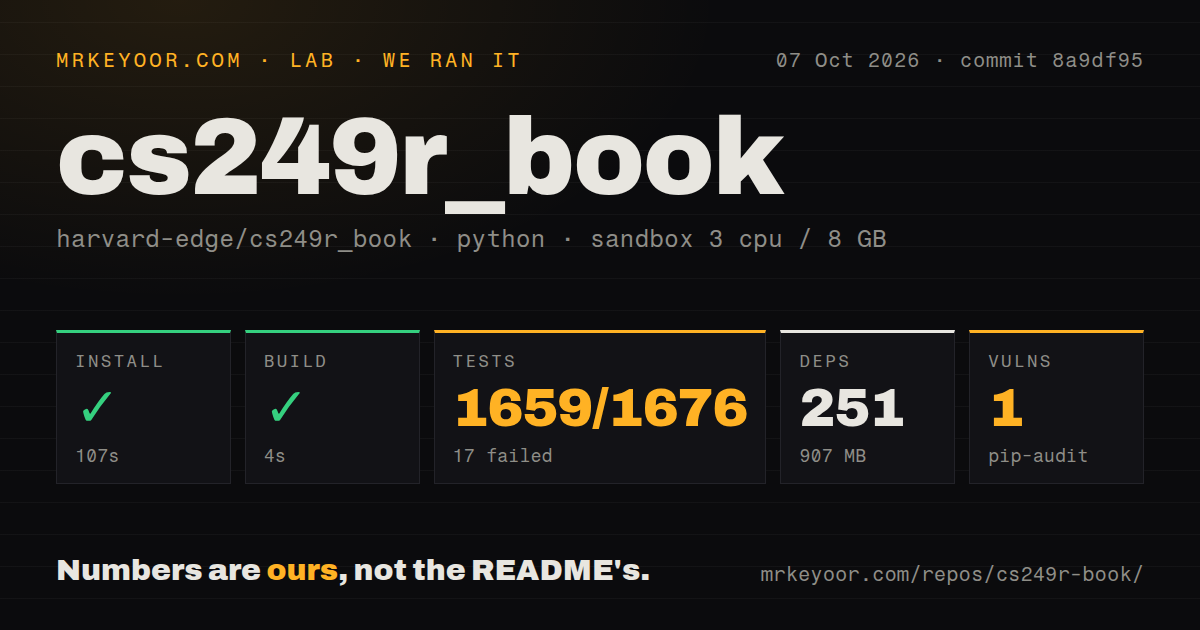
Our Node 22 sandbox installed the root dependencies in 27 seconds, adding 105 packages and using 55 MB. The root had no build script or target, so build was skipped. It also had no test script or target, so tests were skipped. These are absent root entry points, not failed component checks.
Npm audit reported 5 known vulnerabilities: 0 critical, 5 high, 0 moderate, and 0 low. Those results apply to the Node tree at commit 16f8401. They do not assess the browser labs, Python packages, PDFs, or hardware. Inspect the 5 high findings before using the root tooling in an automated publisher.
Our scan counted 67 CI workflow files and found no Dockerfile or tests directory. Component guides name narrower checks, including a static pytest command for labs, but our run had no root test target and ran no tests. Contributors need the workflow for their chosen directory rather than a guessed root command.
The separate publishing paths make that absence more important. A count of 67 workflows shows that automation exists, but it does not identify which checks cover every output at commit 16f8401. Readers can ignore this distinction. Maintainers should map each selected component to its validation command and produced artifact.
Mixed licenses prevent one reuse policy
The textbook and several teaching assets use CC BY-NC-SA 4.0. TinyTorch uses MIT, MLSys·im uses Apache 2.0, and StaffML uses AGPL v3. Its question corpus has a separate CC BY-NC 4.0 license. GitHub therefore reports no single SPDX license for the root.
Commercial trainers need permission for the non-commercial material, while TinyTorch's MIT grant does not extend to the surrounding book. With 17,926 files divided among components, reuse requires a directory-level license check. The README correctly names the license inside each component as authoritative.
The dev branch contains several maturity levels
The default dev branch puts Volume I in editorial polish and Volume II in active development. Labs, MLSys·im, and StaffML are labeled early releases, while TinyTorch and hardware kits are live. The README directs readers seeking the stable single-volume edition to main. Instructors should pin a branch or release before a term.
GitHub recorded 28,098 stars, 15 combined issues and pull requests, and a push on September 2, 2026. Release vol1-v0.7.2 arrived on August 31 with editorial and layout fixes. The 67 workflows support frequent publishing, while the project's own early-release labels still decide what belongs in a fixed syllabus.
Issue 1810's September 2 sweep listed 40 broken URLs across 5 project sites. Other sites were clean, and the nightly tracker is useful maintenance. The 40 failures still affect readers. Check assigned chapters, labs, and slides before distributing them to a class.
Systems constraints take priority over an MLOps recipe
The course connects model work to memory, communication, accelerators, serving, failures, power, and governance. Readers looking for a feature-store or deployment recipe may find it indirect. Made With ML is closer to one applied lifecycle, while Dive into Deep Learning spends more time on model and math foundations.
The 1,003.3 MB repository earns its size when someone uses several connected components. TinyTorch's 20 modules turn framework internals into code, and browser labs avoid local setup. A reader who only wants to implement a transformer should choose a narrower course. CS249r works best when the textbook sets the sequence and one hands-on path reinforces it.
Start online and clone only what you will change
The online route avoids the 105-package root install, 5 high audit findings, and missing npm targets. Read a volume and try a browser lab before cloning. Contributors should then follow the selected component's guide and CI workflow. That selective path suits the curriculum better than treating root npm as a health check for 1,003.3 MB of connected projects.